Seven Hours a Day, 53GB a Month: CST Report Charts the Kingdom's Internet Usage in 2025
Women Lead, Youth Drive: How Internet Usage in Saudi Arabia Transformed in a Single Year
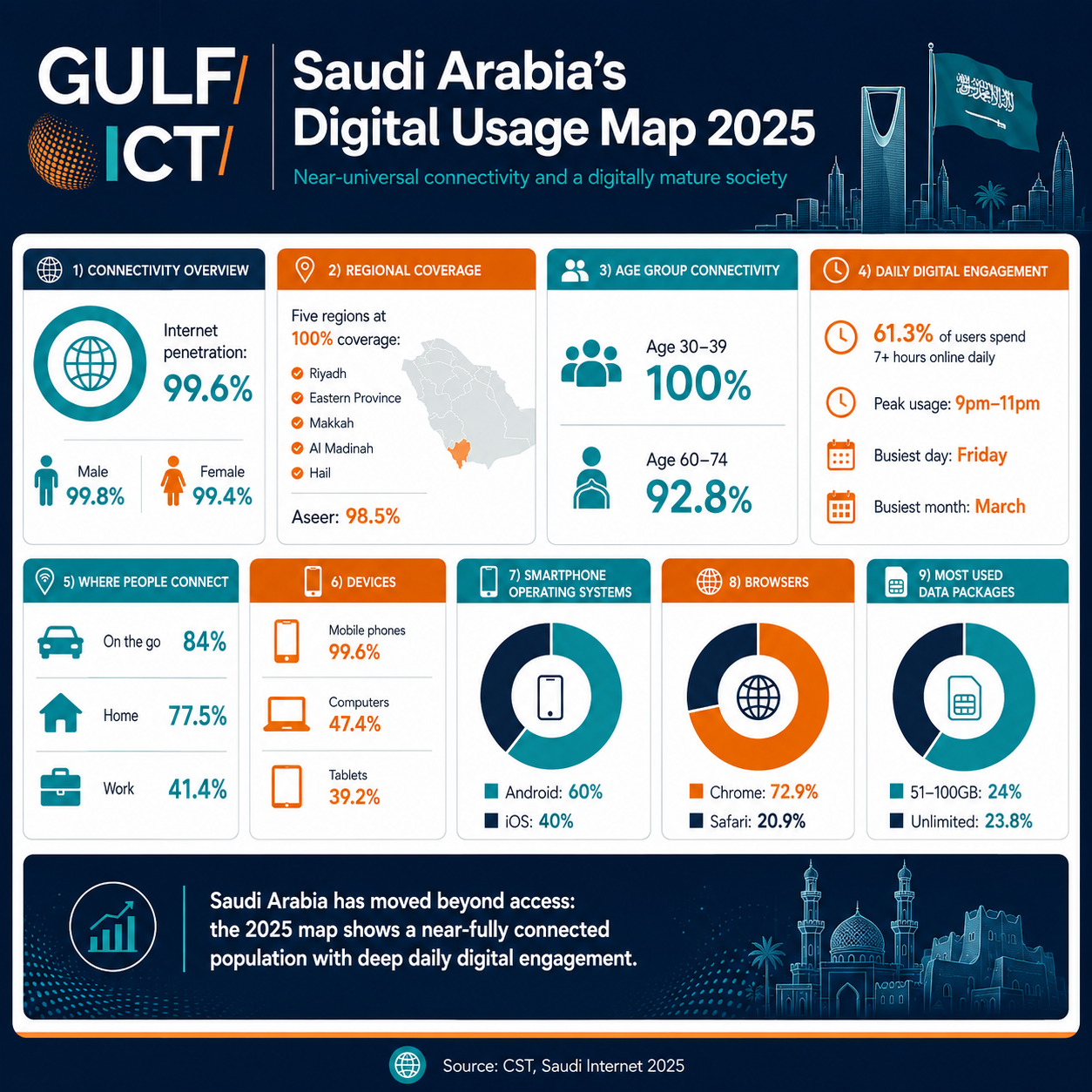
RIYADH — Gulf ICT. Saudi Arabia's internet has reached near-universal coverage at 99.6% of the population, while adoption of artificial intelligence tools has surged to 45.2% — more than double the previous year — according to the fifth edition of the “Saudi Internet 2025” report issued by the Communications, Space and Technology Commission (CST), which draws the most detailed usage map yet of one of the world's most connected societies.
Near-Total Coverage, Five Regions at 100%
Penetration stands at 99.8% among men and 99.4% among women, with the 30–39 age bracket recording full 100% connectivity and even the 60–74 segment reaching 92.8%. Five regions — Riyadh, the Eastern Province, Makkah, Al Madinah and Hail — hit complete 100% coverage, while the lowest-ranked region, Aseer, trails the leaders by just one and a half percentage points at 98.5%.
Seven Hours a Day, With Friday Nights the Usage Peak
The report finds that 61.3% of the Kingdom's internet users spend seven or more hours online daily, rising to 63.8% among women against 59.4% among men. Usage peaks between 9pm and 11pm, with Friday the busiest day of the week and March the busiest month of the year. Mobility defines the pattern: 84% of users connect on the go, ahead of home (77.5%) and work (41.4%).
Mobile phones dominate at 99.6% usage, far ahead of computers (47.4%) and tablets (39.2%). Android holds 60% of the smartphone market against 40% for iOS, while Windows leads computers at 81%.
Government and Banking Services: Near-Universal Usage
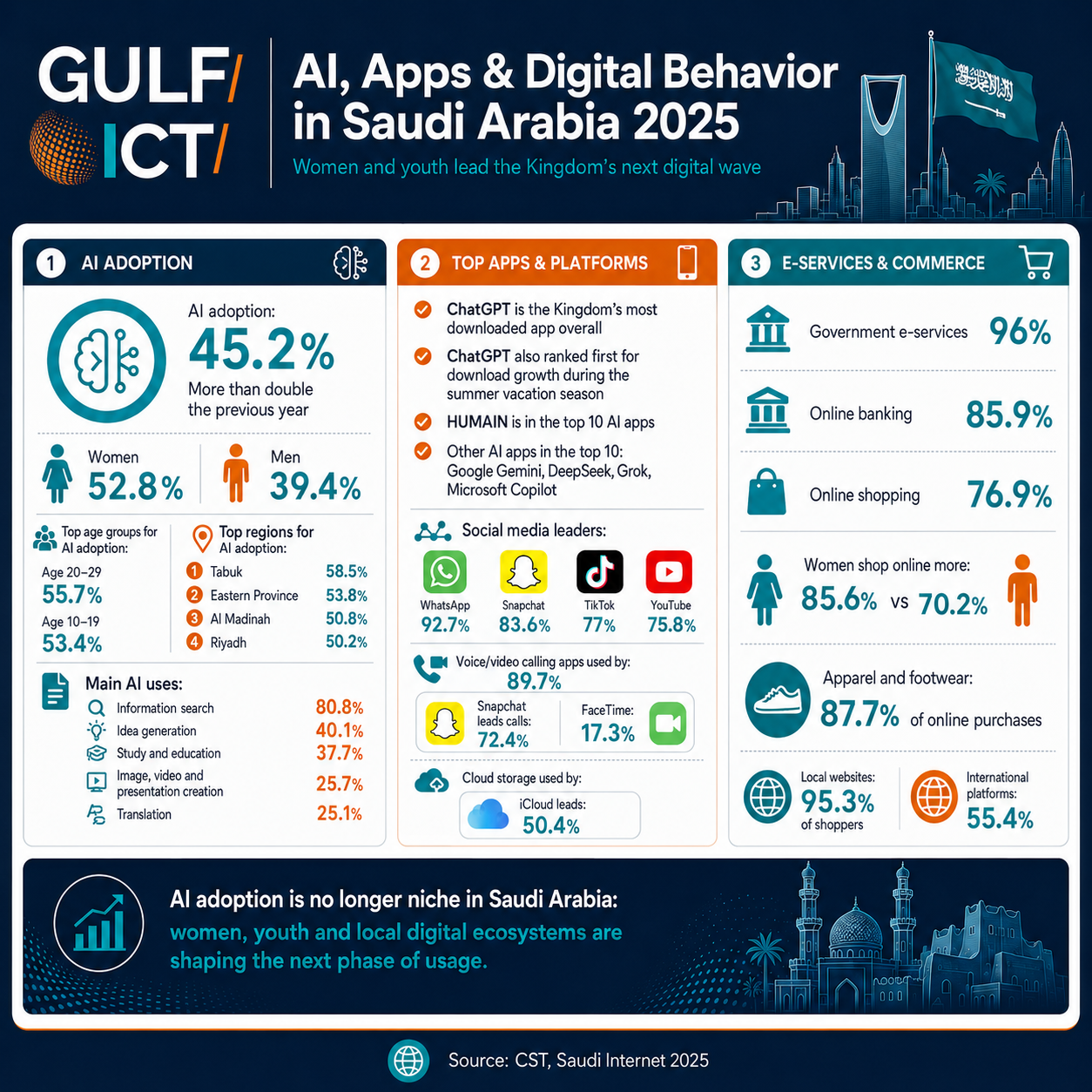
Government e-services recorded 96% usage among internet users, while online banking reached 85.9% with near gender parity. E-commerce stands at 76.9%, with a pronounced gap in favor of women — 85.6% of whom shop online versus 70.2% of men — and apparel and footwear topping purchases at 87.7%. Notably, 95.3% of shoppers buy from local websites against 55.4% for international platforms, a strong signal of a maturing national e-commerce ecosystem.
Women Take the Lead in the AI Race
In the year's most striking shift, women are adopting AI tools at 52.8% versus 39.4% for men, while the 20–29 age group leads all brackets at 55.7%, followed by teenagers aged 10–19 at 53.4%. Regionally, Tabuk tops the map at 58.5%, ahead of the Eastern Province (53.8%), Al Madinah (50.8%) and Riyadh (50.2%).
Information search dominates AI usage at 80.8%, followed by idea generation (40.1%), study and education (37.7%), image, video and presentation creation (25.7%) and translation (25.1%).
ChatGPT Is the Kingdom's Most Downloaded App — and HUMAIN Breaks Into the Top 10
ChatGPT topped the list of the most downloaded applications in Saudi Arabia overall — ahead even of the government identity platforms NAFATH and Absher — and also ranked first for download growth during the summer vacation season. Within the top ten AI applications, Saudi Arabia's own HUMAIN appeared alongside Google Gemini, DeepSeek, Grok and Microsoft Copilot — an early signal of national entrants joining the global model race.
On social media, WhatsApp leads at 92.7%, followed by Snapchat (83.6%), TikTok (77%) and YouTube (75.8%). Snapchat retains a distinctly Saudi role as the Kingdom's default calling app, leading voice and video calls at 72.4% — far ahead of FaceTime at 17.3%.
Faster Gaming: Latency Improves 89%
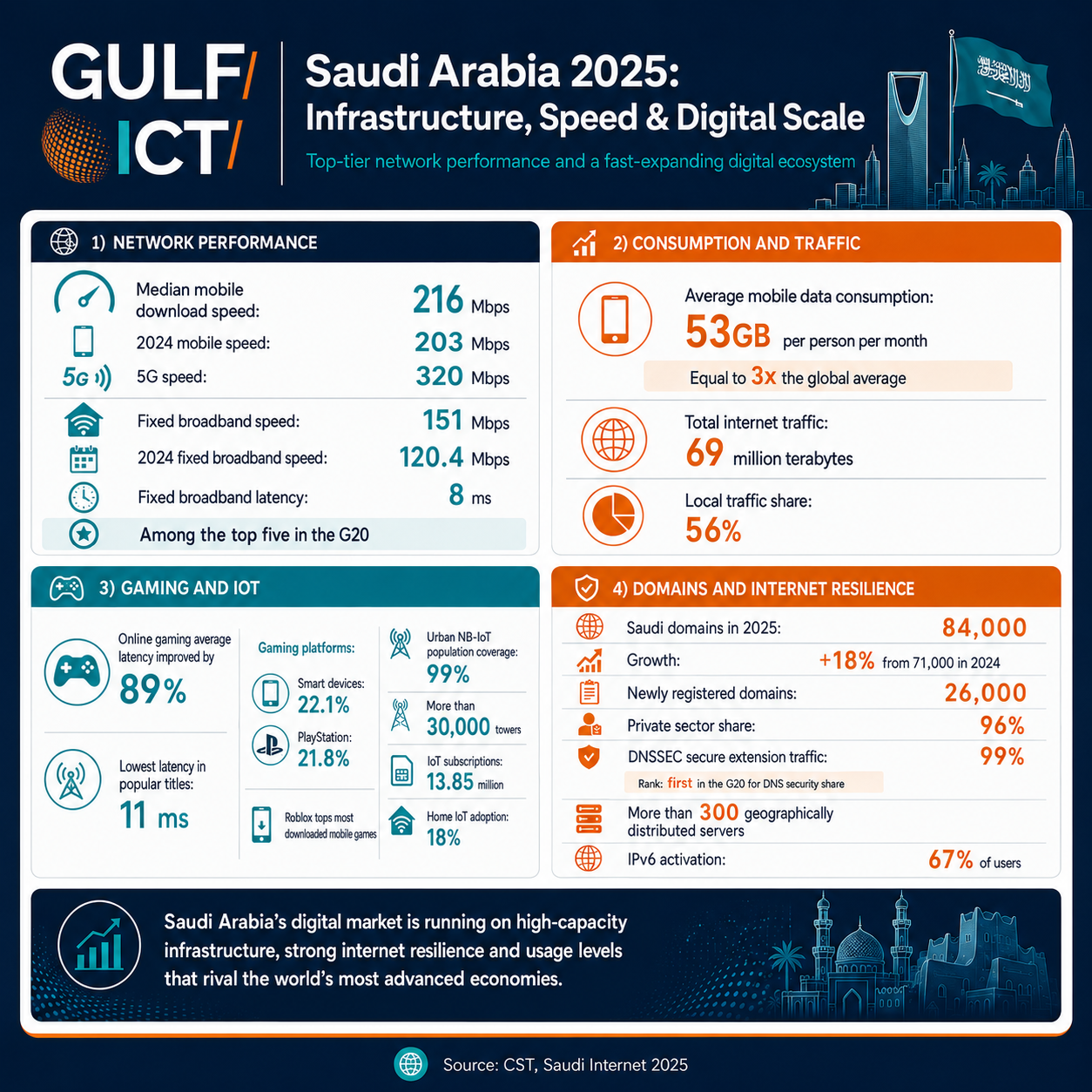
Online gaming quality of experience improved by 89% in average latency across the most popular titles, with League of Legends and Teamfight Tactics dropping to just 11 milliseconds. Smart devices narrowly lead gaming platforms at 22.1% ahead of PlayStation (21.8%), while Roblox tops the most downloaded mobile games.
Infrastructure in the G20's Top Five
Median mobile download speed reached 216 Mbps — among the top five in the G20 — up from 203 Mbps in 2024, with 5G networks delivering 320 Mbps. Fixed broadband climbed to 151 Mbps from 120.4 Mbps a year earlier, with latency of just 8 milliseconds.
The average person in the Kingdom now consumes 53 gigabytes of mobile data monthly — three times the global average — while total internet traffic hit 69 million terabytes, 56% of it local. In the Internet of Things, urban NB-IoT population coverage reached 99% across more than 30,000 towers, with 13.85 million IoT subscriptions.
84,000 Saudi Domains — and First in the G20 for DNS Security
Saudi domain names grew 18% to 84,000 in 2025, up from 71,000 in 2024, including 26,000 newly registered domains, with the private sector accounting for 96%. The Kingdom ranked first among G20 countries for the proportion of traffic served through the DNSsec secure extension at 99%, backed by more than 300 geographically distributed servers representing one of the largest such networks globally, while IPv6 activation reached 67% of users.
Gulf ICT's takeaway: Taken together, the numbers describe not merely a connected market but a fully formed digital society — near-total coverage, consumption triple the global norm, an AI adoption wave led by women and youth, and infrastructure competing in the G20's top tier. One year ahead of Saudi Arabia's designated “Year of Artificial Intelligence 2026,” the Kingdom appears to have finished building the foundations — and moved on to the battle over usage itself.
Key Figures at a Glance
• Internet penetration: 99.6% (male 99.8% / female 99.4%) — five regions at 100%
• 61.3% online 7+ hours daily — peak 9–11pm, Fridays, March
• Devices: mobile 99.6%, computers 47.4%, tablets 39.2% — Android 60% / iOS 40%
• Most used data packages: 51–100GB (24%), then unlimited (23.8%)
• Government e-services 96% — online banking 85.9% — online shopping 76.9% (women 85.6%)
• Most visited websites: Wikipedia, YouTube, Instagram, X, moe.gov.sa, WhatsApp, Absher, ChatGPT, Kooora, Nahdi
• Browsers: Chrome 72.9%, Safari 20.9% — top searched keywords: “مترجم” (translator), “Absher,” “Noor”
• AI adoption: 45.2% (more than double) — women 52.8% / men 39.4% — Tabuk highest region at 58.5%
• Calls: 89.7% use voice/video apps — Snapchat first at 72.4%
• Cloud storage: 78% of users — iCloud leads at 50.4%
• Gaming: 89% latency improvement — lowest latency 11ms
• Speeds: mobile 216 Mbps (G20 top five) — 5G 320 Mbps — fixed 151 Mbps
• Consumption: 53GB per person monthly (3x global average) — total traffic 69 million terabytes
• IoT: 99% urban NB-IoT coverage — 13.85 million subscriptions — 18% home adoption
• Domains: 84,000 (+18%) — 96% private sector — DNSsec at 99% (first in G20) — IPv6 at 67%