Saudi Arabia’s CST and ITU Release Fifth Digital and Space Sustainability Report Highlighting Global IDI Leadership
RIYADH — The Communications, Space and Technology Commission (CST) of Saudi Arabia, in strategic partnership with the International Telecommunication Union (ITU) and the Ministry of Communications and Information Technology (MCIT), has published the fifth edition of the Digital and Space Sustainability Report.
The annual publication tracks the Kingdom's regulatory leadership and technological deployment across digital sustainability, space resilience, the circular economy, and the United Nations Sustainable Development Goals (SDGs).
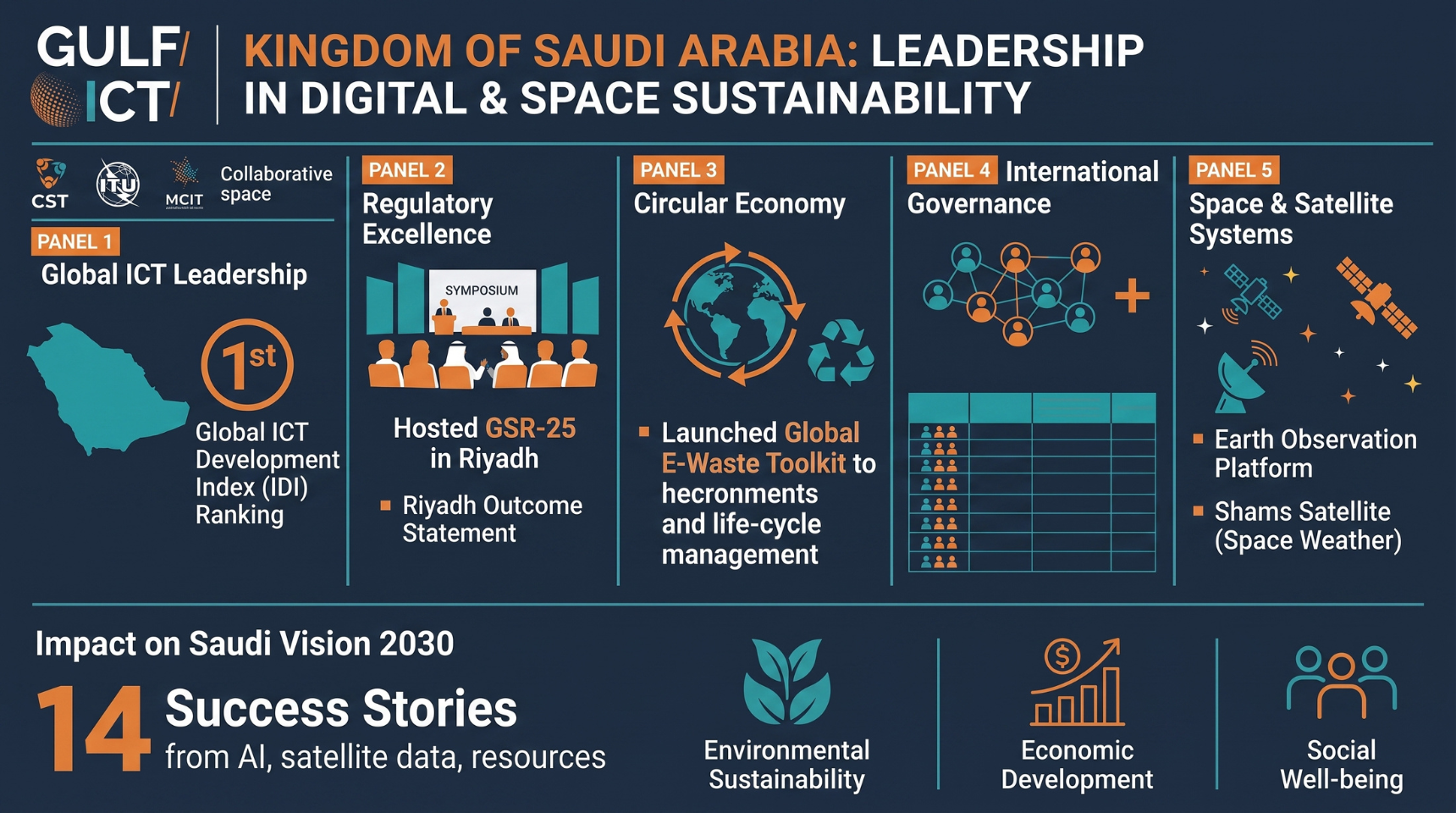
The 2026 report outlines several international benchmarks and national initiatives achieved throughout 2025:
Global ICT Development Index (IDI) Ranking: Saudi Arabia secured the 1st place globally in the ITU’s IDI, validating the resilience and reach of its digital infrastructure.
Global Regulatory Leadership: The Kingdom hosted the Global Symposium for Regulators (GSR-25) in Riyadh under the theme "Regulation for Sustainable Digital Development," resulting in the landmark Riyadh Outcome Statement.
Circular Economy & E-Waste: Launched the Global Toolkit for Policy and Regulation Practices for E-waste to provide a unified international framework for sustainable electronics recycling and life-cycle management.
Multilateral Governance: Formalized Saudi Arabia’s entry into the ITU Digital Regulation Network Board, expanding its role in shaping international standards for sustainable digital governance.
Space Monitoring Infrastructure: Successfully launched the national Earth Observation Platform and the "Shams" satellite dedicated to space weather, heliospheric monitoring, and orbital space sustainability.
The report also details 14 national success stories spanning environmental, economic, and social sustainability contributed by more than 25 public and private sector entities. These case studies highlight real-world applications of artificial intelligence (AI), satellite Earth observation, and space-based technologies to monitor climate indicators, optimize resource utilization, and accelerate the sustainability objectives of Saudi Vision 2030.