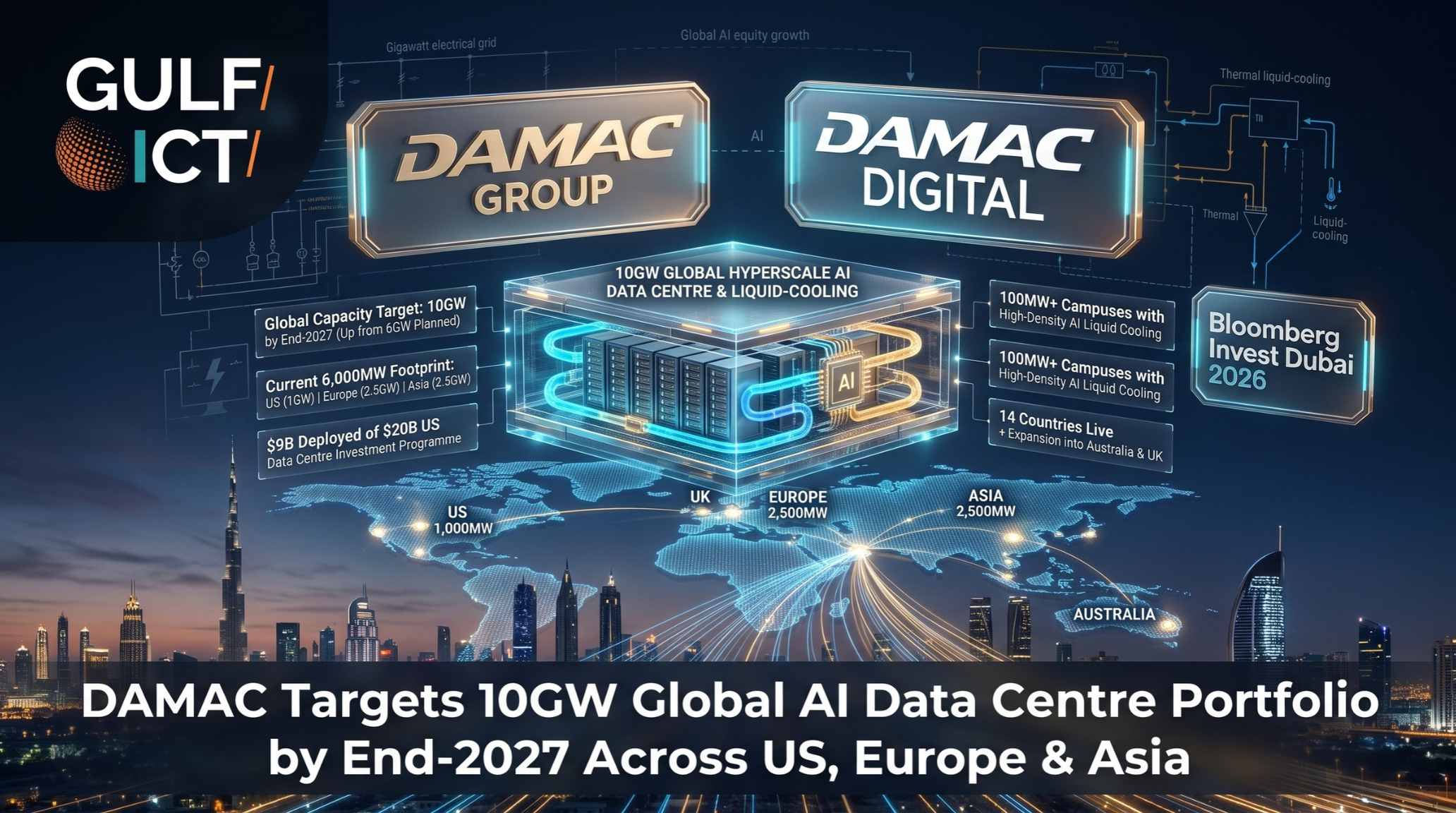
DUBAI — United Arab Emirates conglomerate DAMAC Group plans to expand the total planned capacity of its global data center portfolio to 10 gigawatts (GW) by the end of 2027, scaling up significantly from approximately 6GW currently planned to meet accelerating international demand for artificial intelligence and cloud computing infrastructure, Founder and Chairman Hussain Sajwani announced.
Speaking during Bloomberg Invest Dubai 2026, Sajwani revealed that his equity investments across frontier artificial intelligence and aerospace companies have generated multibillion dollar returns, highlighting stakes in OpenAI, SpaceX, and Anthropic. Notably, Sajwani disclosed that his investment in Anthropic, executed less than two years ago, has produced capital gains comparable to the wealth accumulated across roughly three decades of his prior business operations, underscoring the extraordinary velocity of value creation sweeping the global technology sector.
Executing its international digital infrastructure strategy through DAMAC Digital, the group currently manages active projects and development sites spanning 14 countries across North America, Europe, and Asia. The existing 6,000 megawatts (MW) of planned capacity comprises approximately 1,000MW in the United States, 2,500MW across Europe, and 2,500MW across Asia. Active expansion corridors encompass Thailand, Malaysia, the Philippines, Finland, Spain, Greece, Italy, Türkiye, and the United States. Over the coming 12 to 18 months, DAMAC plans to acquire additional land parcels outside the United States to construct new facilities, including advanced negotiations to secure a major site in Australia alongside evaluated market entry opportunities in the United Kingdom. Sajwani emphasized that international site selection demands disciplined planning around power grid access, logistics, and core infrastructure to ensure sustainable execution.
Regarding North American operations, Sajwani reaffirmed DAMAC’s commitment to its previously announced $20 billion United States data center investment program, confirming that approximately $9 billion of that capital commitment has already been deployed, with further buildouts progressing in lockstep with land and electrical grid availability. While forecasting that the United States will remain the world’s largest data center market by sheer demand volume, Sajwani noted that domestic bottlenecks surrounding power generation, land permitting, and environmental regulations could prompt hyperscalers and developers to channel greater capital toward international hubs.
Technically, DAMAC Digital is prioritizing hyperscale campuses starting at approximately 100MW that rely primarily on advanced liquid cooling architectures purpose built for high density computing and next generation AI accelerators. Addressing industry headwinds, Sajwani observed that global data center construction costs have already climbed by roughly 30 percent and could rise by an additional 20 to 30 percent, with the United States and Europe representing the costliest jurisdictions while Asian markets retain comparative advantages in labor and hardware procurement. However, he cautioned that the sector’s foremost operational bottleneck extends beyond capital inflation to persistent global supply chain disruptions and recurring delivery delays for mission critical electrical and cooling equipment.