FCC Grants Nationwide Waiver to Test Commercial 5G and Cellular Networks for Airborne Drone Safety and BVLOS Flights
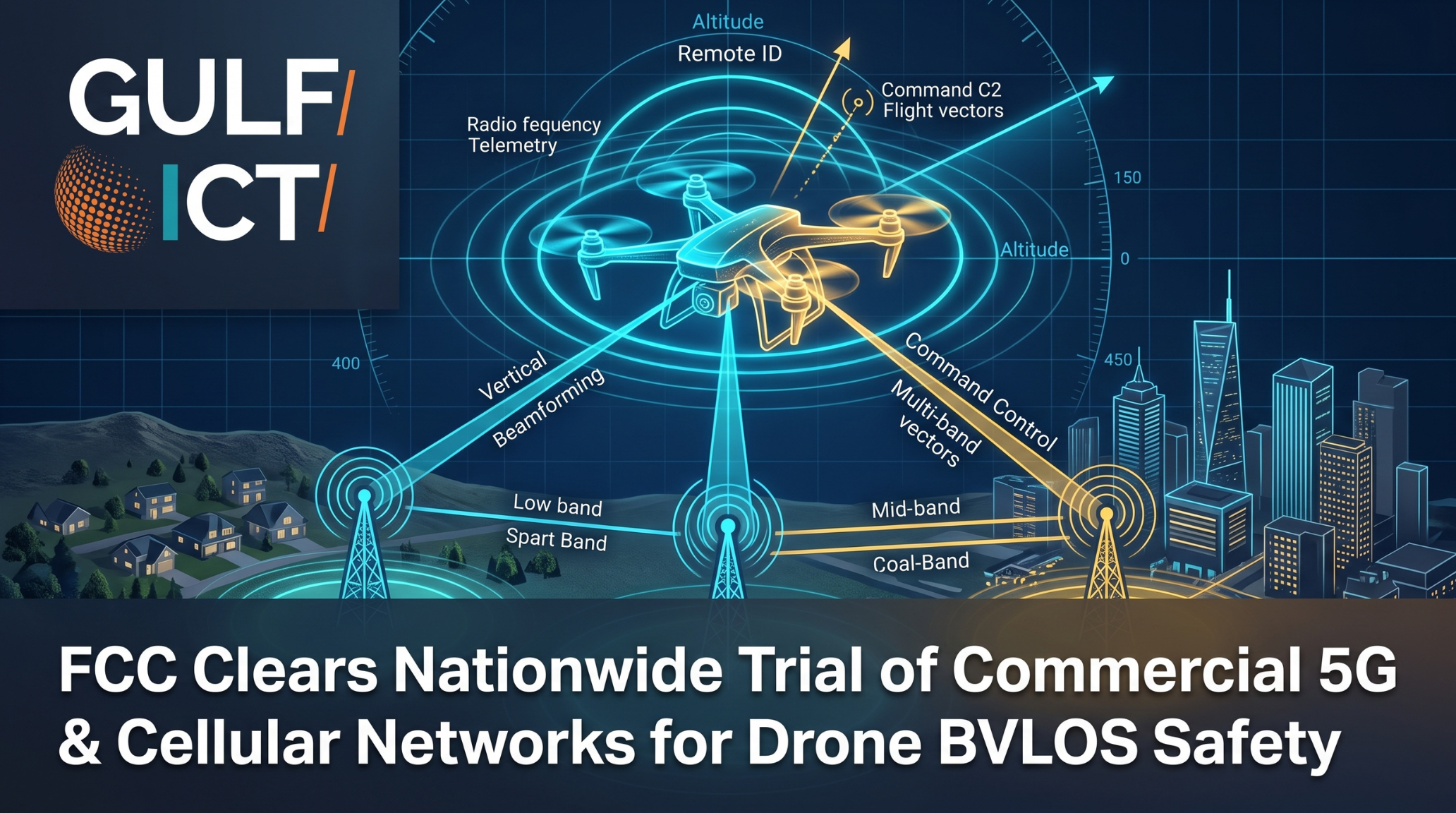
WASHINGTON — The Federal Communications Commission (FCC) has issued a nationwide regulatory waiver granting formal clearance to test commercial cellular networks and 5G connectivity aboard unmanned aircraft systems and general aviation flights, removing a long standing regulatory barrier to airborne mobile broadband.
The waiver order directly supports the United States Department of Transportation’s Mobile Network Aviation Assessment Program (MNAAP), an empirical testing framework engineered to measure real world wireless signal performance, coverage reliability, and latency across varying altitudes and operational geographies. The primary technical objective is assessing whether existing terrestrial commercial wireless infrastructure can reliably support safety critical aviation functions, including beyond visual line of sight (BVLOS) operations, command and control (C2) data links, autonomous detect and avoid systems, Remote ID tracking, and electronic conspicuity.
Historically, federal regulations strictly prohibited cellular transmissions from aircraft at altitude due to technical concerns that elevated transmitters would illuminate dozens of ground base stations simultaneously, causing severe interference across commercial ground networks. Under the newly established waiver framework running through October 1, 2029, testing is strictly bounded to authorized participants. The program authorizes up to 2,000 general aviation pilots deploying standard smartphones alongside 200 uncrewed aerial systems equipped with certified cellular broadcast modules.
The nationwide trial encompasses an expansive spectrum portfolio across low band, midband, and millimeter wave allocations, including 600 MHz, 700 MHz, FirstNet Band 14, 800 MHz cellular, AWS, PCS, WCS, CBRS, and 3.7 GHz C band frequencies. Data aggregated through the centralized assessment database will directly inform upcoming regulatory frameworks, most notably the Federal Aviation Administration’s forthcoming Part 108 BVLOS rule.
While the current waiver does not grant universal authorization for consumer drone pilots to operate over commercial cellular bands, industry analysts observe that utilizing existing commercial cellular and 5G towers offers a scalable alternative to expensive dedicated ground radio networks, providing an already deployed communications layer to safely accelerate commercial drone logistics and infrastructure monitoring.