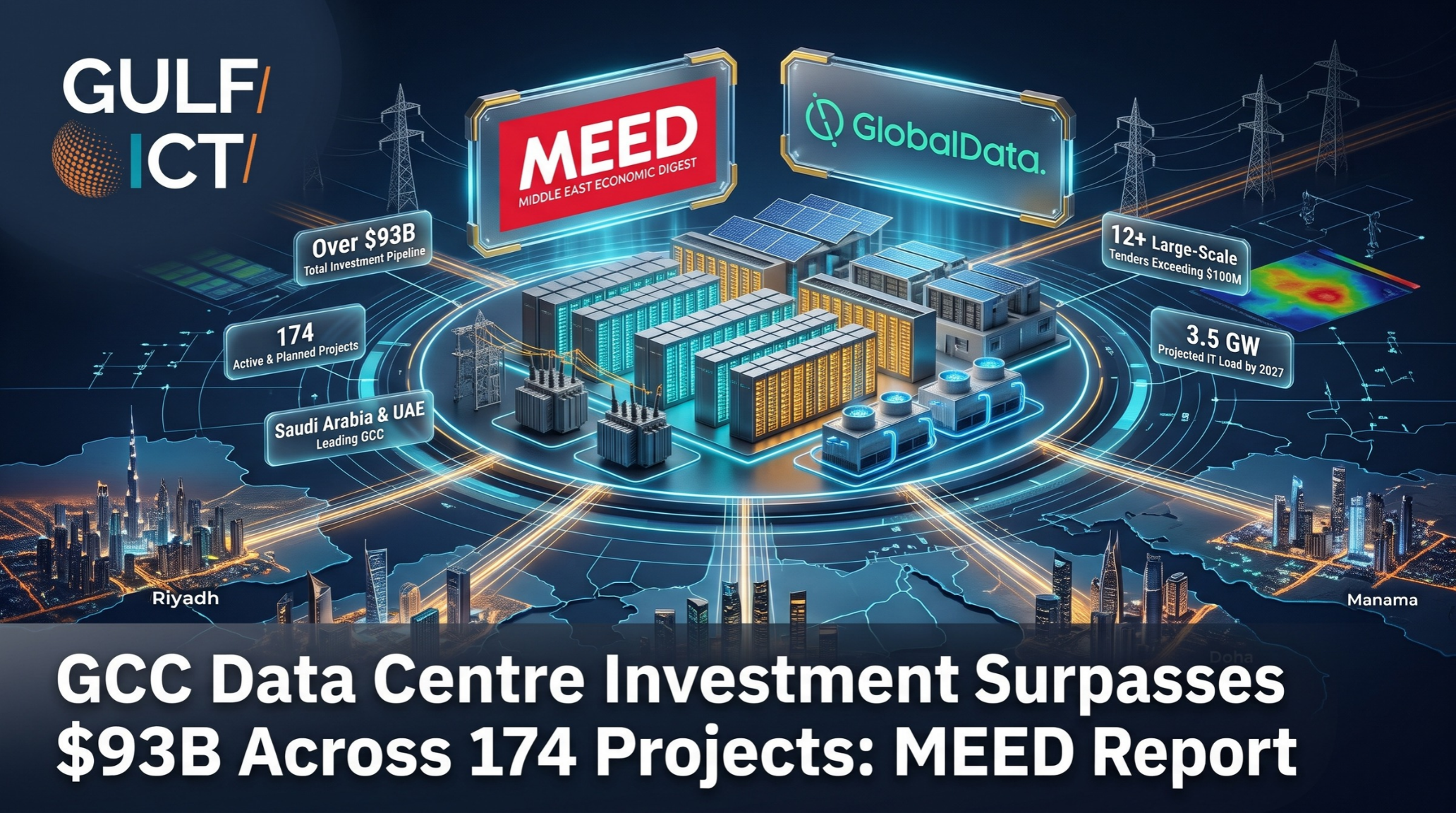
DUBAI — Capital commitments across the data center market in the Gulf Cooperation Council (GCC) have officially exceeded $93 billion, tracking across 174 active and planned facilities, according to a flagship intelligence report titled The GCC Data Centre Projects Market 2027 released by regional business intelligence platform MEED, a subsidiary of GlobalData.
The substantial capital pipeline underscores a systemic structural transformation across the regional infrastructure landscape, shifting digital real estate from peripheral telecommunications assets into foundational utility assets powering sovereign artificial intelligence, cloud modernization, and public sector digital transformation. Accelerating demands for domestic data sovereignty alongside enterprise adoption of generative machine learning workloads have prompted regional governments and global hyperscalers to aggressively build out domestic capacity across hyperscale, colocation,and low latency edge nodes.
Regional investment remains concentrated in Saudi Arabia and the United Arab Emirates, which collectively anchor the vast majority of planned capacity. The expansion is bolstered by large scale national economic roadmaps such as Saudi Vision 2030 and the UAE Digital Economy Strategy, alongside dedicated sovereign initiatives including Saudi Arabia’s Cloud Computing Special Economic Zone and aggressive multi facility rollouts by specialized operators such as Khazna Data Centers. In parallel, Qatar, Oman, Bahrain, and Kuwait are expanding domestic colocation ecosystems and subsea cable interconnections, collectively propelling total operational IT load across the GCC toward an anticipated 3.5 gigawatts by 2027.
The regional project pipeline is undergoing a critical transition from conceptual design toward physical execution. More than a dozen large scale facilities carrying individual capital expenditures exceeding $100 million are actively tendering across Gulf markets, with multiple additional construction and engineering packages slated to hit commercial markets over the coming six to twelve months. This influx of physical procurement is unlocking high value project portfolios for international engineering contractors, specialized modular facility builders, and critical systems providers.
However, the rapid acceleration in scale is placing unprecedented scrutiny on electrical utility infrastructure and cooling technologies. Access to high voltage grid allocations, substation interconnect timelines, and sustainable continuous power have become primary determinants for project bankability, alongside extreme ambient cooling efficiency, physical land availability, and stringent water consumption mandates. As regional facilities transition from traditional ten megawatt enterprise hosting hubs toward high density, hundred megawatt computing campuses engineered for AI model training and inferencing, power availability and advanced liquid cooling topologies are establishing the baseline requirements across the Middle Eastern digital landscape.