The third day of LEAP 2026 moved the conversation from who is building the infrastructure to who is funding what runs on it. New data centre capacity, an AI acquisition vehicle, a government-venture partnership and a run of startup rounds all landed within a single session.
Khuzam Digital Valley
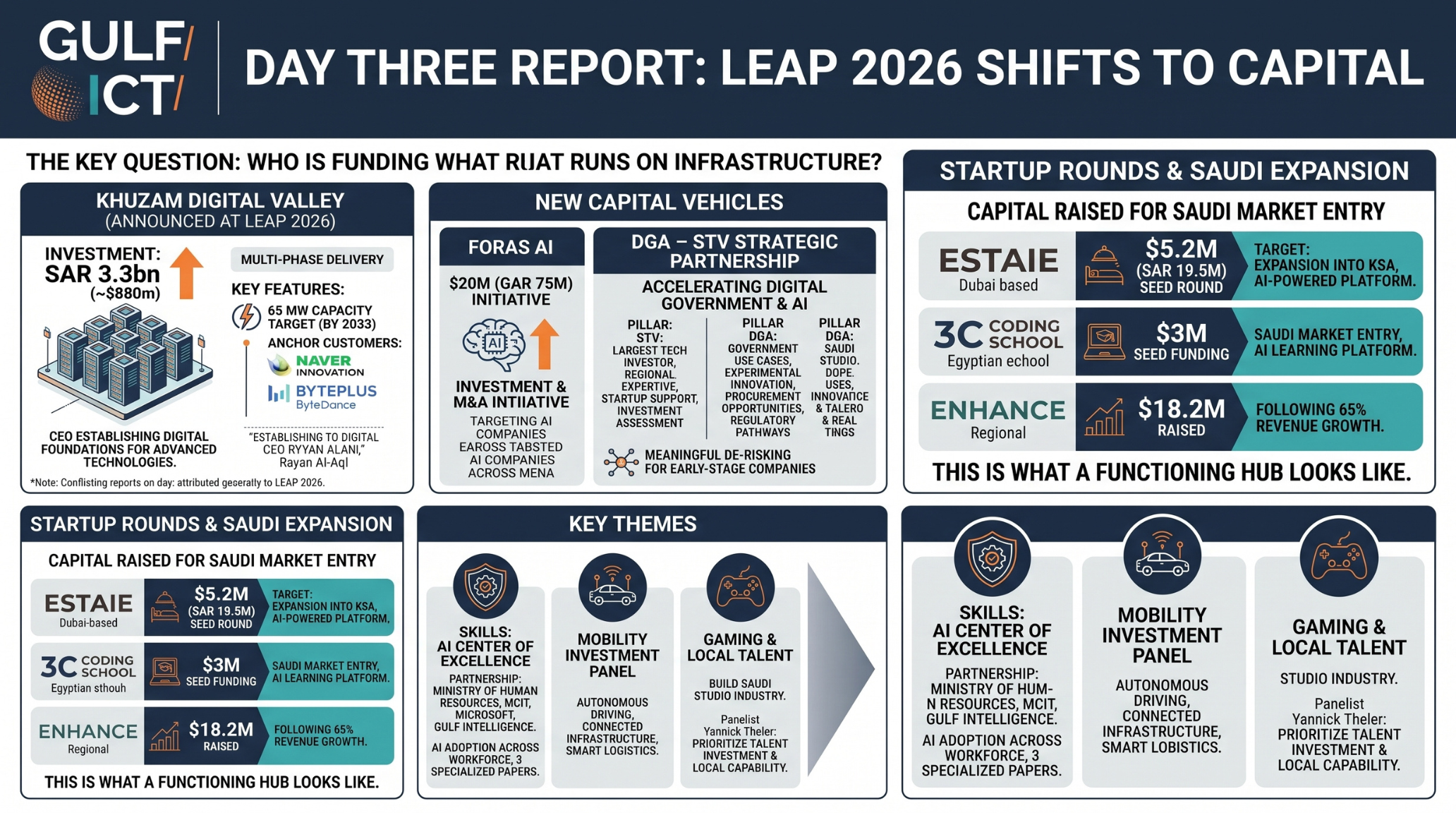
NHC Innovation announced the Khuzam Digital Valley data centre project, an investment of SAR 3.3bn, equivalent to roughly $880m, to be delivered across multiple phases. NAVER Innovation and BytePlus join as the first two anchor customers. Wire coverage puts the target capacity at 65 MW by 2033.
NHC Innovation chief executive Rayan Al-Aql framed the project as establishing digital foundations to meet rising demand for advanced technologies while creating an environment that brings global technology partners and businesses together.
Editorial note on the date. LEAP's own release places Khuzam Digital Valley on day three. Economy Middle East and Enterprise both reported it as a day-two announcement, grouped with the Zain KSA–DataVolt MoU. The figures match across all accounts, so this is a day-attribution conflict rather than a factual one. Our recommendation is to describe it as announced "at LEAP 2026" without pinning a day, and note the discrepancy in the piece.
The anchor tenants are the part worth dwelling on. NAVER is Korean, BytePlus is ByteDance's enterprise cloud arm. Saudi data centre capacity is now being pre-sold to Asian platform companies before it is built, which is a different customer profile from the US hyperscaler story that dominated day one.
New capital vehicles
Foras AI, an AI investment platform focused on the Middle East and North Africa, announced a $20m (SAR 75m) investment and mergers-and-acquisitions initiative aimed at investing in and acquiring AI companies across the region.
The Digital Government Authority and STV announced a strategic partnership to accelerate innovation in digital government services and AI. STV will provide technical expertise, identify and support startups, and assess investment opportunities through its dedicated AI and emerging technologies fund. The DGA will supply government use cases, an experimental innovation environment, procurement opportunities, and regulatory and funding pathways.
The DGA–STV structure is the more interesting of the two. STV is the largest technology investment firm in the region with over $1.5bn under management, and its AI fund counts Google and Saudi Awwal Bank among its backers. Pairing that with guaranteed access to government procurement pathways is a meaningful de-risking mechanism for early-stage companies, and it is a model other GCC states do not currently have an equivalent of.
The startup round
Dubai-based digital hospitality platform estaie announced a $5.2m (SAR 19.5m) seed round to accelerate expansion into Saudi Arabia. The company applies AI to pricing, inventory management and the booking experience across hotels, serviced apartments and residential rentals.
Egyptian edtech 3C Coding School raised $3m in seed funding, its first outside institutional money in ten years, earmarked partly for Saudi market entry and its AI-powered learning platform. Enhance raised $18.2m following 65% revenue growth.
The pattern across all three is the same: capital raised at LEAP by non-Saudi regional companies whose stated use of funds is Saudi expansion. That is what a functioning hub looks like, and it is a more durable signal than the headline investment totals.
Skills, mobility and gaming
The Ministry of Human Resources and Social Development, through its Digital Sector Skills Council, launched an AI Center of Excellence in partnership with MCIT, Microsoft and Gulf Intelligence. The initiative targets AI adoption across the Saudi workforce and will produce three specialised papers. Note: this is a distinct initiative from the PwC Middle East–Microsoft AI Centre of Excellence announced at LEAP 2024. Do not conflate them.
A mobility investment panel featuring Mercedes Cebrián of Parkron, Dong-Soo Kim of LG Technology Ventures and Ahmed Mhiri of Free2move covered autonomous driving, connected infrastructure and smart logistics as investment categories beyond electric vehicles.
In gaming, Yannick Theler of Steer Studios used a session on building a Saudi studio industry from scratch to argue for talent investment and local capability development over transplanted international models.
Our read
Days one and two were about capacity. Day three was about who pays for what sits on top of it, and the answer is increasingly not the Saudi state.
Three of the day's announcements involved foreign or private capital committing to Saudi-based activity: Korean and Chinese anchor tenants for Khuzam, a Dubai company raising to expand into the Kingdom, an Egyptian company doing the same. Meanwhile Saudi capital moved outward through Vision Invest's stake in WIOCC.
That two-way flow is the development worth tracking for the rest of the GCC. The UAE has run this playbook for two decades through free zones and sovereign vehicles. What is new is a second Gulf state running it at comparable scale in the same asset class at the same time. Whether that produces genuine regional depth or two competing hubs bidding for the same tenants is the question none of this week's announcements answer.