UAE Ranks Sixth Globally for Cyber Activity as Microsoft 2026 Digital Defense Report Highlights AI Weaponization and Identity Vulnerabilities
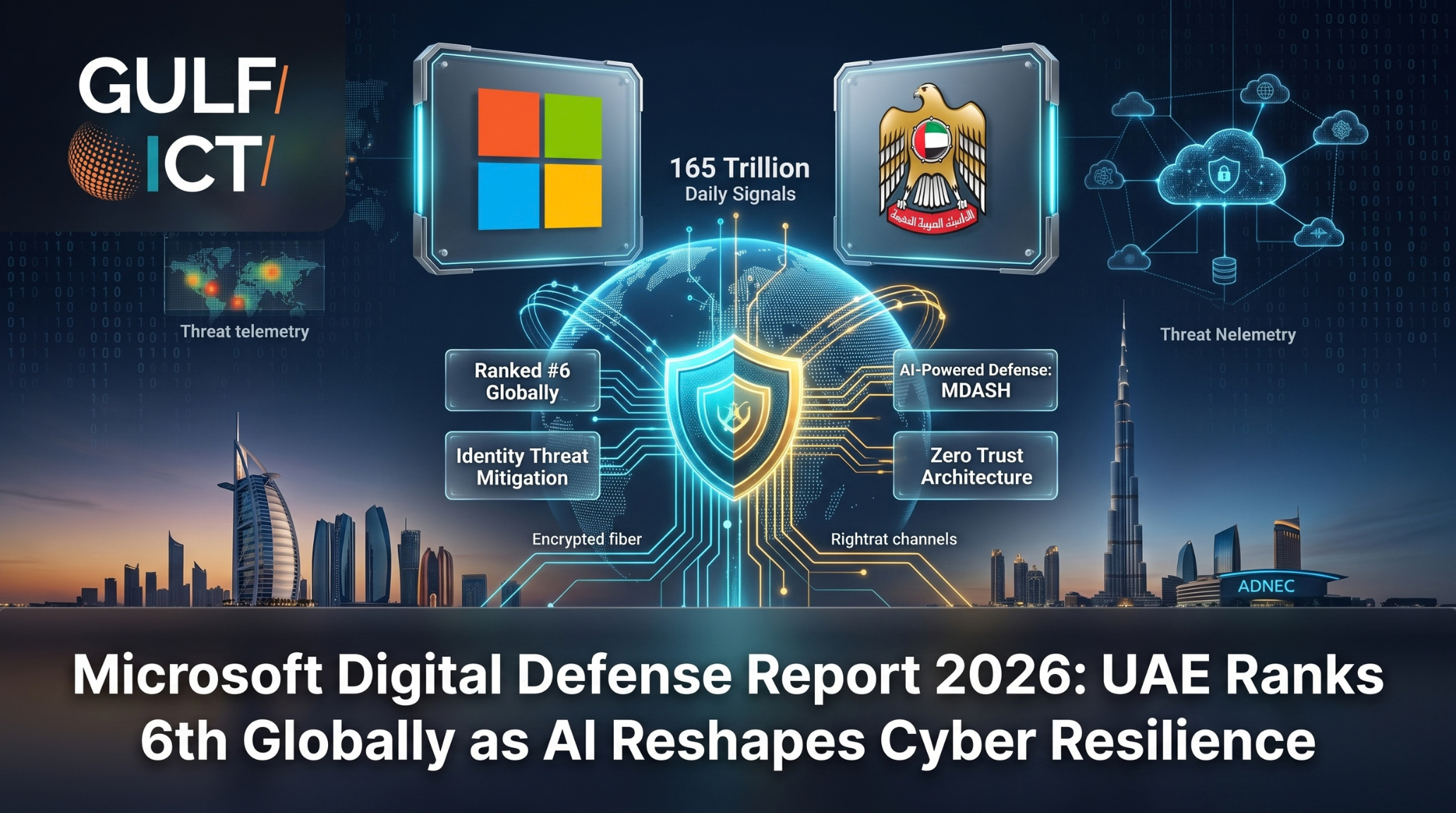
DUBAI — The United Arab Emirates ranked sixth globally and second across the Middle East and Africa among countries where enterprise customers were most frequently impacted by malicious cyber activity during the first half of 2026, according to the newly released Microsoft Digital Defense Report 2026.
Published to coincide with International Cyber Security Awareness Month, the annual threat study synthesizes telemetry drawn from more than 165 trillion security signals processed daily across Microsoft’s global digital ecosystem. The 2026 edition identifies three fundamental macro shifts transforming the cyber landscape: the rapid acceleration of both offensive exploitation and defensive response by artificial intelligence, the persistence of identity credentials as the primary initial access vector, and the expanding blast radius of digital supply chain disruptions where attacks rapidly cascade beyond the initial victim organization.
The report notes that as sovereign administrations and commercial enterprises embed cognitive algorithms into mission critical operating models, threat actors are leveraging agentic tools to increase the speed, automation, and scale of their intrusions. Conversely, defenders must utilize autonomous cognitive mechanisms to correlate signals and intercept exploits at machine speed, addressing the growing attack surface introduced by expanding algorithmic interfaces, data pipelines, and machine identities. Despite evolving attack complexity, human credential compromise remains dominant, emphasizing that robust multi-factor authentication, privileged access hygiene, and passwordless architectures remain the first line of enterprise defense.
These findings carry immediate operational significance for the UAE as it accelerates civic and economic artificial intelligence deployment. To fortify national resilience, Microsoft, the UAE Cyber Security Council (CSC), and G42 sovereign digital enabler Core42 recently formalized a collaboration to deploy MDASH, Microsoft’s specialized artificial intelligence powered code security platform, across federal and local government bodies. Hosted via Core42’s Sovereign Public Cloud, MDASH deploys automated multi-model agentic scanning to identify source code vulnerabilities and generate remediated fixes prior to deployment.
Yazan Khasawneh, Director of Cyber Security at Microsoft UAE, stated that the country has entered a transformative era where artificial intelligence functions as the baseline operating model of public governance and private enterprise. Khasawneh underscored that cybersecurity cannot be treated as a secondary mechanism bolted on post transformation, but must be architected directly into identity controls, data pipelines, and business continuity frameworks from inception to counter increasingly interconnected threat vectors.