DUBAI — Global private 5G and 4G LTE network projects have climbed to 9,600 across 135 countries worldwide, advancing from 8,800 entries tracked just over a year ago, according to a newly released market research report and deployment tracking database from SNS Telecom & IT. Searchable across industry verticals, geographic markets, enterprise end users, systems integrators, and hardware vendors, the benchmark study forecasts that annual global spending on private cellular networks for vertical industries will expand at a compound annual growth rate (CAGR) of approximately 18 percent between 2026 and 2029, surpassing $7.8 billion by the close of 2029. More than 80 percent of that capital expenditure, representing an estimated $6.6 billion, will be channeled directly into standalone private 5G networks, a segment projected to scale at twice the velocity of the broader private cellular market.
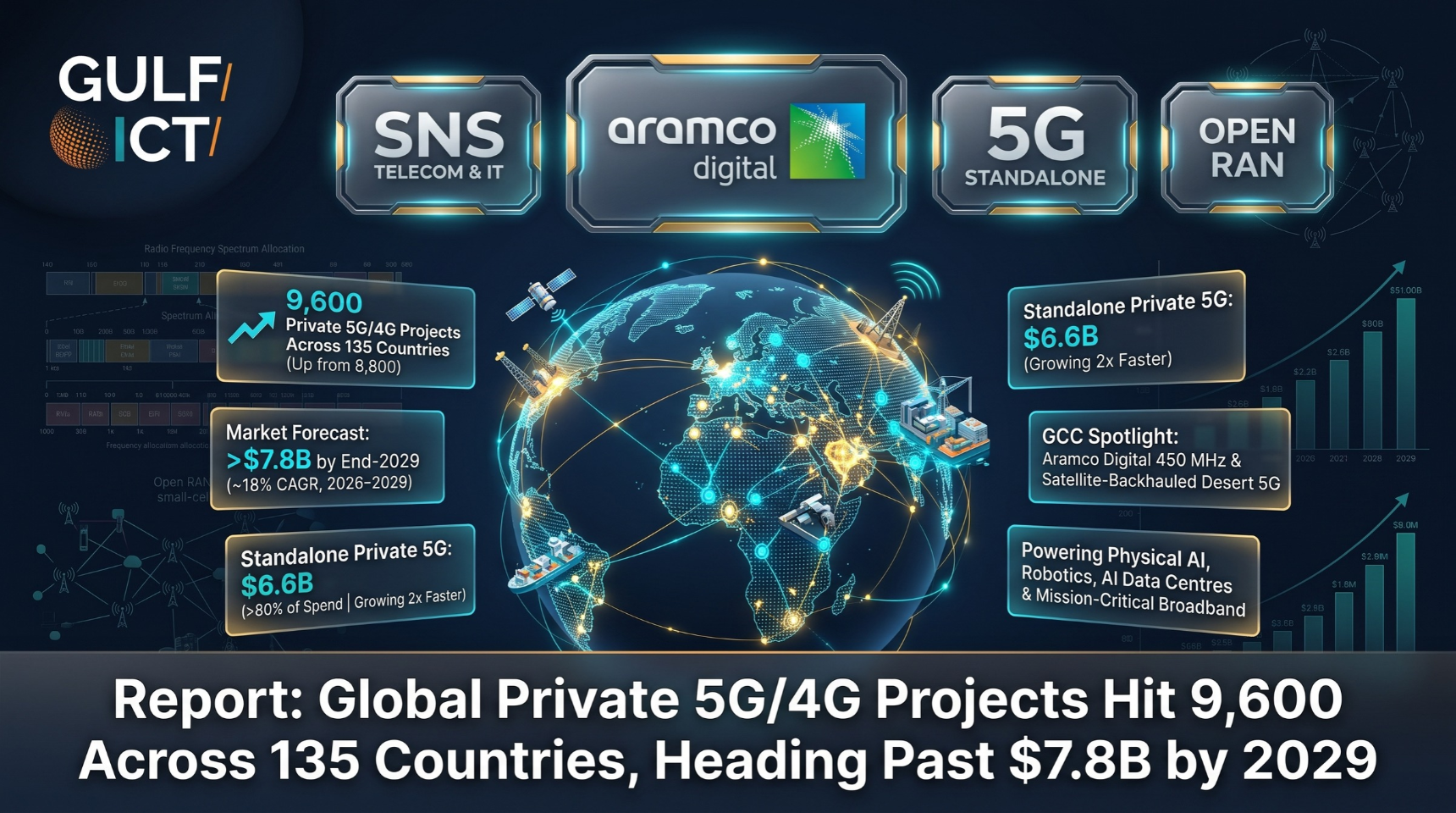
Transitioning decisively into mainstream enterprise and public infrastructure, active deployments, ongoing rollouts, and planned private networks now span an expansive cross section of global industries and sovereign corridors. Highlighted regional and international deployments extend from Aramco Digital’s nationwide 450 MHz industrial network and satellite backhauled private 5G installations serving remote desert drilling rigs in Saudi Arabia, to Google’s artificial intelligence data center campuses, Shell’s oil refineries, Nestlé’s manufacturing plants, Chick fil A Supply’s distribution hubs, Europe’s Spaceport in French Guiana, Formula 1 racing circuits, NBA arenas, hospitals, multi story corporate towers, correctional facilities, offshore platforms, shipyards, maritime ports, and international airports. Wide area and transport implementations further encompass rural broadband in Arizona’s Pinal County, military installations in Guam and Lešť in Slovakia, rail maintenance depots operated by SNCF, DB, and Adif, urban metro systems across New York, Mexico, Taiwan, and Australia, and territory wide utility broadband grids across the United States.
Across both localized facilities and nationwide footprints, private 5G and LTE architectures have solidified their standing as unified wireless platforms powering mission critical communications, industrial automation, physical AI, and enterprise intelligence, accelerated by broader regulatory access to shared, local area licensed, and dedicated vertical spectrum. Specifically, localized standalone 5G deployments have emerged as the preferred wireless medium for autonomous material transport, fulfillment center robotics, remote controlled mining dozers, high bay inventory scanning, predictive maintenance visual inspections, and unmanned security patrols. Concurrently, wide area critical communications remain an equally vital growth engine as defense ministries, public safety agencies, railways, and utilities migrate off legacy P25, TETRA, and GSM R narrowband systems toward mission critical broadband, providing equipment suppliers a resilient revenue stream alongside cyclical public carrier capital expenditure.
Even as overall deployment volumes surge, the vendor landscape is undergoing a marked structural realignment as major Western radio access network (RAN) incumbents restructure their enterprise units. Nokia’s agreement to divest its Enterprise Campus Edge (ECE) division to AURELIUS, alongside Ericsson’s reorganization of its indoor private 5G and neutral host operations, reflect compressed campus hardware margins, smaller standalone deal sizes, and vendor fragmentation, compounded by strategic preparations among the Nordic suppliers for mobile operators’ upcoming 6G investment cycle from 2030 onwards as well as SpaceX’s planned nationwide 5G deployment with Qualcomm.
While Nokia and Ericsson continue competing aggressively for multi year, wide area mission critical contracts across defense, public safety, railways, and utilities valued from tens of millions to billions of dollars, their campus participation is increasingly concentrated on large strategic engagements. Stepping rapidly into that opening, private 5G startups, small cell manufacturers, Open RAN suppliers, and specialized mobile core developers have captured multi site enterprise contracts with blue chip organizations including Google, Walmart, Meijer, Chick fil A, BMW, Toyota, Hyundai, Nestlé, Cargill, BP, Marathon Petroleum, LyondellBasell, Celanese, Trinity Industries, SNCF, DB, Infrabel, and the United States military. Underscoring the rising financial scale of multi site enterprise rollouts, operational benchmarks already include a $20 million private 5G deployment spanning 55 production plants for a multinational chemical producer, alongside Sweden’s ongoing $35 million Region Västra Götaland (VGR) 5G initiative delivering indoor private 5G across more than 500 critical properties and hospitals.