PIF-Backed Humain Partners with China’s MiniMax to Launch 428B Parameter Arabic LLM humain-m3 on Humain Node
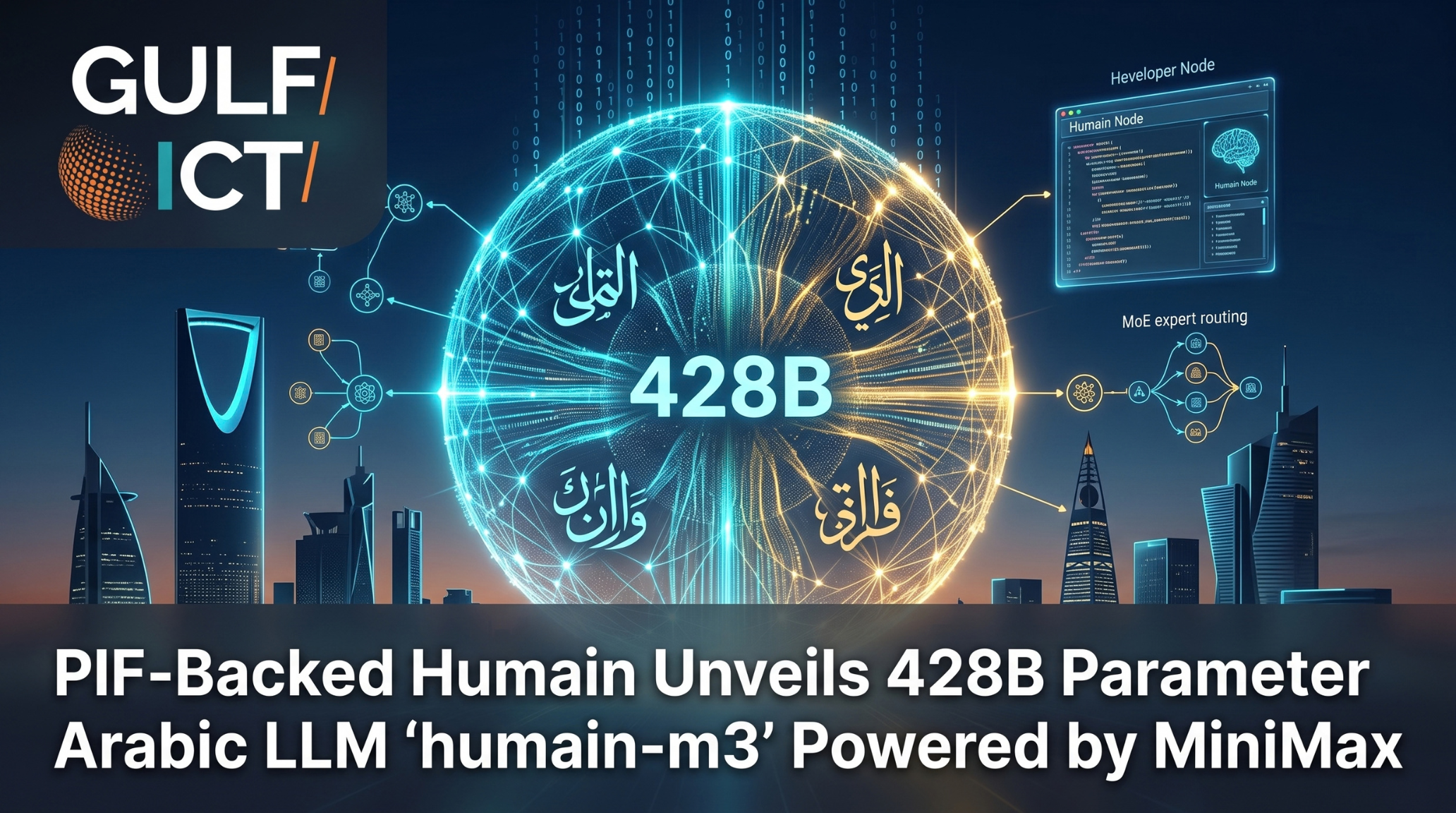
RIYADH — Saudi Arabian artificial intelligence enterprise Humain, backed by the kingdom’s sovereign wealth vehicle the Public Investment Fund (PIF), has unveiled humain-m3, a flagship Arabic first large language model comprising 428 billion parameters built upon the open architecture developed by Chinese artificial intelligence unicorn MiniMax.
Formally unveiled at the LEAP technology conference in Riyadh and made accessible through the Humain Node developer platform in research preview, the model establishes a precedent in international technology cooperation by positioning an open weight Chinese foundation at the center of a Gulf nation’s sovereign cognitive infrastructure. Rather than training an architecture entirely from scratch or relying on closed proprietary Western application programming interfaces, Humain adopted the MiniMax-M3 mixture of experts (MoE) design and layered intensive pre training and post training across more than 1 trillion tokens of native, non translated Arabic text.
The technical specifications of humain-m3 feature an efficient mixture of experts design that activates 23 billion parameters per inference pass, balancing dense reasoning with compute efficiency across a 1 million token context window. The multimodal model was jointly trained across text, image, and video inputs to handle complex long horizon agentic workflows, native computer screen interaction, and dialect rich regional idioms across the Arab world.
Humain reported that humain-m3 achieved an average score of 89.37 percent across seven public Arabic benchmarks, including AlGhafa, ArabicMMLU, MadinahQA, and AraTrust, positioning its preview checkpoint competitively against leading international frontier models. Humain expects to release the model weights openly under the MiniMax Community License following the completion of safety and alignment evaluations.
Tareq Amin, Chief Executive Officer of Humain, emphasized that while Arabic is spoken by hundreds of millions globally, the language remains historically underrepresented across frontier intelligence models. Amin noted that humain-m3 converts sovereign capital into foundational capability, giving regional developers, government ministries, and corporate enterprises a dedicated platform optimized natively for Arabic cultural context, linguistics, and dialectal nuances.
The strategic selection of a Chinese foundation model underscores the kingdom’s pragmatic multi vector approach to advanced technology diplomacy. As Saudi Arabia expands investments under Saudi Vision 2030, the deployment demonstrates how open weight architectures from Chinese labs offer sovereign entities complete operational autonomy, frictionless deployment, and zero software licensing dependencies while bypassing proprietary foreign cloud lock in.