ABU DHABI — Total trade in mobile phones and telecommunications equipment across the United Arab Emirates surged to approximately AED 246 billion during the first nine months of 2026, marking a 23.6 percent year on year increase compared with roughly AED 199 billion recorded during the corresponding period of 2025. According to newly released figures from the Federal Competitiveness and Statistics Centre (FCSC), the record expansion underscores an accelerated structural transformation across the Emirates’ non oil economy, cementing the nation’s position as a premier technology powerhouse and global logistics hub linking Asian manufacturing centers directly with consumer markets across the Middle East, Africa, and Europe.
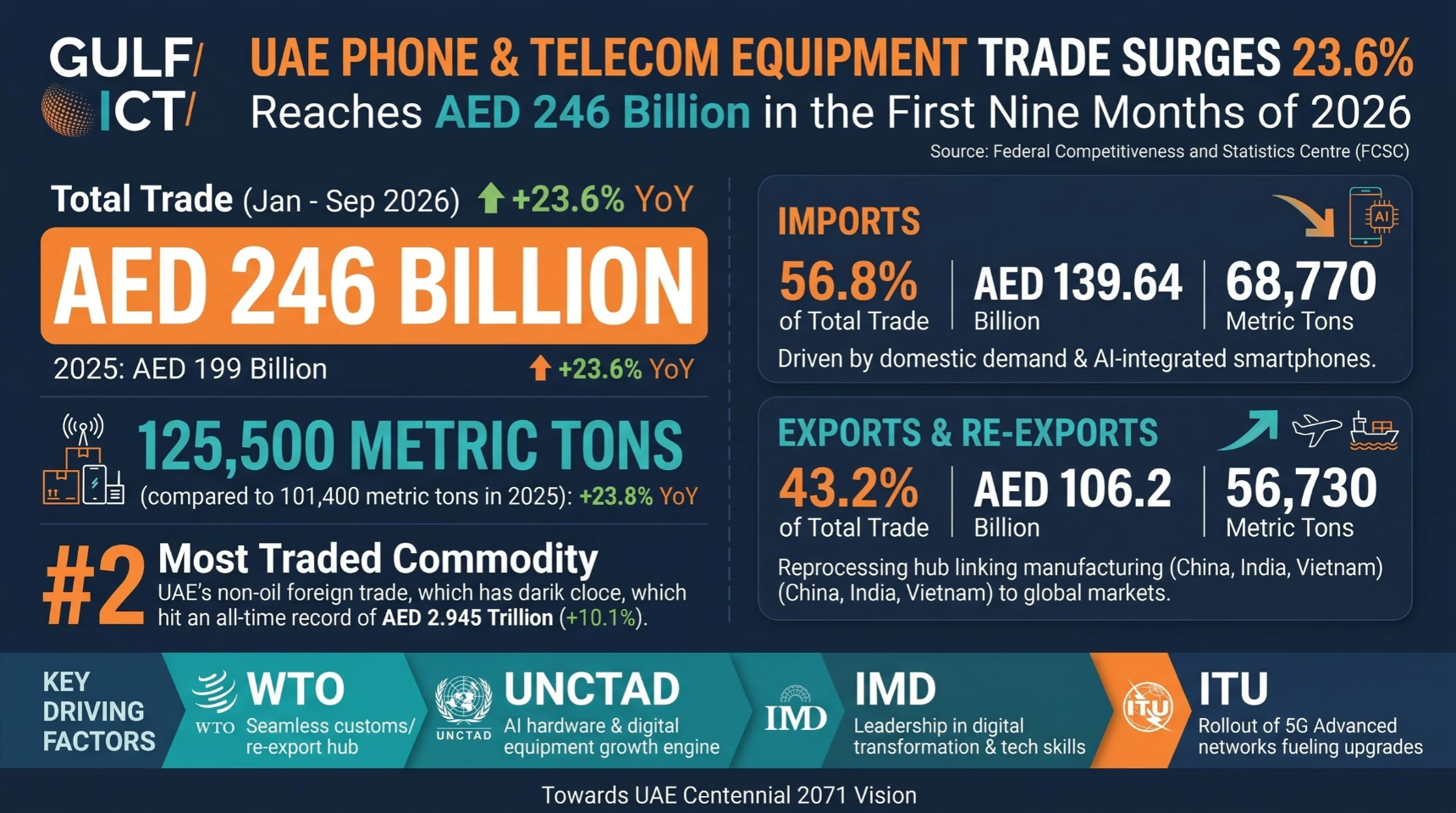
Measured by physical cargo volume, total shipments of mobile handsets and telecom hardware reached 125,500 metric tons from the start of the year through the end of September 2026, climbing nearly 23.8 percent from 101,400 metric tons during the same nine month window in 2025. Propelled by this momentum, the technology and telecom hardware sector captured second place overall among the most traded commodities within the UAE’s non oil foreign trade, which itself set an all time record of AED 2.945 trillion on 10.1 percent growth over the first nine months of 2026, surpassing major traditional sectors including the automotive trade in total commercial value.
Breaking down the sector’s structural trade flows reveals two complementary pillars strengthening the resilience and sustainability of the national trade balance. Imports accounted for the largest share at approximately AED 139.64 billion with a combined cargo weight of 68,770 metric tons, representing 56.8 percent of total sector trade, driven by robust domestic consumer purchasing power and strong appetite for next generation innovations, particularly smartphones integrated with generative artificial intelligence capabilities. Concurrently, combined national exports and re exports reached roughly AED 106.2 billion across 56,730 metric tons, making up 43.2 percent of total sector trade as sensitive electronic shipments arrive from major manufacturing complexes in China, India, and Vietnam to be processed across the UAE’s smart free zone logistics ecosystem and dispatched via air and maritime fleets to emerging regional and global markets alongside local technical assembly, software integration, and advanced mobile accessories.
International economic bodies and global competitiveness benchmarks attribute the commercial surge to the Emirates’ agile operating environment for leading global device manufacturers. The World Trade Organization (WTO) classifies the UAE among the world’s foremost re export hubs for high value electronics, citing smart customs clearance automation, strict intellectual property protection, and seamless port, airport, and free zone integration that shields global manufacturers against supply chain disruptions. Similarly, the global report issued by the United Nations Conference on Trade and Development (UNCTAD) identifies AI linked hardware and digital equipment as primary engines sustaining international merchandise trade growth, pointing to modern logistics corridors like the UAE as secure, vital links for intercontinental technology flows.
Reinforcing these structural advantages, the World Competitiveness Yearbook published by the International Institute for Management Development (IMD) highlights the UAE’s continued leadership across corporate digital transformation, technological skills, and internet penetration sub indices, attracting multinational hardware giants to anchor regional logistics operations inside the Emirates. Meanwhile, the International Telecommunication Union (ITU) notes that the nationwide rollout of 5G Advanced networks across the UAE has fueled sustained consumer and enterprise device upgrade cycles, complementing the World Bank’s consistent placement of the country near the top of its global Logistics Performance Index for rapid cargo handling and express freight connectivity. Anchored by incoming Comprehensive Economic Partnership Agreements (CEPAs) with major global trading partners, the sustained expansion of technology and telecom trade insulates the national economy from traditional commodity volatility while accelerating the shift toward a sustainable knowledge economy aligned with the UAE Centennial 2071 vision.