Seconds Before the Shaking: Why Android Phones Warned the Middle East and iPhones Stayed Silent
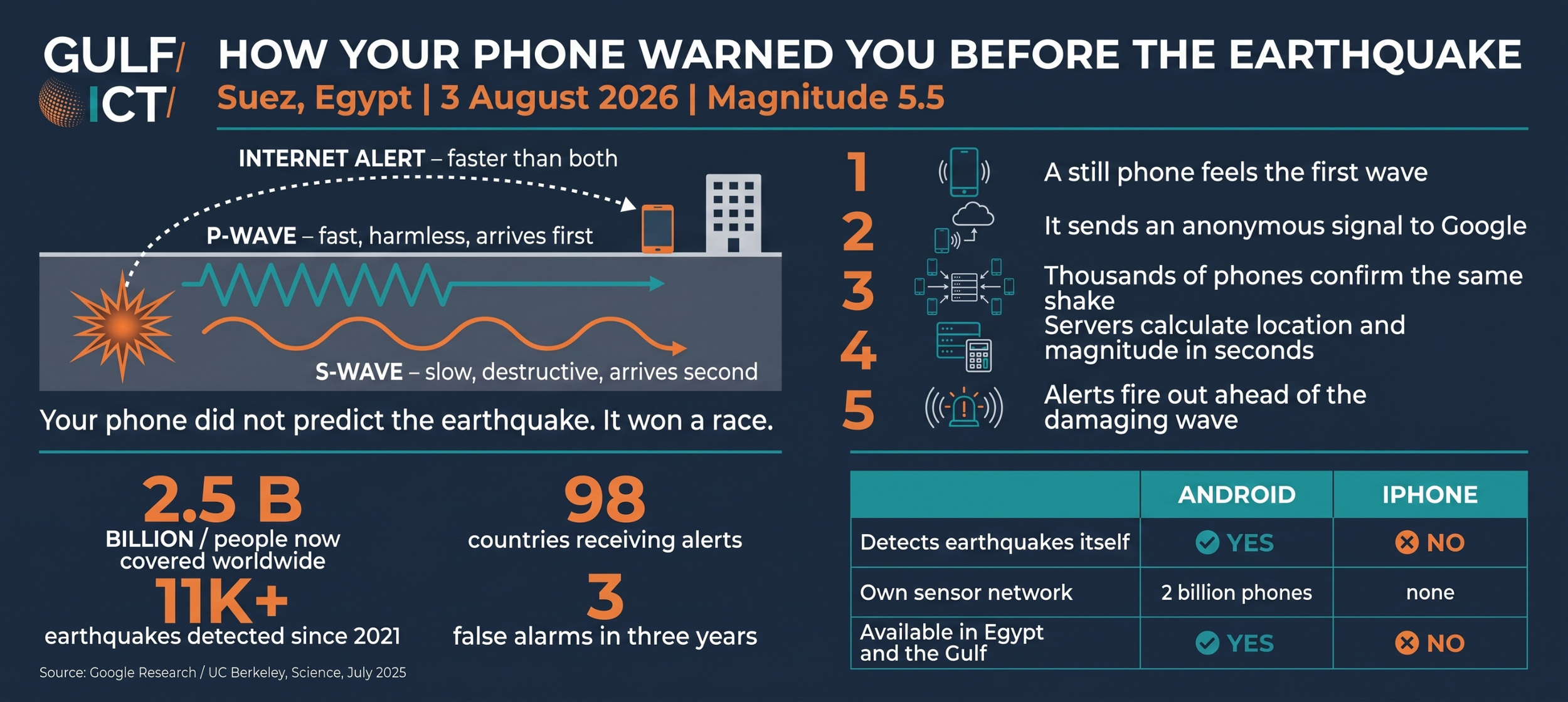
A magnitude 5.5 earthquake woke seven countries at three in the morning. Millions of people got a warning first. Millions of others got nothing at all. The difference came down to which phone they happened to buy.
What happened
At 3:01 on Monday morning, the ground moved about 29 kilometres north-east of the Egyptian city of Suez. The earthquake measured somewhere between 5.3 and 5.7 depending on which agency you ask, and Egypt's National Research Institute of Astronomy and Geophysics settled on around 5.5. It was shallow, roughly ten kilometres down, which is why so many people felt it so clearly.
Cairo felt it. So did the Delta, the Canal cities, and then, further out, Jordan, Palestine, Lebanon, Syria, Cyprus and the north-west of Saudi Arabia. The European-Mediterranean Seismological Centre estimated that around 66 million people were inside the area where the shaking could be felt. Nobody was killed, and no buildings came down.
But something happened in those few seconds that is worth paying attention to, and it has very little to do with geology.
The part that confused everyone
Across Egypt, people woke up to their phones screaming at them. A full screen alert, a loud alarm, a warning that an earthquake had been detected and that they should take cover. Then, a few seconds later, the shaking arrived.
The person lying next to them, holding an iPhone, got nothing. Complete silence.
By breakfast, this was the question filling Arabic social media: why did his phone warn him and mine didn't?
It was not a fault, and it was not a coincidence. It was the result of a decision two companies made about five years ago, and the cost of that decision is measured in the handful of seconds a person needs to move away from a window.
Your phone did not predict anything
The first thing to clear up is the thing almost everyone got wrong. Your phone did not see the earthquake coming. Nobody can predict earthquakes. Not Google, not any government, not any scientist working today.
What your phone did was win a race.
Think about lightning and thunder. You see the flash, then you count the seconds until you hear the sound, because light travels faster than sound. An earthquake works in a similar way. It sends out two kinds of wave. The first one is fast and mostly harmless, and you barely notice it. The second one is slower, and it is the one that shakes buildings and hurts people. Depending on how far you are from the centre, the gap between the two can be a few seconds or more than a minute.
Google found a way to beat both of them, using something faster than either: the internet.
Every smartphone has a tiny sensor inside it called an accelerometer. It is the thing that flips your screen sideways when you turn the phone. It costs a few cents and it has been in phones for over fifteen years. It turns out that the same sensor can feel the ground move.
So when a phone is sitting still on a bedside table and it feels that first fast wave, it quietly sends a signal to Google along with a rough idea of where it is. One phone on its own means nothing, because it could be a passing truck or a dropped device. But when thousands of phones across a whole region report the same shiver at the same instant, the pattern becomes impossible to mistake. Google's servers work out roughly where the earthquake started and how strong it is, and then send warnings racing outward to everyone standing in the path of the slower wave that has not arrived yet.
At three in the morning, almost every phone in the country is sitting still. Which is exactly why the system worked so well on Monday.
This is not an experiment
It would be easy to assume this is some new feature being tested. It is not. Google and the University of California, Berkeley published a full scientific review of the system in the journal Science last July, covering its first three years of operation.
In that period the system picked up more than eleven thousand earthquakes, and it now sends alerts in ninety-eight countries. The number that really stands out is this one: in 2019, roughly 250 million people in the world had access to any kind of earthquake early warning. Today the figure is around 2.5 billion. That is a tenfold jump in six years, and almost all of it came from a free feature switched on by default in Android phones, not from governments building sensors.
The system is also more careful than you might expect. Across three years it issued alerts for 1,279 events and produced only three false alarms, one of which was set off by a thunderstorm.
It has been tested in serious conditions. More than half a million people in Türkiye and Syria were warned before the huge earthquake of February 2023. In June this year, Google says 11.4 million people in Venezuela were alerted ahead of two back-to-back quakes, with the first warning going out nine seconds after the rupture began underground.
It is not flawless, and Google does not claim it is. During the Türkiye earthquake the system underestimated how strong the quake was, some people were warned only after the shaking started, and others were not warned at all. Google rebuilt parts of the system afterwards. The company is also careful to say this is meant to add to national seismic networks, not replace them.
So where was Apple in all this
This is the part that produced the most anger online, and it deserves a straight answer rather than a slogan.
Apple does have an earthquake warning feature. It is called Enhanced Safety Alerts, it arrived with iOS 26.2, and it works in almost the same two-level way that Android's does. There are two reasons it said nothing in Cairo, Amman and Tabuk on Monday morning.
The first is simply that it is not available here. According to Apple's own documentation, the feature currently works in the United States and Taiwan and nowhere else. Egypt is not on the list, and neither is Saudi Arabia, the UAE, Qatar, Kuwait, Bahrain, Oman or Jordan. An iPhone in the region can still receive official government emergency broadcasts, but that only helps if a government is actually running an earthquake warning service and pushing alerts through that channel. Across most of the Middle East, no such service exists.
The second reason is the more important one. Apple's system passes alerts along. Google's system creates them. Apple's own support pages describe the feature as relying on information from alert originators, which is a polite way of saying that somebody else has to detect the earthquake first. In California, Oregon and Washington that somebody is ShakeAlert, a network of around 1,675 professional seismic sensors run by the US Geological Survey. Where a government network like that exists, an iPhone is well served. Where it does not, an iPhone has nothing to pass on.
Google went the other way. Rather than wait for ninety-eight countries to each build a sensor network, it turned the network it already had into the sensor. Around seven in every ten smartphones on earth run Android. That installed base is the infrastructure.
iPhones have accelerometers too. They are every bit as capable. Apple has simply chosen not to use them this way.
Why this should matter in the Gulf
It would be easy to file this under Egyptian news and move on. That would be a mistake.
The GCC monitors earthquakes extremely well. What it does not do is warn its citizens about them.
Saudi Arabia runs one of the largest seismic monitoring networks in the region, with more than three hundred stations spread across active fault zones, volcanic areas and important economic sites. The UAE operates its own national seismic network through the National Centre of Meteorology. Kuwait has had monitoring capability since the 1980s. These are serious scientific systems staffed by serious people.
But monitoring and early warning are two entirely different products. Monitoring tells a geologist what happened. Early warning tells a sleeping family on the eighteenth floor to get away from the glass, right now, in the seconds that are left.
The gap between those two things is not a hardware problem. The sensors are already in the ground. It is a problem of getting a reading from a seismic network into a message on a citizen's phone, and that sits squarely with telecom regulators and operators rather than with geologists.
The region already has most of what it needs. Cell broadcast systems are deployed. National emergency platforms already push warnings for fog, dust and severe weather. Smartphone ownership is above ninety-five per cent in several Gulf markets, and national government apps are installed on almost every device. What is missing is the layer that connects them, along with an agreed magnitude threshold, a rule for who gets alerted where, and a tested message in Arabic and English.
Until that exists, the only functioning earthquake early warning service for a large part of this region is one run by a private American company as a free feature, with no service agreement and no regulatory oversight of any kind.
What you can actually do tonight
On Android, open Settings, go to Safety and Emergency, then Earthquake Alerts, and make sure it is switched on. Location services need to be on as well. On some phones the setting sits under Settings, then Location, then Advanced.
On iPhone, open Settings, go to Notifications and scroll all the way down to Government Alerts, then turn everything on. If you want something closer to real early warning today, the free MyShake app from Berkeley is the nearest available option, though its coverage is limited too.
And whichever phone you have, remember what those seconds are actually for. Ten seconds is not enough time to leave a building. It is enough time to drop, take cover, hold on, and move away from glass. Knowing what to do with the warning is what turns a notification into a life.
Gulf ICT's takeaway
The most effective piece of public safety infrastructure in the Middle East this week was not built by a government. It was not in anyone's national budget, it did not go through a tender, and no regulator approved it. It arrived pre-installed on hardware that people bought because they wanted a good camera.
That is a genuinely impressive piece of engineering. It is also an uncomfortable thing to depend on.
Google's system worked on Monday because Android happens to dominate the market. That is a fragile foundation for public safety. It rests on a commercial decision made by a foreign company, one that can be reversed, deprioritised or restricted by export policy at any moment, and nobody in this region would get a say. It reaches people based on the phone they bought rather than the country that is supposed to protect them. An iPhone owner in Tabuk and an Android owner in Tabuk met the same earthquake with completely different information, and neither of them chose that.
The Gulf has spent a decade and a great deal of money building sovereign clouds, national data centres and local AI capability. Earthquake early warning is a far smaller problem than any of those, and the sensors are already in the ground.
Research cited by Google suggests that more than half of earthquake injuries could be prevented if people simply receive a warning in time. That is the return on investment here, and it is not measured in gigabits.
The question for the region's regulators is not whether the technology works. Google has now proved twice in eighteen months, on two different continents, that it does. The question is whether the Gulf is comfortable leaving a company in California to keep running it on the region's behalf.