The Gulf Isn't Catching Up on Mobile Banking. It's Building the Roads Underneath It
A new global forecast names the Middle East and Africa as the world's fastest-growing region for mobile banking. Read it closely, and the Gulf's actual story is missing.
Mordor Intelligence published a forecast this month on the global mobile banking market. Value moving through banking apps, it estimates, will climb from around USD 32 trillion in 2026 to about USD 58 trillion by 2031.
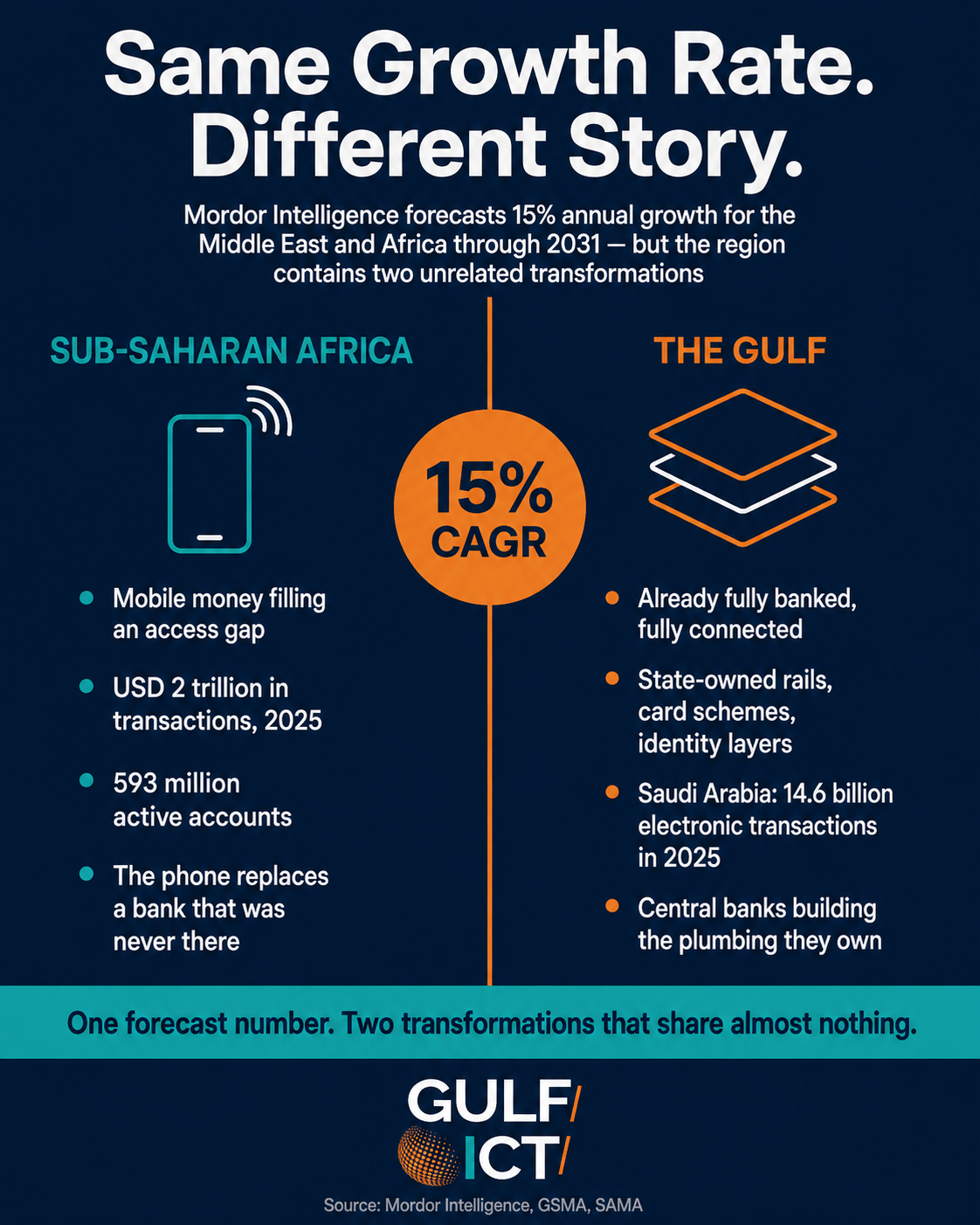
One line in it should interest anyone working in Gulf financial infrastructure. Asia-Pacific stays the biggest region by far. But the fastest-growing one through 2031 is the Middle East and Africa, at roughly 15 percent a year.
That sounds like a Gulf story. It isn't, quite.
What the report means by “Middle East and Africa”
When Mordor explains why the region grows fastest, it points to mobile money in Sub-Saharan Africa, citing GSMA figures of about USD 2 trillion in transactions and close to 593 million active accounts in 2025. The logic is simple: branches are scarce, phones are everywhere, so the phone becomes the account.
That's a real growth story. It just isn't the Gulf's.
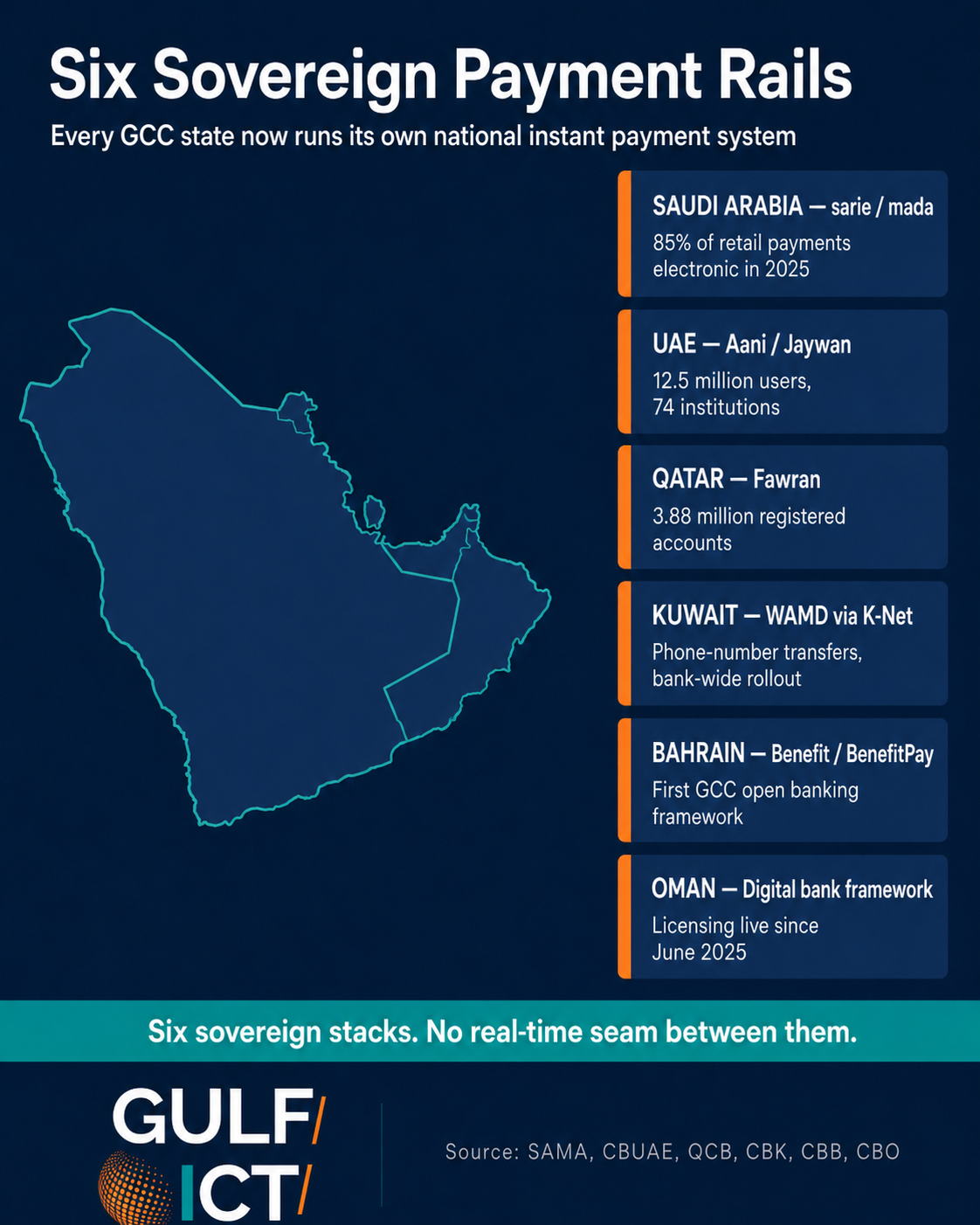
Saudi Arabia and the UAE aren't solving an access problem. Both are already among the most banked, most connected markets in the world. What's happening across the Gulf is something else entirely, and for a technology publication it's the more interesting thing: six central banks building the payment machinery themselves, then licensing new banks to run on top of it.
Think of it as the difference between a country getting its first roads and a country deciding it will no longer rent someone else's highway. Both show up as growth. Only one is about ownership.
Saudi Arabia: the target was hit, then passed
The Saudi Central Bank reported in April that electronic payments made up 85 percent of retail payments in 2025, up from 79 percent the year before, across roughly 14.6 billion transactions. Vision 2030's Financial Sector Development Program had set 70 percent as the goal. The Kingdom reached it in 2023, a year early, and hasn't stopped climbing.
Underneath those numbers sits infrastructure SAMA built rather than imported: mada for cards, sadad for bills, and sarie for round-the-clock instant transfers.
Then came the institutions. SAMA licensed three digital banks and all three are now live. D360 Bank opened in December 2024 and passed two million customers during 2025. STC Bank and Vision Bank followed in early 2025.
Mordor's own framing describes mobile becoming the default banking channel rather than a side door. Saudi Arabia crossed that line before the forecast period even started.
The UAE: the one place the Gulf is treated as a driver
The UAE appears in the report in an unusual spot. In the table of what's pushing global growth, Mordor lists biometric and passkey login, and names the UAE alongside India, the EU and the Philippines as places where regulation is speeding it up.
It's the only moment in the report where a Gulf state is treated as a force shaping the global market rather than a territory inside it.
The infrastructure behind that is moving fast. The Central Bank of the UAE reported in April that Aani, its national instant payment platform, had reached 12.5 million users across 74 licensed financial institutions, with transfers settling in seconds. Jaywan, the national card scheme launched in 2024, began issuing live cards in July 2026 through First Abu Dhabi Bank and Commercial Bank of Dubai.
Then on 3 August, the Ministry of Finance became the first federal entity to accept both for government fees and fines. That step reads smaller than it is. Once government collection runs on a national rail, the rail stops being an option and becomes the default.
The four countries filed under “Rest of”
Mordor's geography names exactly two Gulf states on their own: the UAE and Saudi Arabia. Qatar, Kuwait, Bahrain and Oman are folded into “Rest of Middle East and Africa.”
They don't look residual.
Qatar's instant payment platform Fawran, launched by the central bank in 2024, reached 3.88 million registered accounts by June 2026, with transaction value up roughly 159 percent year on year. Across the whole system, card payments slipped from 94.5 percent of volume to 89.2 percent as transfers gained ground.
Kuwait went live with WAMD, its phone-number transfer system running through K-Net under central bank supervision, adopted by NBK, KFH and the digital bank Weyay.
Bahrain was the first GCC market to regulate open banking, and its Benefit company runs both the national wallet and the domestic transfer system.
Oman issued its digital bank licensing framework in June 2025, setting capital requirements and a physical presence rule for anyone wanting in.
Four national payment rails, the region's first open banking regime, and a fresh licensing framework — all inside a line item called “Rest of.”
Where the real friction sits
Two of the report's listed obstacles land differently here than its global framing suggests.
The first is fraud. Mordor cites FBI data on account takeover losses exceeding USD 262 million since January 2025, driven mainly by scammers impersonating bank support staff. The important part is that this attack happens outside the app. No interface design fixes a customer who is talked into approving a transfer over the phone. Where mobile is already the main channel, which describes most of the Gulf, the exposure is bigger, not smaller.
The second is closer to home. Mordor flags scattered data-residency rules as a drag on anyone operating across several countries. In the Gulf, that friction is a direct product of the sovereignty push itself. Jaywan requires payment data to stay inside the UAE. Every GCC state has built or is building its own rails under its own regulator. Each decision makes sense alone. Together they mean a bank serving all six markets integrates six systems, under six regulators, with six sets of rules.
Sovereignty and interoperability are pulling against each other, and nobody has finished the seam.
The absence worth noting
Mordor profiles twenty companies in its competitive section. Not one is based in the GCC. In a report naming the Middle East and Africa as its fastest-growing region, the list runs from JPMorgan and HSBC through Revolut and Nubank without a single Gulf institution — no Al Rajhi, no Emirates NBD, no QNB, the largest bank in the region by assets.
It's a fair reflection of how Gulf financial technology is still catalogued globally: as a market to be measured, not a set of institutions to be compared.
One caution on the numbers. Mordor says its sizing comes from its own estimation model, and the trillions being quoted are value flowing through apps, not revenue banks earn from it. Those are very different quantities, and the headline figure travels much further than its definition does.
Gulf ICT's takeaway
The forecast is right that this region grows fastest through 2031. Where the Gulf is concerned, it's right for the wrong reasons.
Sub-Saharan Africa is growing because the phone replaced a bank that was never there. The Gulf is growing because six governments decided payment rails and identity systems are national infrastructure, and are paying for them accordingly. Those two stories produce a similar growth rate and almost nothing else in common.
The gap isn't really about one research firm. Global analysis still reads the Gulf as a consumer market, when what's being built is a set of state-owned financial operating systems — sarie and mada in Riyadh, Aani and Jaywan in Abu Dhabi, Fawran in Doha, WAMD in Kuwait City, Benefit in Manama, and an open licence waiting in Muscat.
The unfinished work is the join between them. Six national systems that can't talk to each other in real time make a strong set of countries and a weak single market. Whoever solves that without asking any central bank to give up control of its own rails will have built something no forecast currently has a line for.