Egypt's Telecom Complaints Climb 14% to 141,224 in H1 2026 — and Fixed Lines, Not Mobile, Are Driving It
Egypt's regulator resolved escalated complaints faster than at any point on record in the first half of 2026, cutting average response time to 0.70 days from 1.1 a year earlier. But total escalations rose 14% to 141,224, with the entire increase coming from fixed broadband and fixed voice. Mobile complaints were effectively flat — and 94% of all verified refunds came from mobile wallet disputes, not from telecom services at all.
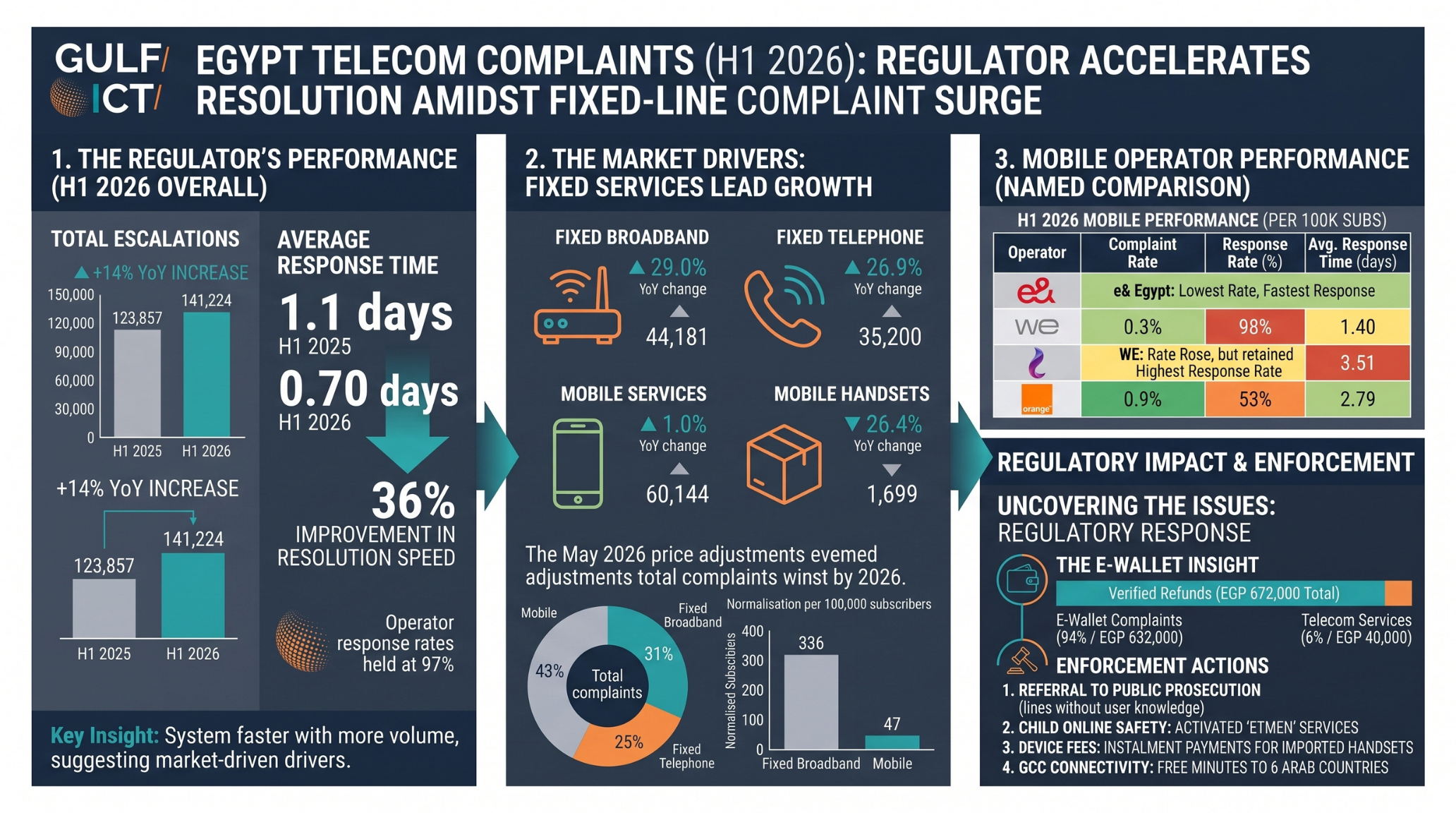
Egypt's National Telecommunications Regulatory Authority (NTRA) received 141,224 escalated user complaints in the first half of 2026, up 14% from 123,857 in the same period of 2025. Operator response rates held at 97%, while the average response time fell to 0.70 days from 1.1 days a year earlier — a 36% improvement in resolution speed against a rising caseload.
That combination is the story. Egypt's complaint system got materially faster while handling significantly more volume, which means the increase is unlikely to be a processing backlog. It reflects something happening in the market itself.
Where the growth actually came from
Almost all of it came from fixed services. Mobile — the category that accounts for the largest share of complaints in absolute terms — barely moved.
Mobile services generated 60,144 complaints, or 43% of the total, up just 1.0% from 59,554 a year earlier, when they represented 48% of the caseload. Fixed internet came second at 44,181 complaints, or 31% of the total, a rise of 29.0% from 34,261. Fixed telephone followed with 35,200 complaints, or 25%, up 26.9% from 27,734. Mobile handset complaints were the only category to contract, falling 26.4% to 1,699 complaints, or 1% of the total, from 2,308 in H1 2025. Together the two fixed categories added roughly 17,400 complaints year on year — slightly more than the entire net increase for the market.
Normalised per subscriber, the gap is starker. The fixed internet complaint rate reached 336 per 100,000 subscribers, against 47 per 100,000 for mobile — roughly seven times higher. Fixed telephone sat at 245 per 100,000. Mobile was the only category where the complaint rate fell year on year, from 51 to 47 per 100,000.
Complaint channels also shifted, and not in the direction a digital-transformation narrative would predict. The 155 call centre handled 89% of escalations, up from 84% a year earlier, while the NTRA website's share fell to 4% from 9%. WhatsApp accounted for 4% and the My NTRA app for 3%, broadly unchanged. Voice remains overwhelmingly the channel of choice, and its share is growing.
The timing is worth noting. On 6 May 2026, the NTRA approved price adjustments of 9% to 15% on selected fixed and mobile internet packages, while holding fixed and mobile voice call rates, prepaid recharge cards and e-wallet fees unchanged. The same decision obliged fixed internet providers to introduce an entry-level package at EGP 150 per month, replacing a market floor of EGP 210, alongside a new EGP 5 mobile data tier. The complaint data covers a period that includes that repricing, though the NTRA report does not draw a causal link and neither do we.
Mobile: e& fastest, WE the only operator moving the wrong way
Among the four mobile operators, e& Egypt — the UAE-headquartered e& group's Egyptian unit — recorded both the lowest complaint rate and the fastest response time in the market, at 39 complaints per 100,000 subscribers, down from 43 a year earlier, with a 96% response rate and an average response time of 0.05 days.
Vodafone Egypt came second on complaint rate at 45 per 100,000, down from 50, with a 97% response rate and an average response time of 0.09 days — unchanged year on year. WE, the Telecom Egypt retail brand, recorded 48 complaints per 100,000, up from 37, alongside the market's highest response rate at 98% and an average response time of 0.30 days, roughly half its 0.55 days in H1 2025. Orange Egypt sat at the bottom on both measures, with 56 complaints per 100,000, down from 63, the lowest response rate in the market at 94%, and a response time that slowed to 0.54 days from 0.41. The market average was 47 complaints per 100,000, down from 51, with a 96% response rate and an average response time of 0.25 days.
Three of the four operators cut their mobile complaint rate year on year. WE was the exception, and its 30% increase moved it from best-in-market to third — though it retained the highest response rate and roughly halved its response time while doing so.
Fixed internet: the inverse relationship between volume and speed
The fixed broadband figures contain the report's sharpest structural tension. The operator with the lowest complaint rate is also the slowest to respond, and vice versa.
WE recorded the lowest fixed internet complaint rate at 269 per 100,000 subscribers, up from 198, with a 99% response rate — but an average response time of 1.41 days, the slowest in the market by a wide margin, albeit down from 2.11 days. Vodafone Egypt recorded 515 complaints per 100,000, up 27% from 406, with a 100% response rate and an average response time of 0.02 days. e& Egypt posted 599 per 100,000, down 34% from 903 — the largest single improvement anywhere in the report — with a 100% response rate and a response time that slowed to 0.28 days from 0.03. Orange Egypt had the highest complaint rate at 879 per 100,000, marginally down from 909, with a 99% response rate and a response time of 0.24 days, up from 0.08. Across the market, the rate was 336 complaints per 100,000, up from 282, with a 99% response rate and an average response time of 0.98 days.
WE, the incumbent and by far the largest fixed broadband provider, generates the fewest complaints per subscriber but takes roughly seventy times longer than Vodafone to respond once a complaint is escalated.
Two readings are available, and the data does not settle between them. One is that scale and infrastructure ownership genuinely produce fewer service failures per line, with slower handling reflecting the operational drag of a national copper and fibre estate. The other is that per-subscriber normalisation flatters the operator with the largest and most heterogeneous base. Anyone using these figures as a procurement or benchmarking input should be explicit about which reading they are applying.
Handsets: complaints down 26%, dealer resolution times roughly halved
Mobile handset complaints against authorised dealers fell to 1,699 from 2,308, with a 99% response rate and an average response time of 2.2 days — still the slowest category in the report, but down from 3.8 days.
Every dealer except one cut resolution time by 40% or more. Safi was fastest at 2.6 days, down from 5.6. Raya Distribution followed at 3.0 days, down from 6.8. i2 and Sky both landed at 3.4 days, from 7.2 and 5.3 respectively. Ro'ya was unchanged at 4.9 days — fastest in the market in H1 2025 and now the slowest, without having got any worse.
The complaint mix also inverted. Replacement refusals rose to 42% of handset complaints from 27% a year earlier, becoming the largest category. Repair and maintenance problems fell to 38% from 57%. Objections to a dealer's technical assessment rose to 20% from 16%. Read together: dealers fixed the repair-quality problem and moved the friction to the point of refusing replacement.
The refund data points somewhere else entirely
The NTRA refunded EGP 672,000 to users whose complaints it upheld — broadly flat against EGP 681,000 in H1 2025. But the composition shifted sharply. Mobile wallet complaints accounted for 94% of the refunded value, up from 76%.
In absolute terms that is roughly EGP 632,000 in wallet-related redress, against approximately EGP 518,000 a year earlier — a 22% increase. Every other complaint category combined now accounts for around EGP 40,000.
This is the report's most under-signposted finding. Mobile wallets are not broken out as a complaint volume category at all, yet they are where nearly all verified financial harm in Egypt's telecom consumer system now sits. Financial disputes carried over telecom rails are behaving as a distinct regulatory problem from service quality, and the current reporting structure does not surface them as one.
Enforcement: all four operators referred to prosecutors
The NTRA lists four remedial actions taken during the period. The most consequential is the referral of all four mobile operators to the Public Prosecution.
The regulator referred Egypt's four mobile operators over complaints from users about mobile lines registered under their personal data without their knowledge or possession, following inspection and verification procedures during which evidence and documentation were compiled. The referral was announced in early August 2026, after the reporting period closed.
The accompanying emergency measures included suspending the sale or activation of new lines through operator systems to private sector and government entities, requiring operators to message all existing lines instructing holders to re-contract in the actual holder's name under threat of permanent cancellation, and directing operators to accelerate biometric verification of line holders through their apps.
NTRA spokesperson Mohamed Ibrahim said the authority had received over 3,000 complaints in a two-day window, alongside more than 100,000 call centre inquiries, relating to lines registered in people's names without their possession.
For context on scale: 3,000 complaints in two days is roughly 2.1% of the entire half-year escalation volume, arriving in a 48-hour window on a single issue. The H1 2026 report was compiled before that spike. The H2 2026 figures will look very different.
The other three actions listed are narrower. On child online safety, the NTRA activated the "Etmen" and "Etmen Ala El-Akhar" services with all four mobile operators; the services were publicly launched with technology provider Kidzonet Egypt alongside MCIT, the NTRA and CyShield, with "Etmen" filtering unsuitable content and enabling safe browsing, and "Etmen Ala El-Akhar" adding parental controls over specific websites and social apps. On device fees, the NTRA and the Egyptian Customs Authority enabled instalment payment of registration fees on imported handsets, with consumer finance company Valu the first provider to offer instalment-based payment for this fee category — a measure that follows the January 2026 end of the passenger handset customs exemption. The fourth was a directive to operators to grant subscribers free international minutes to six Arab countries.
The GCC angle: five free minutes to the Gulf
That fourth measure is the one that lands directly in this publication's coverage area. The NTRA instructed mobile operators to grant each subscriber five free international minutes for calls to Saudi Arabia, the UAE, Qatar, Bahrain, Kuwait and Jordan, framed as enabling citizens to check on family members abroad amid regional developments affecting those countries. Vodafone Egypt extended the measure commercially, offering free international minutes to the same six countries over a three-day window.
Egypt has one of the largest expatriate populations working in the GCC. A regulator-mandated connectivity floor to five GCC states plus Jordan is a reminder that Egypt–Gulf telecom traffic is not simply a wholesale commercial relationship — it is treated in Cairo as consumer infrastructure with a social obligation attached, capable of being directed by regulatory instruction at short notice.
Why this matters beyond Egypt
Egypt publishes named-operator complaint rates, normalised per 100,000 subscribers, twice a year, with response times to two decimal places. That level of granularity in consumer-outcome disclosure has no close published equivalent among GCC regulators, which have generally reported aggregate quality-of-service indicators rather than operator-level complaint league tables.
For GCC operators with Egyptian exposure — e& most directly — this is the only market in the region where their consumer complaint performance is published against named domestic competitors on a comparable basis. e& Egypt currently benefits from that transparency, holding the best mobile complaint rate and response time in the market.
The wider question the report raises is one every regulator in the region will eventually face. Egypt's fixed broadband complaint rate is seven times its mobile rate and rising, in a market undergoing rapid fibre expansion and repricing. Fixed access is where subscriber expectations and delivered quality diverge fastest, and Egypt is the market publishing enough data to show it.