Saudi internet is among the world's fastest. So why did a new study give it an average score for watching video?
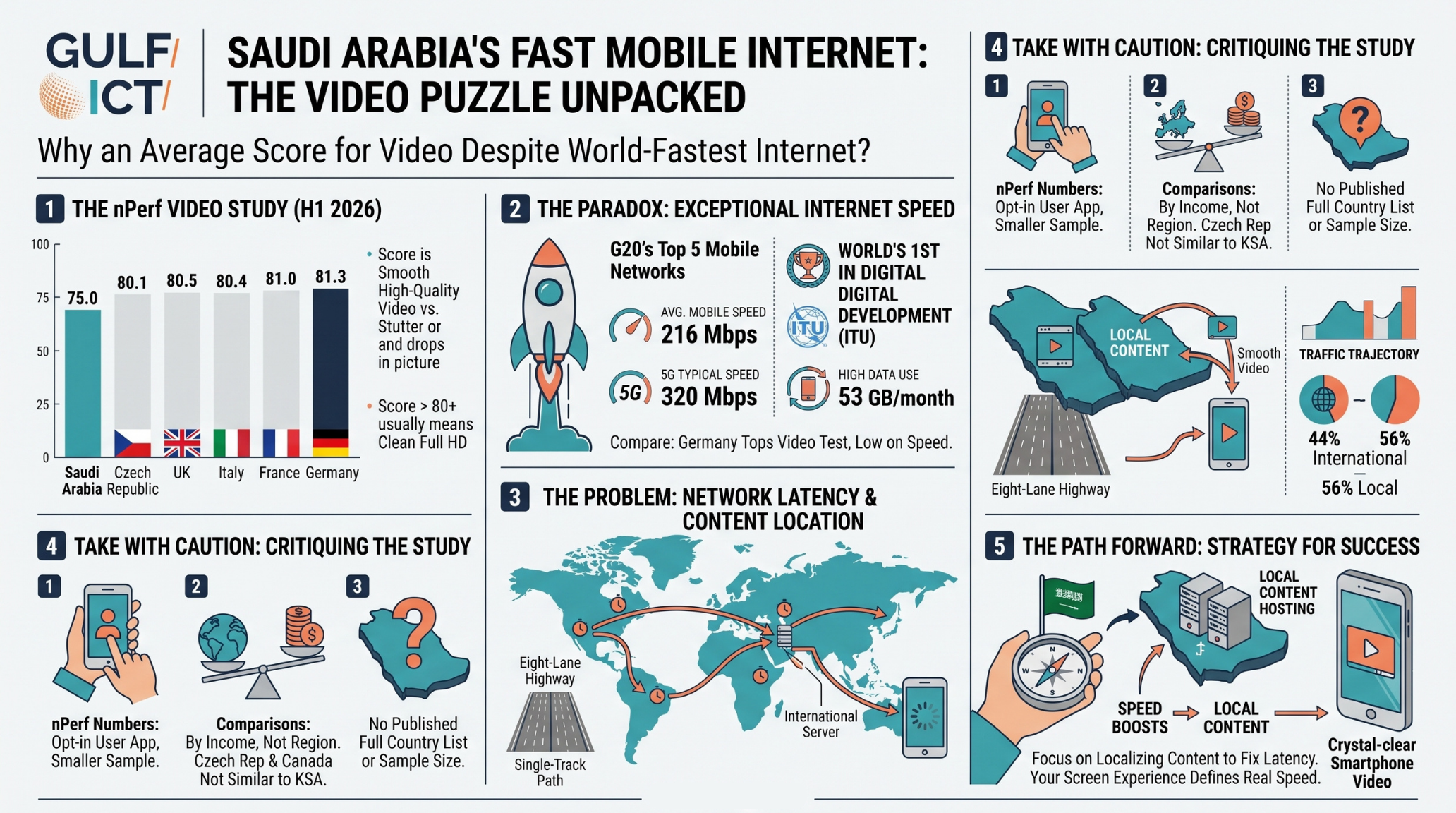
Saudi Arabia has some of the fastest mobile internet on the planet. That is not in question. What a new set of measurements suggests is that fast internet and smooth video are not quite the same thing.
What the study found
French measurement company nPerf tested how well mobile networks handle video playback in the first half of 2026. It gave Saudi Arabia a score of 75 out of 100.
For comparison, in the same group of countries:
Germany scored 81.3
France scored 81.0
The United Kingdom scored 80.5
Italy scored 80.4
The Czech Republic scored 80.1
Saudi Arabia scored 75.0
Israel scored 71.7
Spain scored 70.1
Canada scored 70.0
The score is not about download speed. It measures something simpler: when you press play on a video, does it run smoothly in high quality, or does it stutter and drop to a blurrier picture? A score above 80 usually means video plays cleanly in full HD.
Why this is surprising
By almost every other measure, Saudi Arabia is at the top of the table.
The Communications, Space and Technology Commission published its annual internet report in July. It found that the typical mobile download speed in the Kingdom is 216 Mbps, up from 203 Mbps the year before, putting Saudi Arabia among the five fastest countries in the G20. On 5G, the typical speed is 320 Mbps. The average person in Saudi Arabia uses 53 GB of mobile data a month, about three times the world average.
The ITU, the United Nations telecoms body, ranked Saudi Arabia first in the world this year for digital development, ahead of 159 other countries.
Germany, which topped the video test, beats Saudi Arabia on none of those numbers.
A simple way to think about it
Speed is like the width of the road outside your house. Saudi Arabia has built an eight-lane highway.
But video does not start at your house. It starts wherever the video is stored. If a film is kept on a server inside the Kingdom, it has a short trip. If it is stored abroad, it has to travel a long way and cross other networks along the way, and every one of those steps can add delay.
When a video app senses that delay, it does something you have probably noticed without thinking about it: it quietly lowers the picture quality to keep the video from freezing. To a test like nPerf's, that drop registers as a lower score, even though your connection is fast.
The regulator's own report contains a number that supports this idea. Of all the internet traffic in Saudi Arabia last year, 44 per cent came from outside the country. Only 56 per cent stayed inside it.
This is our reading of the numbers, not a confirmed explanation. Neither nPerf, the regulator, nor any Saudi operator has commented on the result.
Take the score with some caution
A few things are worth knowing about how this study was done.
nPerf's numbers come from ordinary people who choose to run its speed-testing app. That is useful, but it is a smaller and less controlled sample than the regulator uses.
The study also compares countries by income rather than by region, which is how Saudi Arabia ended up being measured against the Czech Republic and Canada. That grouping tells you little about how similar those networks actually are.
And nPerf has not published the full list of countries or explained its sample size. It released the results as a note built around the UK's ranking, with Saudi Arabia mentioned only in passing. The British trade site ISPreview, which also covered it, advised readers to treat the study cautiously for exactly that reason. So do we.
What it means
None of this undoes Saudi Arabia's achievement. The Kingdom built one of the fastest mobile networks in the world in a very short time, and the ITU ranking reflects that.
But it points to where the next round of work sits. Making the network faster will not fix this. Bringing more of the content people watch inside the country will.
It is a less exciting story than 5G. It is also the one that decides what you actually see on your screen.