Five Gulf Countries Are Now Too Close to Tell Apart on Global Connectivity
Every Gulf state now sits near the ceiling of the UN's connectivity index — as a group, above Europe. But the things the index leaves out are exactly the things the six countries differ on.
Every year, the International Telecommunication Union — the United Nations agency for telecoms — tries to answer one question about every country in the world: how close is it to getting everyone online, properly and affordably?
The answer comes as a single score out of 100. It's called the ICT Development Index, or IDI.
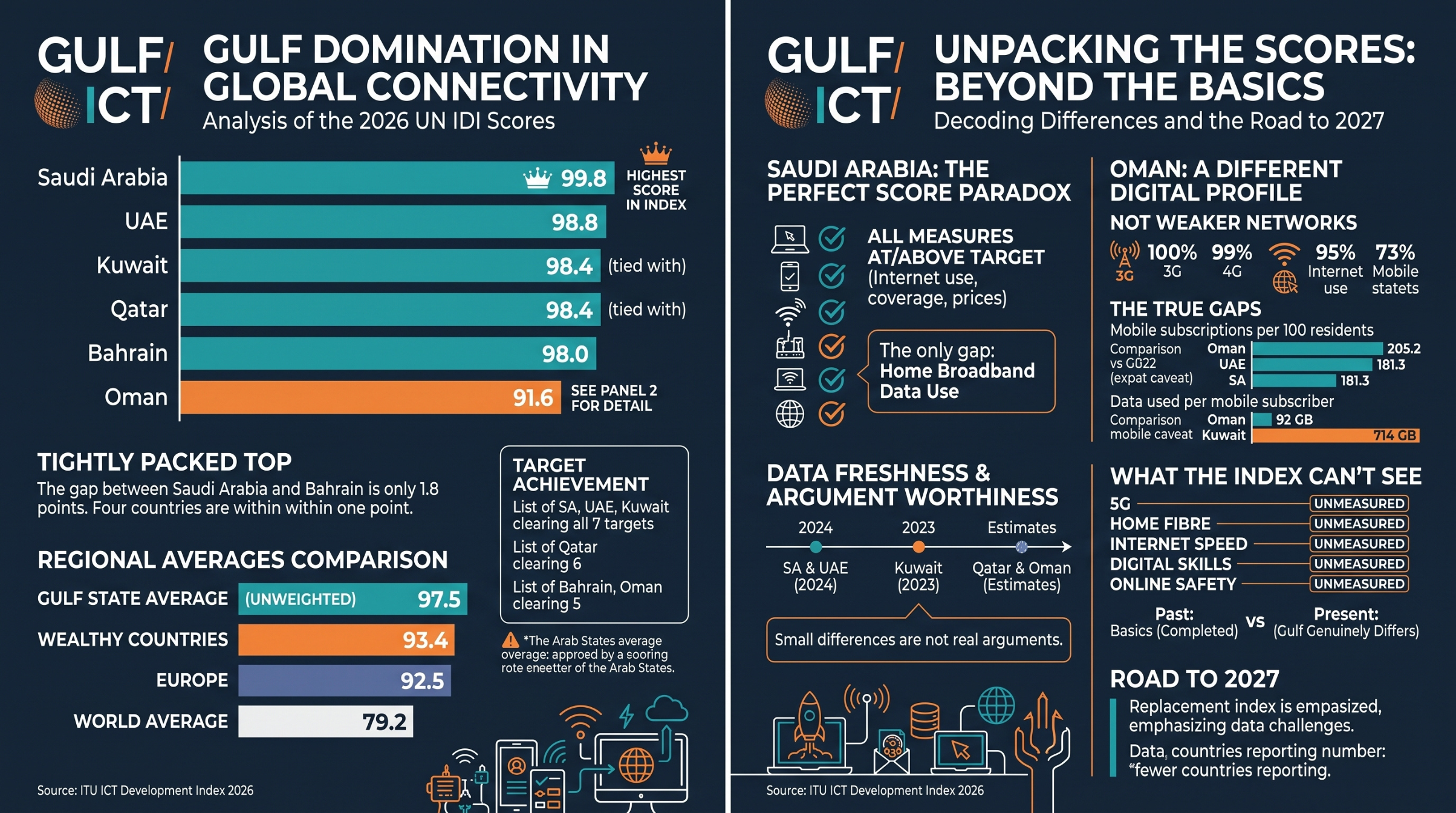
The 2026 edition is out. Saudi Arabia scored 99.8 — the highest score of any country in the index. The UAE, Kuwait, Qatar and Bahrain all scored above 98. Oman scored 91.6.
The world average is 79.2.
So the Gulf did extremely well. But the more interesting part of this report is what it doesn't measure — and we'll get to that.
What the score is actually measuring
The ITU looks at ten things in every country. They fall into two groups.
Group one: are people online?
How many people used the internet in the last three months
How many households have internet at home
How many mobile broadband subscriptions there are, per 100 people
Group two: is being online any good?
How much of the population is covered by 3G and 4G networks
How much data the average mobile subscriber uses
How much data the average home broadband subscriber uses
How much a mobile plan costs, compared to the average income
How much a home internet plan costs, compared to the average income
How many people personally own a mobile phone
Each of the ten gets a score out of 100 against a target. Average them out, and you get the country's score.
Two things to know before reading any of the numbers.
There is no ranking. The ITU deliberately refuses to rank countries, and its member states voted for that. Their argument: one country getting its people online doesn't take anything away from another country, so this isn't a race. They also point out that if every country scored 95 out of 100, someone would still be "last" — which would be a silly thing to report. So the ITU publishes scores only. We do the same.
The numbers are from 2024. It takes about two years to collect, check and standardise this kind of data across 159 countries. That delay is normal and permanent.
How the six Gulf countries compare
Saudi Arabia scored 99.8, the highest of any country in the index. The UAE came next at 98.8, followed by Kuwait and Qatar, tied at 98.4, and Bahrain at 98.0. Oman scored 91.6.
Read that list again and notice how tightly packed the top is. The gap between Saudi Arabia and Bahrain is 1.8 points. The gap between the UAE, Kuwait, Qatar and Bahrain is less than a single point. That's not a coincidence, and we'll come back to it.
The six-country average is 97.5. To put that in context: Europe, the strongest region in the index, averages 92.5. Wealthy countries worldwide average 93.4. Everything else sits further down — the former Soviet states average 86.6, Asia-Pacific 80.0, the Americas 78.5, and Africa 59.4. The world as a whole averages 79.2.
So the six Gulf states, taken together, average higher than the entire European region. Not higher than a few European countries — higher than the regional average of the strongest performing region in the index.
One number deserves a warning label: the Arab States average, at 78.4, is almost exactly the world average. That figure is close to meaningless for our purposes. It covers everything from Saudi Arabia at 99.8 to Somalia at 37.2, in a year when the lowest score anywhere in the world was 25.2. Lumping the Gulf into a regional average tells you nothing useful — these are six specific national markets, not a regional trend.
One technical note on all of those averages: the ITU calculates them unweighted, meaning every country counts equally regardless of how many people live there. A country of two million and a country of two hundred million move the average by the same amount.
All figures in this article come from the ITU's The ICT Development Index 2026, Table 1 and Annex 4.
The ITU mentions that only seven countries in the world hit all seven of the index's real-world targets (things like near-universal internet use, full 4G coverage, and affordable plans). It doesn't name them — but comparing the published country data against those targets ourselves, Saudi Arabia, the UAE and Kuwait all appear to clear every one. Qatar clears six. Bahrain and Oman clear five.
Why Saudi Arabia came out on top
Because it has no weak spot at all.
Almost every measure — internet use, home internet, phone ownership, 3G coverage, 4G coverage, mobile prices, home internet prices — is at or above the ITU's target. The only measure where Saudi Arabia falls short of a perfect score is how much data the average home broadband customer uses.
That single figure is the whole difference between Saudi Arabia and 100 out of 100.
Why Oman scored lower — and why it's not what you'd think
Oman is seven points behind its neighbours, and it's easy to assume that means weaker networks or fewer people online. It doesn't.
Oman has 100% 3G coverage and 99% 4G coverage. About 95% of people use the internet. About 98.5% own a mobile phone. Roughly 98% of households have internet at home. All of those are top-of-the-scale results.
The gap comes from two measures only:
Mobile subscriptions per 100 people. Oman has 101.5. The UAE has 205.2. Saudi Arabia has 181.3.
Data used per mobile subscription. Oman averages about 92 GB. Kuwait averages 714 GB. Saudi Arabia averages 554 GB.
That first number needs a caveat. It counts SIM cards, not people. In countries with very large expatriate populations, and where lots of people carry two SIMs — one for work, one personal, or a local one plus a home-country one — the count goes way above 100 per 100 residents without a single extra person actually getting online.
Oman's own figures for internet use and phone ownership are basically at the ceiling. So its population looks about as connected as anyone else's in the Gulf. The subscription measure is telling us something about how the market is structured, not how many people have access.
Oman's score also dipped by about one point from last year. The ITU warns explicitly that small movements like this can happen when a country submits corrected data later — the index can't be revised after publication, so improved reporting can look like a change in performance.
One more caveat: the data isn't equally fresh
Saudi Arabia and the UAE submitted official 2024 figures for all ten measures. Kuwait's entire entry is built on 2023 figures. Some of Qatar's and Oman's numbers are ITU estimates rather than government submissions.
None of that makes the scores wrong. It does mean that arguing about who beat whom by 0.4 of a point is not a real argument.
The part the index can't see
Here's the thing the ITU is refreshingly honest about.
The index contains nothing about 5G. Nothing about home fibre internet. Nothing about internet speed. Nothing about digital skills. Nothing about online safety and security.
The ITU's reason isn't that these don't matter. It's that most countries in the world don't collect this data in a way that can be compared. On digital skills, for example, only 88 countries have submitted anything at all since 2020, and only eight have submitted a full picture. You can't build a global measure on that.
But look at that list again. Every single item on it is something Gulf countries are actively working on right now — and something they genuinely differ on.
The index is measuring the things the Gulf finished years ago. It's silent on everything happening today. That's why four of our six countries are bunched within a single point: the questions that would separate them aren't being asked.
What happens next
This is the last edition using the current method. It was designed to last four years, and countries have now formally started work on a replacement for 2027.
The ITU has already warned that big changes will be hard, for the same reason as before: the data isn't there. But the process is running now.
There's a related warning in the report that got little attention. The number of countries in the index is falling — 159 this year, down from 169 three years ago — because more governments are failing to report even the minimum data required to be included. The ITU calls that a major cause for concern.
All six Gulf countries are comfortably inside the index. When the scores are this high, that's easy to overlook. It shouldn't be.
The short version
On the basics of connectivity — coverage, getting people online, phones, prices — the Gulf is essentially done. Five countries are within two points of a perfect score, and the sixth is held back by a measure that arguably counts SIM cards rather than people.
The region has outgrown this particular scorecard. That's a good problem to have. But the next real comparison between Gulf markets will have to be built on measures the ITU doesn't publish yet — and the window to shape what those measures are is open right now.