Across 14 national metrics and 13 regions, Saudi Arabia's latest network scorecard shows a market decided by fractions of a point, where the winner depends on your city and how you connect.
Ask someone in Riyadh which mobile network is fastest, then ask someone in Asir. You will probably get two different answers, and both of them will be right. That is one of the clearer takeaways from the Meqyas report for the first half of 2026, published by the Communications, Space and Technology Commission (CST) on 19 November.
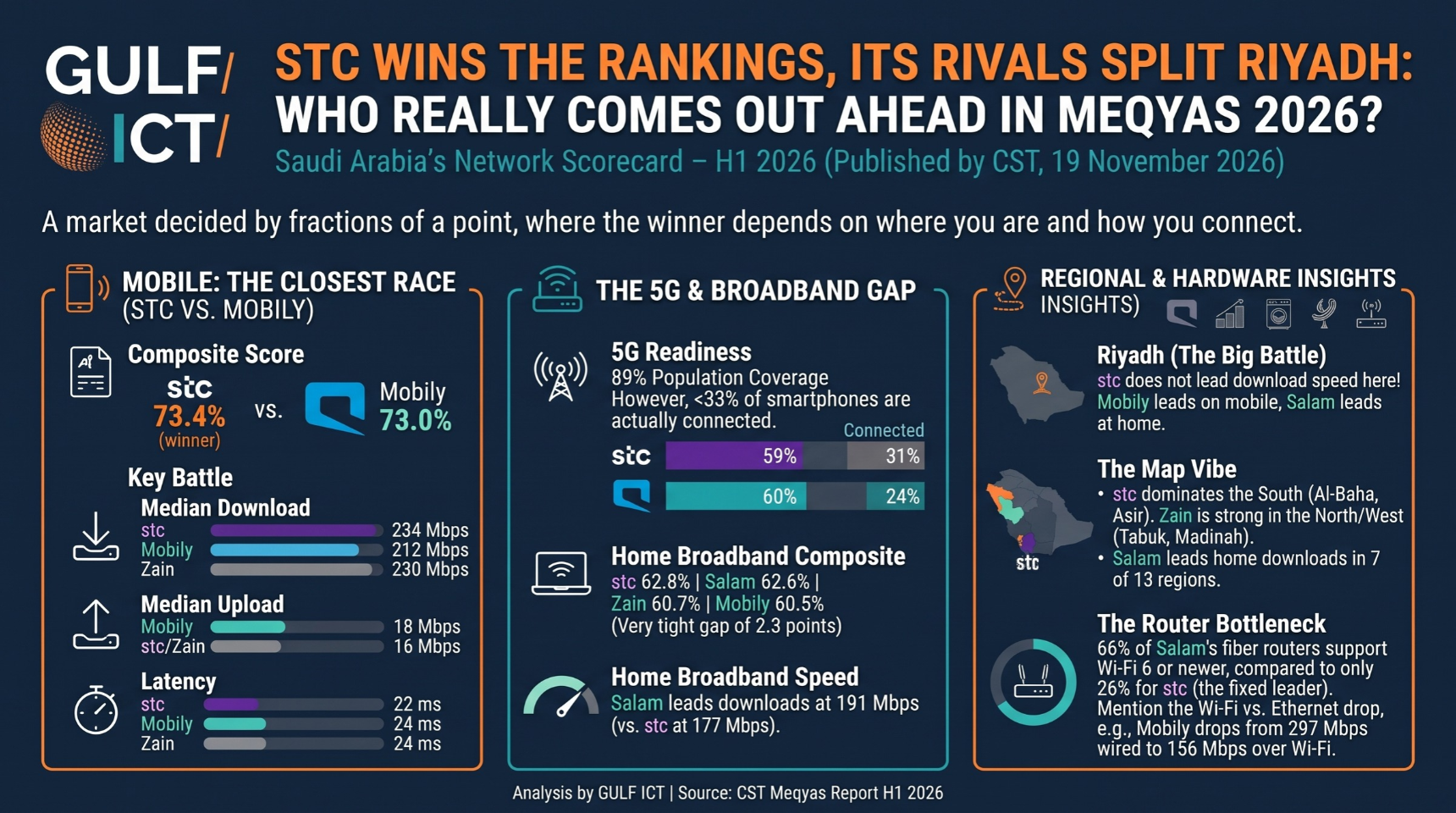
On paper, the result looks settled. stc tops the composite score for mobile and the composite score for fixed broadband, and finishes first, alone or tied, in 8 of the 14 national metrics the report tracks. Mobily and Salam split the remaining six, three each. Zain does not win a single metric outright; its only first place is a shared one, tying stc on fixed-network latency.
Look past the rankings to the numbers themselves, though, and the race is far tighter. The gap between first and second place is four-tenths of a point on mobile and two-tenths at home. And on the regional map, the picture flips in several places, starting with the capital.
Mobile: stc and Mobily, neck and neck
stc scored 73.4% on the mobile composite index. Mobily scored 73%. Races rarely get closer than that.
stc built its lead on download speed, with a median of 234 Mbps against Mobily's 212, and on latency, at 22 ms against 24. Mobily answered on upload, taking first place at 18 Mbps. That is the number that matters to anyone posting video, working remotely or spending the day on video calls.
Zain's story is harder to read. On downloads it sits just 4 Mbps off the lead at 230 Mbps, comfortably ahead of Mobily. Yet it finished third on the composite at 70.6%, after coming last on upload at 16 Mbps and tying Mobily on latency. The composite blends download, upload and latency using weights the report does not disclose, so raw download speed alone does not win it.
5G: the phones are ready, the connections are not
5G networks now cover 89% of the Kingdom's population. Even so, no operator has more than a third of its smartphones actually connected to 5G.
Mobily shows the gap most sharply. 60% of its customers' smartphones support 5G, the highest share in the market, yet only 24% are actually connected to it, the lowest. stc has an almost identical share of 5G-capable devices at 59%, but gets 31% of phones onto the network. Zain sits in between, at 53% capable and 25% connected.
The same pattern shows up in voice. 88% of stc's call traffic runs over VoLTE, compared with 72% at Mobily and 69% at Zain.
Home broadband: Salam is faster, stc ranks higher
Fixed broadband brings a fourth player into the race and makes it more crowded. Just 2.3 points separate first from last on the composite: stc at 62.8%, Salam at 62.6%, Zain at 60.7% and Mobily at 60.5%.
If download speed is your yardstick, Salam wins at 191 Mbps, 14 Mbps ahead of stc. But stc took the overall lead on latency, at 6 ms (tied with Zain), and on upload, at 94 Mbps. Upload speeds are almost identical across the board: 94, 93, 92 and 91 Mbps, a spread of just 3 Mbps.
The real battle is behind the router
The most revealing part of the report compares wired speeds with Wi-Fi speeds, because Wi-Fi is what actually reaches most phones and laptops at home.
Over Ethernet, Mobily leads at 297 Mbps. Over Wi-Fi, it drops to last place at 156 Mbps. That is a 141 Mbps gap between the two, close to half the wired speed and the largest of the four operators. Salam, by contrast, leads on Wi-Fi at 186 Mbps and comes second over Ethernet at 290.
That raises the hardware question. 66% of the routers Salam supplies to fibre customers support Wi-Fi 6 or newer, against 59% for Mobily, 45% for Zain and just 26% for stc, the overall fixed-broadband leader. Routers do not explain everything, though: Mobily has the second-highest share of modern routers and still posts the widest wired-to-Wi-Fi gap.
A map that does not match the national table
In Riyadh, the Kingdom's largest market, stc does not lead download speed on either mobile or home broadband. Mobily leads on mobile and Salam leads at home. Mobily also tops mobile downloads in Qassim, Al-Jouf and Najran.
stc looks strongest in the south. It sweeps all three mobile metrics (download, latency and upload) in Al-Baha and Asir, and leads mobile downloads in Jazan and Makkah, as well as the Eastern Province and the Northern Borders.
Zain, absent from the national podium, is very much present on the map. It leads mobile downloads in Tabuk, Madinah and Hail, leads home-broadband downloads in five regions (Qassim, Makkah, Asir, Jazan and the Northern Borders), and sweeps all three fixed-network metrics in Qassim.
At home, Salam leads download speed in 7 of the 13 regions. stc leads only in Madinah, though it sweeps all three fixed metrics there.
Fibre first, copper on its way out
When technologies compete rather than companies, the contest is over almost before it starts. Fibre delivers a median download of 185 Mbps with 6 ms latency, against 104 Mbps and 24 ms for home 5G. Copper DSL manages just 9 Mbps, but its subscribers now make up less than 3% of the fixed wired base.
Where the next round will be decided
Saudi download speeds have reached a level where users barely notice a gap of 4 or 14 Mbps. At Gulf ICT News, we expect the next rounds to be decided in two places. One is the user's pocket, where at least two-thirds of smartphones are still off 5G despite near-universal coverage. The other is the living room, where an ageing router can quietly eat into the speed a subscriber is paying for.