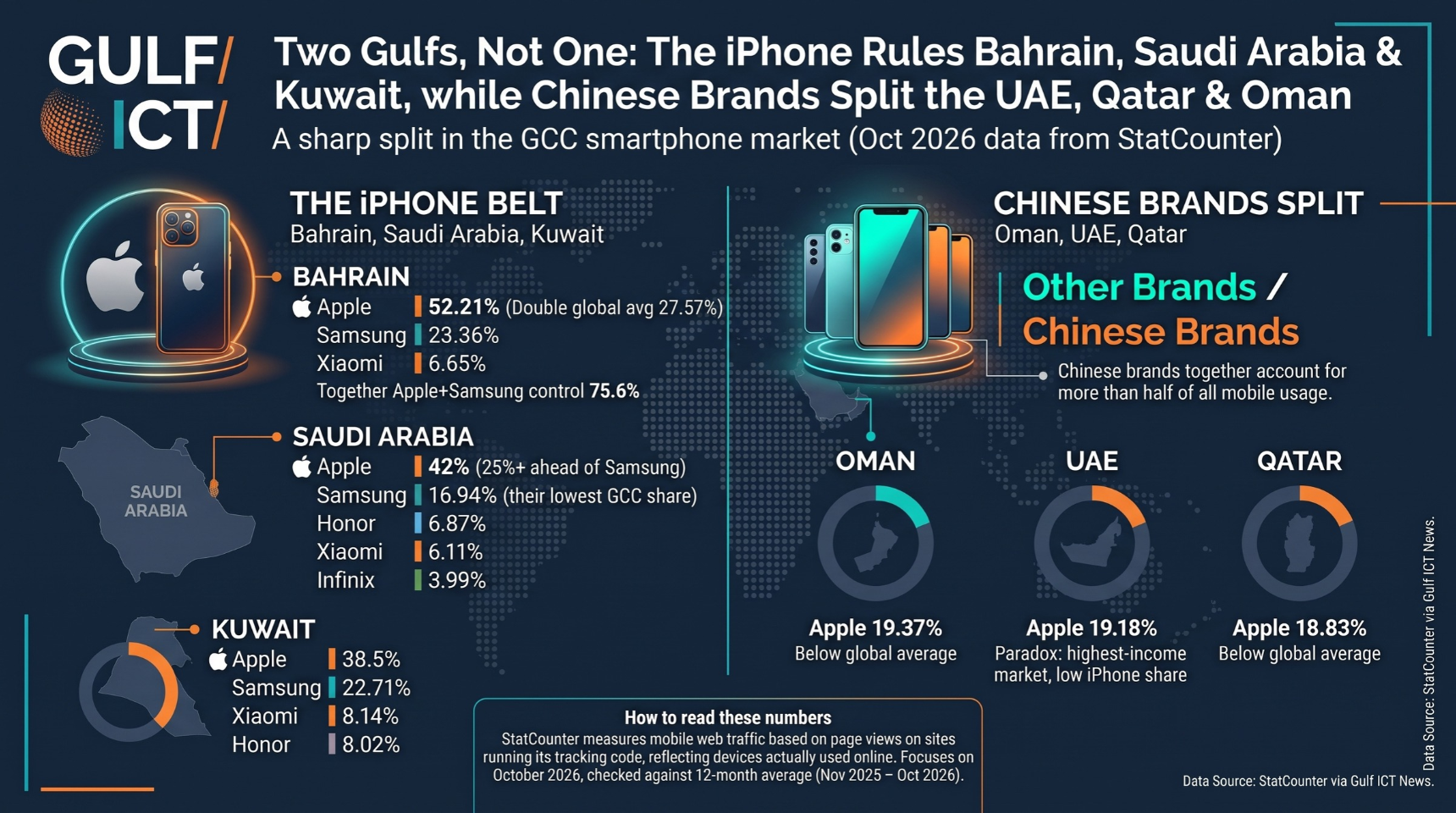
StatCounter data for October 2026 shows a sharp split in the GCC smartphone market. In three states, Apple’s share runs far above its global level. In the other three, it falls below it, and Chinese brands together account for more than half of all mobile usage.
It is tempting to treat the six GCC states as a single smartphone market and to assume that high purchasing power translates automatically into premium-brand dominance. The October 2026 data we analysed at Gulf ICT News tells a different story. The Gulf is two smartphone markets, not one.
In Bahrain, Apple accounts for 52.21% of mobile usage, almost double its worldwide share of 27.57%. Saudi Arabia follows at 42% and Kuwait at 38.5%. At the other end, Apple’s share falls to 19.37% in Oman, 19.18% in the UAE and 18.83% in Qatar, all below the global average. The paradox is that two of the region’s highest-income markets, the UAE and Qatar, sit on the side of the Gulf that relies least on the iPhone.
How to read these numbers
StatCounter measures each brand’s share of mobile web traffic, based on page views on the websites that run its tracking code. It is therefore a measure of the devices people are actually using online, not of unit sales or shipments. Because monthly figures fluctuate, we used October 2026, the latest complete month, as our primary reference and checked it against the 12-month average from November 2025 to October 2026.
The iPhone belt: Bahrain, Saudi Arabia and Kuwait
Bahrain is the most Apple-dependent market in the GCC. Samsung is a distant second at 23.36%, which means the two giants together control 75.6% of mobile usage and leave roughly a quarter of the market to everyone else. Xiaomi, the world’s third-largest vendor by this measure, holds just 6.65% in Bahrain.
In Saudi Arabia, the region’s largest market, Apple leads at 42%, more than 25 percentage points ahead of Samsung at 16.94%. That is Samsung’s lowest share anywhere in the GCC and well below its global share of 22.72%. Honor has climbed to third place in the Kingdom at 6.87%, ahead of Xiaomi at 6.11%, while Transsion’s Infinix holds 3.99%, nearly double its global share.
Kuwait follows the same pattern. Apple leads at 38.5% and Samsung follows at 22.71%. Third place is a near tie between Xiaomi at 8.14% and Honor at 8.02%.
The open markets: the UAE, Qatar and Oman
Across the other half of the Gulf, no single brand holds a commanding share. In the UAE, Samsung leads at 20.86%, ahead of Apple at 19.18% and Xiaomi at 16.92%. That makes the UAE the only GCC state where Apple was not the leading brand in October 2026.
In Qatar, just a fifth of a percentage point separates Apple (18.83%) from Samsung (18.63%), which is effectively a tie. Oman shows the same picture, with a gap of only 0.75 points between Apple (19.37%) and Samsung (18.62%). In all three markets Xiaomi ranks third with a share between 15% and 17%, comfortably above its global share of 11.81%.
This is not a one-month anomaly. The 12-month averages confirm the pattern. Apple averaged 20.32% in the UAE, 20.94% in Qatar and 22.7% in Oman, all below its global average of 30.52% over the same period. By contrast, it averaged 50.2% in Bahrain, 38.75% in Kuwait and 33.07% in Saudi Arabia.
The Chinese wave: more than half the market in three states
The most striking finding emerges when we combine the shares of the main Chinese brands: Xiaomi, Vivo, Oppo, Honor, Realme, OnePlus and Huawei, together with Transsion’s Infinix, Tecno and Itel. Their combined share reaches about 55.8% in Oman, 54.5% in Qatar and 52.7% in the UAE. In all three states that is more than Apple and Samsung combined, and well above the group’s combined global share of about 38.4%.
The same group falls to about 35% in Saudi Arabia, 33.3% in Kuwait and just 21% in Bahrain. The Gulf, in other words, does not agree on what phone it carries. Half of the region leans towards the iPhone, and the other half towards a broad range of Chinese alternatives.
Vivo and Oppo show this strength most clearly. In Qatar, Vivo holds 10.92% and Oppo 9.76%. In the UAE the figures are 9.86% and 9.23% respectively, both above the brands’ global shares of 7.35% and 7.17%.
Samsung: the steady number two
Samsung’s position across the region is relatively stable. Its share ranges from 16.94% in Saudi Arabia to 23.36% in Bahrain, and in no GCC state does it meaningfully exceed its global share. The UAE is its standout market, where it leads outright, while Saudi Arabia remains its clearest weak spot.
What to treat with caution
We are committed to reading data honestly, and three points deserve attention:
Apple’s jump in Saudi Arabia. Apple’s share in the Kingdom rose from about 24% in the first quarter of 2026 to roughly 50% in July and August, before settling at 42% in October. Over the same period, StatCounter’s “Unknown” device category in Saudi Arabia fell from about 20% to under 2%. This suggests that part of the jump reflects better device classification rather than a shift in user behaviour of the same size.
Honor’s simultaneous rise. Honor’s share doubled or more between August and October 2026 in most GCC states and worldwide, all at the same time. A synchronised global move points more to a possible change in device detection than to a sales surge.
Year-on-year comparisons. Because the share of unidentified devices changed substantially between 2025 and 2026, comparing October 2026 with October 2025 may overstate the shifts. For that reason, our analysis is based on comparing countries within the same month.
What it means for the market
Usage data alone does not explain why the region is split this way, but it raises direct questions for operators, retailers and manufacturers. A single pricing or device-bundling strategy is unlikely to perform equally well in Manama and Muscat. Digital services, and government apps in particular, need testing across a wider range of Android devices in markets where the iPhone does not dominate. For Chinese manufacturers, the UAE, Qatar and Oman offer a solid base, while Saudi Arabia, given its size, remains the biggest prize still in play.
Our conclusion: talking about “the Gulf smartphone market” in the singular hides the most important thing the numbers have to say.
Source: StatCounter Global Stats, Mobile Vendor Market Share.