The Gulf Built the Networks. Someone Else Owns the Visitor.
A new global map shows where visitors' mobile data reaches the internet. Madrid handles 27 per cent of it. The Gulf handles none. That is a revenue question, a sovereignty question, and a deadline.
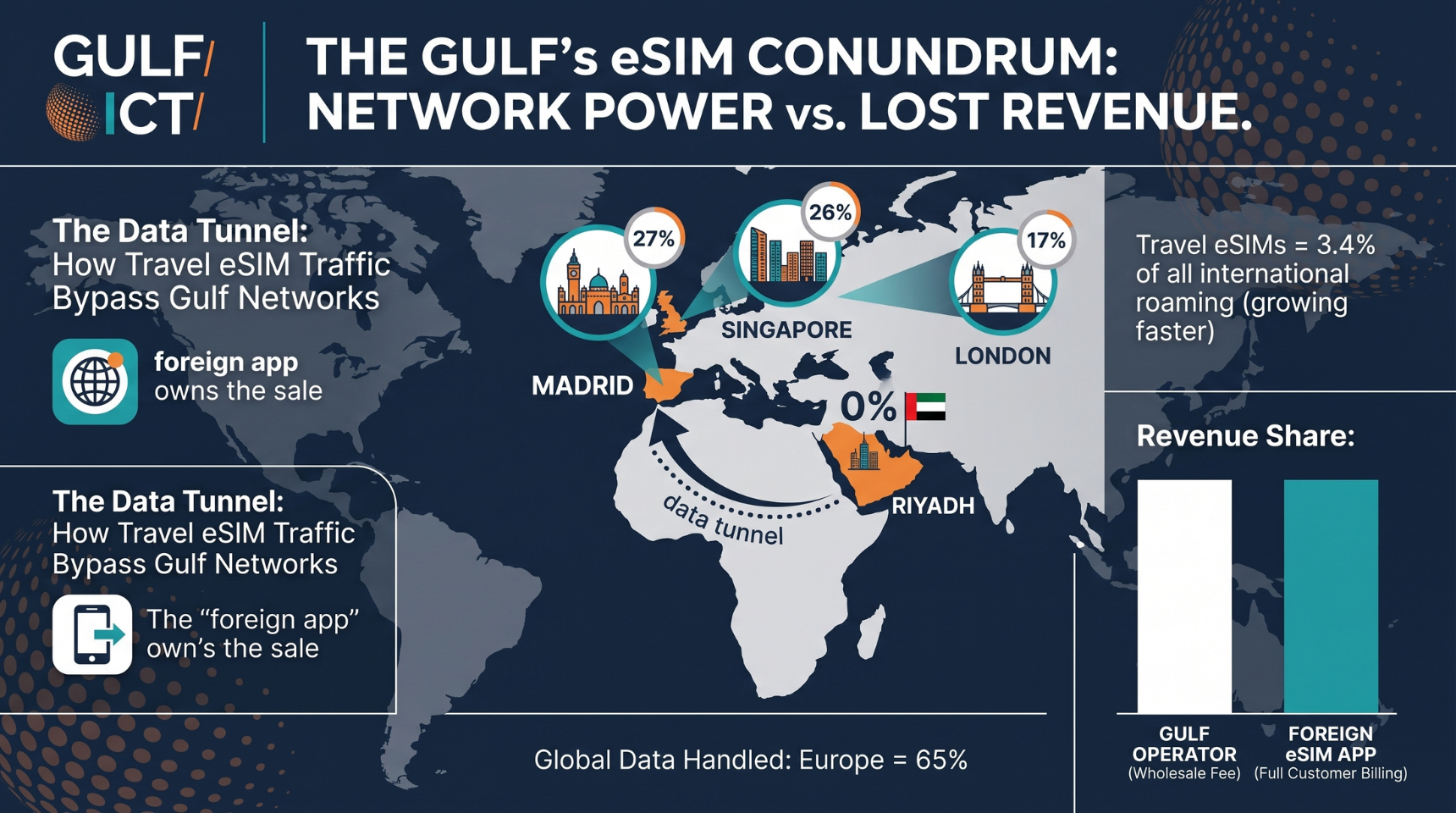
A tourist lands in Riyadh, opens her phone, and connects. She installed a travel eSIM from an app before she flew, the way millions of travellers now do. Her data travels up to a Saudi tower, and then it keeps going. Through a private tunnel, across a continent, until it finally reaches the open internet in Madrid, five thousand kilometres from where she is standing.
Everything she does online for the rest of her trip happens from Spain.
One number, and what is missing from it
Ookla published measurements this month showing where the world's travel eSIM traffic actually reaches the internet. It is a startlingly short list of cities. Madrid takes 27 per cent. Singapore takes 26. London takes 17. Europe as a whole absorbs 65 per cent of the global total.
No Gulf city appears anywhere on that map.
This is not a small or shrinking category. Travel eSIMs now carry 3.4 per cent of all measured international roaming, up from 2.7 a year earlier, and they are growing several times faster than roaming overall. Every one of those travellers uses a local operator's towers. Almost none of them are a local operator's customer.
Why this matters, one: the revenue is leaving
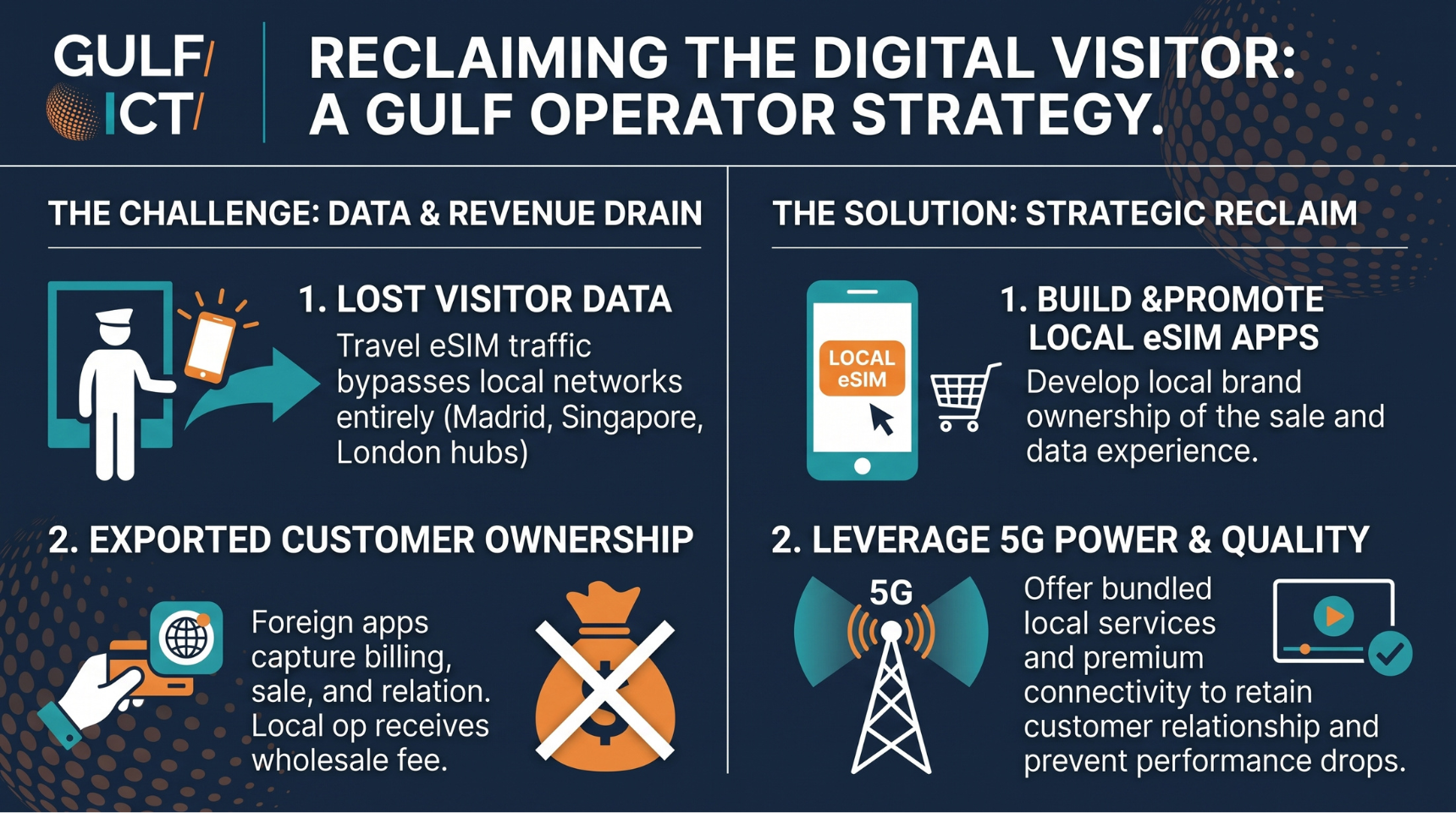
Under this model the Gulf operator does the expensive part and captures the cheapest part of the value. It built the towers, bought the spectrum, and rolled out 5G coverage that consistently ranks among the fastest in the world. A foreign app owns the sale, the billing, the account and the customer relationship. The operator receives a wholesale fee.
That trade would be tolerable if the visitor were getting a better product. Research from NYU Abu Dhabi, measuring travel eSIMs against local SIMs on the same networks, found the opposite. In Qatar and Saudi Arabia, the likelihood of a video streaming at full HD fell by 43 and 44 per cent on the travel eSIM. And the Saudi local SIM recorded the fastest average download speed of any market in that entire 24-country study.
So the region is exporting the customer relationship and importing a worse experience. That is the part worth pausing on. The network is not the weak link. The business model is.
Why this matters, two: the visitor is not here
Wherever data exits is where the internet believes the user to be. A visitor in Riyadh routed through Madrid is, to every service she touches, a user in Spain. Her bank sees Spain. Government portals see Spain. Analytics platforms measuring the visitor economy see Spain.
Every Gulf state is investing heavily in data localisation, sovereign cloud and national digital infrastructure. Meanwhile an entire and fast-growing layer of traffic inside their borders exits offshore by default, outside the registration regime that governs every other visitor connection, and outside any regulator's line of sight. No GCC authority has yet addressed this publicly. It is arguably the largest unexamined gap in the region's digital sovereignty agenda.
Why this matters, three: the clock
The Gulf is about to receive the largest sustained inflow of international visitors in its history. The AFC Asian Cup in 2027, Expo 2030 in Riyadh, and the World Cup in 2034 arrive in sequence, alongside national tourism targets that assume tens of millions of annual arrivals.
Every one of those visitors will make a connectivity decision in the first ten minutes after landing, and increasingly they will make it before they land. The question facing the region's operators and regulators is simply whether that decision defaults to a Gulf product or a European gateway. It is being answered right now, by default, in favour of the second.
What would actually fix it
The technical remedy is unglamorous and well understood. It is called local breakout, and it means letting a visitor's traffic reach the internet inside the country being visited rather than tunnelling it abroad. Ookla's own conclusion is that an operator offering this, or selling its own visitor eSIM with genuinely local exit, would outperform most of the current market on responsiveness by an order of magnitude.
Gulf operators already hold every asset this requires: the radio networks, the international interconnection, and cloud regions sitting in the same cities as the customers. What is missing is the product and the commercial decision to build it rather than watch it be rented out from Madrid.
Gulf ICT's takeaway
The region has spent a decade and enormous sovereign investment on becoming a destination. It has spent almost nothing on becoming a destination for data. Ookla has now mapped where the fastest-growing category of roaming traffic surfaces onto the internet, and the Gulf is not on the map, despite sitting on top of the cables and cloud regions that would make it the obvious place to put a gateway.
This is not a failure of engineering. It is an absence of ownership, and it is fixable within a single planning cycle. A visitor eSIM with genuine local breakout is a product any Gulf operator could launch before the 2027 Asian Cup. Until one of them does, the fastest mobile networks on earth will keep delivering their visitors an experience assembled somewhere else.
Check it yourself in thirty seconds
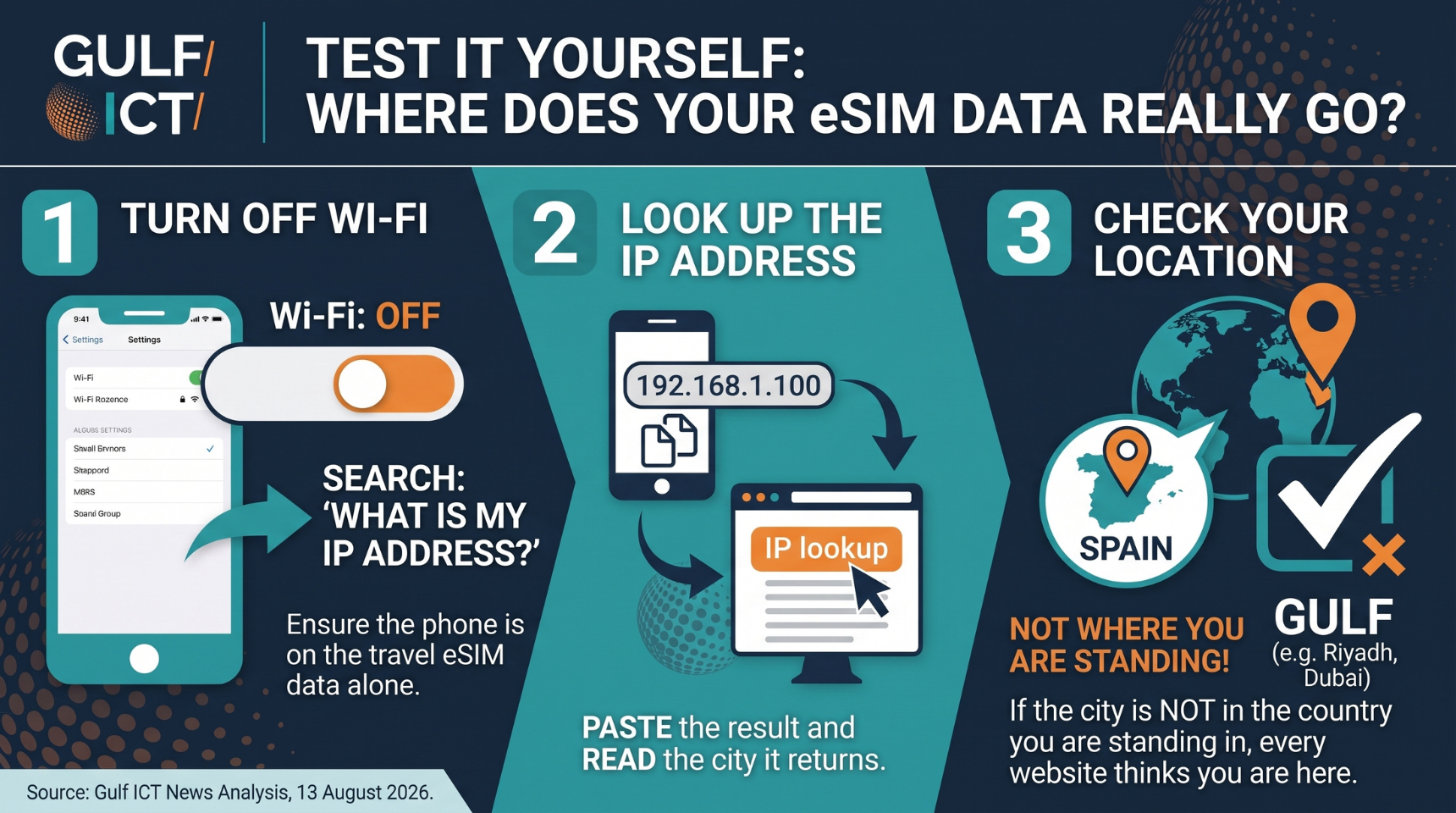
1. Turn Wi-Fi off so the phone is on the travel eSIM alone, then search for what is my IP address.
2. Paste the result into any IP lookup service and read the city it returns.
3. If that city is not in the country you are standing in, that is where your data reaches the internet, and that is where every website thinks you are.
Sources: Ookla, The Travel eSIM Performance Penalty, Luke Kehoe, 11 August 2026, based on Speedtest Intelligence Q2 2026 data across approximately 190 countries. Jang, Varvello, Lutu and Zaki, Unraveling the Airalo Ecosystem, NYU Abu Dhabi with Nokia Bell Labs and Telefonica Research, fieldwork late 2023 to mid 2024. Figures are reported with attribution; no charts or tables have been reproduced. The Gulf comparison figures come from single-brand measurements on limited samples and are indicative rather than definitive.