$55 billion and a final closing bell: how Saudi Arabia went from EA shareholder to EA owner
The deal closed, the leadership changed the same day, and the industry is left with a new equation: patient Gulf capital now owns one of the heaviest franchise portfolios in global entertainment.
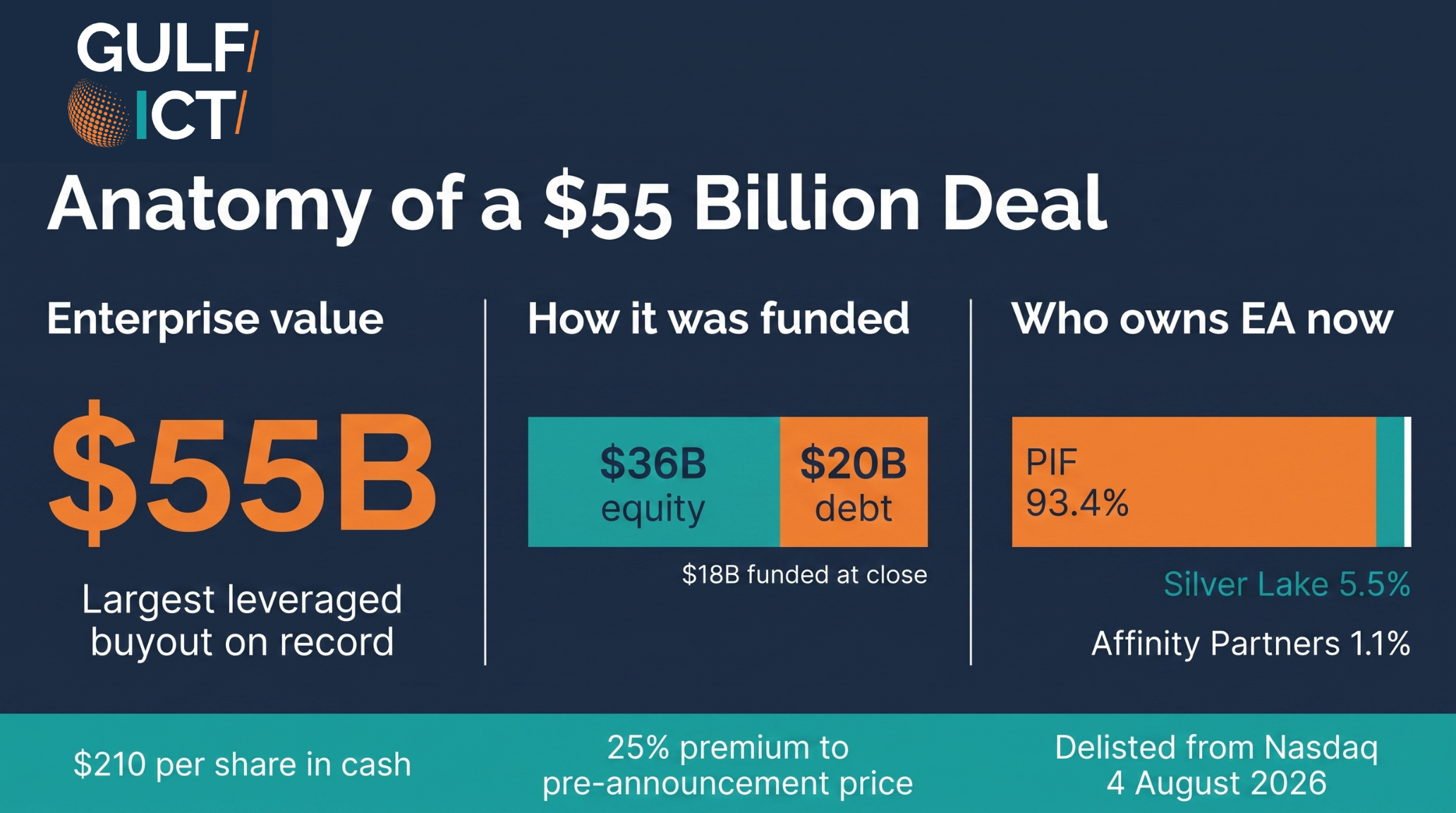
Thirty-five years of public trading ended on a single bell. On 4 August 2026, Electronic Arts confirmed the completion of its acquisition by a consortium led by Saudi Arabia's Public Investment Fund, alongside Silver Lake and Affinity Partners, covering 100 percent of the American publisher behind EA Sports FC, Battlefield, The Sims, Apex Legends, Madden NFL and Need for Speed. Shareholders were paid $210 in cash per share, a premium of roughly 25 percent to the pre-announcement price, and the stock came off Nasdaq.
The numbers, and the five years that preceded them
The transaction carries an enterprise value of approximately $55 billion, the largest leveraged buyout on record. The structure says a good deal about the nature of the buyer: around $36 billion of equity from the three partners, including the roll-over of PIF's existing 9.9 percent stake, set against $20 billion of debt financing committed solely by JPMorgan Chase Bank, of which $18 billion was funded at close. According to the deal documentation, the fund emerges holding roughly 93.4 percent.
The relationship, though, is considerably older than the deal. PIF became a shareholder more than five years ago, investing over $3 billion in the publisher in 2021 and increasing its position later. Turqi Alnowaiser, Deputy Governor and Head of International Investments at PIF, said those years gave the fund a deep understanding of EA's platform and its sports and gaming franchises, and that entertainment and sport are strategic focus areas for the fund among the fastest-growing sectors globally. Put differently: this was not an entry transaction. It was a completion.
Football moves to the centre of the decision room
On the same day, before the ink on the announcement had dried, chairman and chief executive Andrew Wilson sent an internal message setting out new leadership arrangements. Cam Weber, who had been running EA Sports, was elevated to President and Chief Studios Officer, with responsibility extending across the entire franchise portfolio, the studio organisations, and creative and development teams company-wide. David Tinson, a twenty-year EA veteran across marketing, communications, strategy and technology, becomes President and Chief Operating Officer. Wilson wrote that leading this next phase requires bold creativity and exceptional execution.
The groundwork for this structure was laid two months before closing. On 9 June 2026 the company shared an internal set of leadership updates, moving Laura Miele to President, Enterprise Development, working with the chief executive on growth opportunities beyond the core business, and folding the Central Technology organisation under CTO Matt Thomlinson into the Experiences group.
For anyone who reads org charts as strategy statements, the message is legible. When the head of the sports business is elevated to oversee every studio, the sports franchises, EA Sports FC above all, are no longer one product line within a portfolio. They are the company's operational centre of gravity. That is precisely where the new owner and the company overlap: sport, interactive entertainment, broadcast and live events. EA remains headquartered in Redwood City, California, reported GAAP net revenue of approximately $7.5 billion in fiscal 2026, and enters its new chapter with $18 billion of debt on the balance sheet.
What changes when a major publisher leaves the public market
Delisting is not an accounting formality. It changes the tempo of the company. Listed businesses run to a quarterly pulse; private ownership opens the door to longer production cycles and bets that are not marked to market every ninety days. Egon Durban, CEO and Managing Partner of Silver Lake, described the consortium as a long-term partner intending to invest heavily in EA's growth, including in what artificial intelligence can do for game development and player experience.
There is an informational cost on the other side of that. The end of listing means the end of detailed quarterly disclosure, removing one of the sector's most useful open benchmarks from public view. From a market-structure angle, the industry keeps concentrating: after Microsoft and Activision Blizzard, then Scopely, Moonton and ESL FACEIT, there are fewer large owners than there were, and patient decade-horizon capital is steadily displacing quarterly capital.
Artificial intelligence remains the most contested variable. EA had already begun scaling generative AI adoption across development cycles through external partnerships and internal adoption targets, and the new ownership has explicitly signalled investment along that path. The result is that the largest transaction in the industry's history will also be one of its broadest experiments in AI-assisted entertainment production, and the outcome will be read as a precedent.
From the investor's seat to the owner's seat
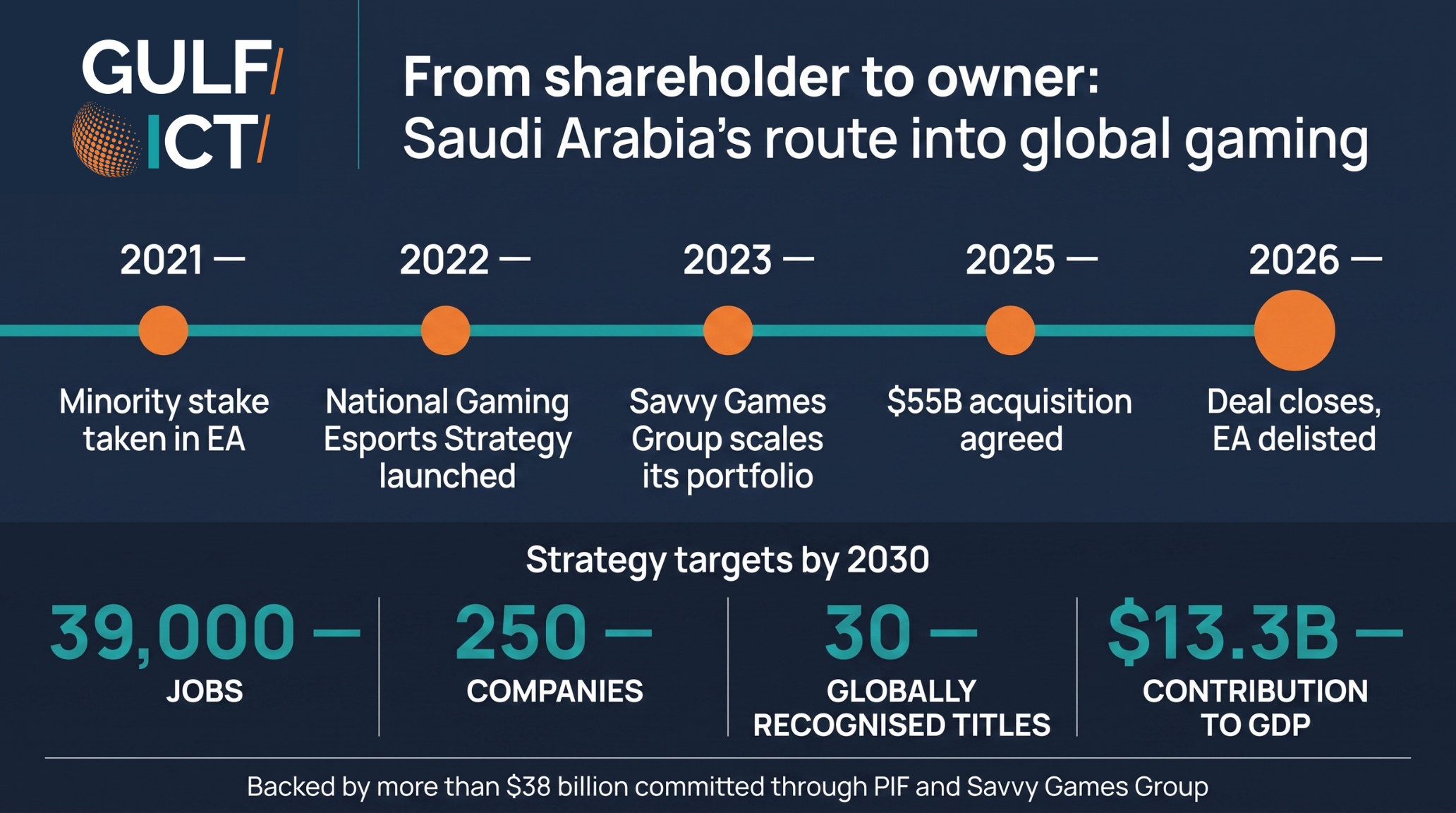
Saudi Arabia is today the largest games market in the Middle East and North Africa, accounting for roughly a fifth of regional gaming revenue. It is also the only country operating a written national gaming and esports strategy, launched in September 2022 under Vision 2030 with explicit numerical targets: 39,000 jobs, 250 companies, 30 globally recognised titles and a contribution of around $13.3 billion to GDP by 2030, backed by more than $38 billion channelled through PIF and Savvy Games Group.
Savvy, founded in 2022, now holds Scopely, ESL FACEIT Group and Steer Studios, and in early 2026 PIF transferred a gaming portfolio valued at roughly $12 billion into it. PIF manages more than $900 billion in assets across over 220 portfolio companies, and lists gaming and esports among its strategic sectors alongside artificial intelligence and renewable energy. Fund governor Yasir Al-Rumayyan has said PIF will continue supporting Vision 2030 objectives by building competitive domestic ecosystems, investing in national champions capable of scaling globally, and forming international economic partnerships.
On the ground, Riyadh built one of the world's largest esports platforms in two years. The Esports World Cup, launched from Riyadh in 2024 as the successor to Gamers8, reached a record prize pool above $75 million in its third edition, across 25 tournaments and 24 titles, with more than 2,000 players from 200 clubs and over 100 countries. The 2026 edition was staged in Paris as the first international outing under a rotating-host approach, with the organising foundation describing Riyadh as the tournament's home. Saudi club Team Falcons holds the title after two consecutive wins. The Kingdom is expected to host the first Olympic Esports Games in 2027, while a dedicated gaming and esports district is under construction at Qiddiya with four arenas, one of them among the largest esports venues in the world.
What makes the EA transaction a step change is that it moves the Kingdom from financial investor and event host to industrial owner. Whoever owns the franchise owns the localisation decision in all its detail: the language of the game, its priority markets, where its servers sit, its seasonal content and its sporting partnerships. In the case of EA Sports FC specifically, where football is the region's first cultural currency and sports simulation leads mobile player spending, that decision reaches tens of millions of Arab players directly.
Gulf ICT's takeaway
We read the closing as the end of the buying phase and the start of the building phase. In four years the Kingdom has moved from taking minority stakes to owning one of the most valuable intellectual property portfolios in global entertainment, and that is a financial and strategic achievement worth stating plainly. But the metric we will be watching from here is not the size of the next deal. It is the conversion rate: how many local studios own their own IP, how many original Arabic titles are produced and exported, how many regional data centres actually host these games, and how many Saudi and Gulf engineers enter the industry each year. Capital has done its job. The ecosystem is what comes next.