Two “world firsts” in two weeks: the UAE splits the Upper 6GHz band, and starts a race
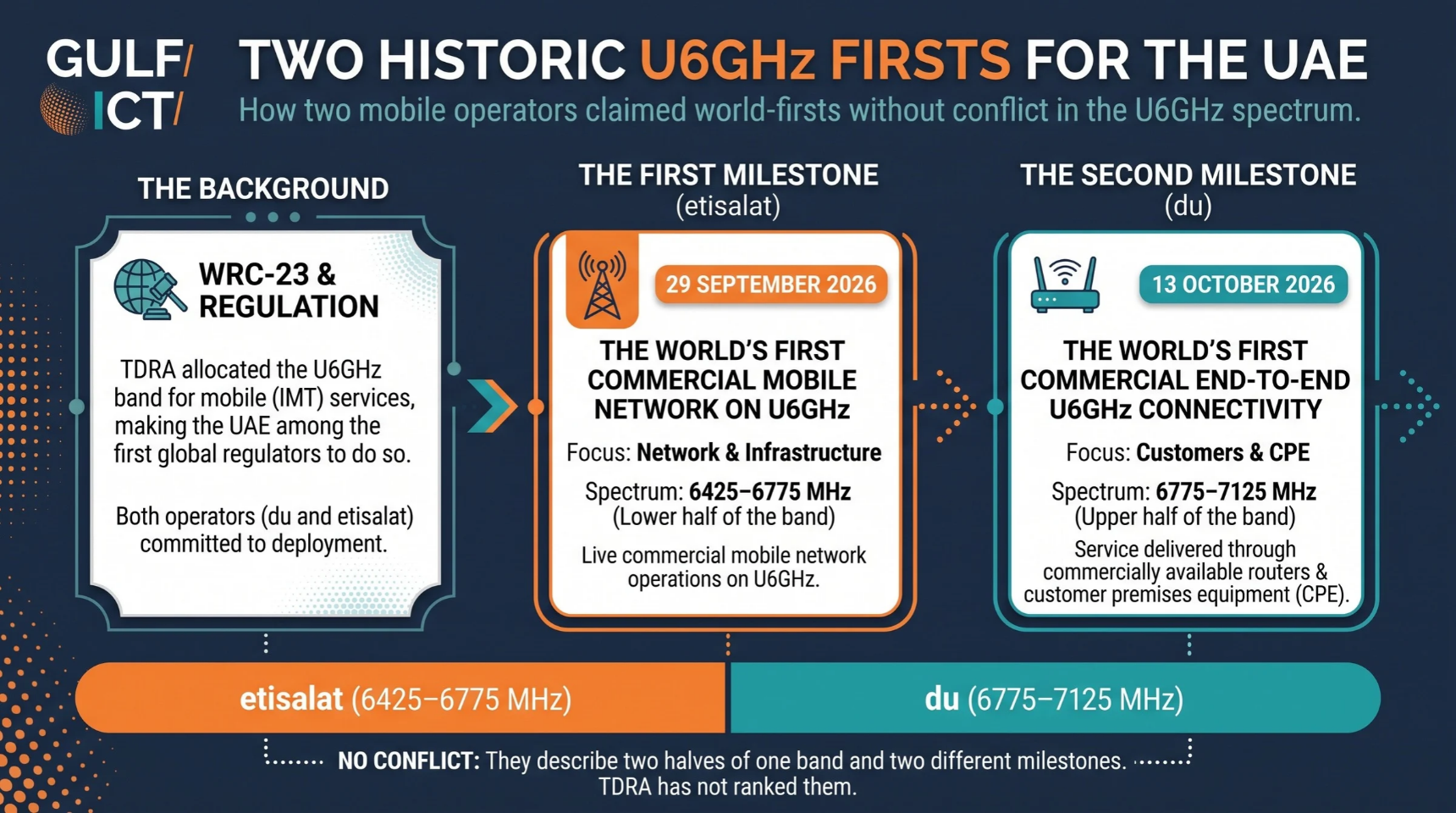
du and etisalat have each claimed a global first in the same slice of spectrum. Read side by side, the claims do not collide. They describe two halves of one band and two different milestones.
Within fourteen days, both of the UAE’s mobile operators have announced a world first in Upper 6GHz (U6GHz), the mid-band spectrum the industry increasingly treats as the bridge from 5G-Advanced to 6G. On 29 September, etisalat, then still trading as e& UAE, switched on what it called the world’s first commercial mobile network on U6GHz. On 13 October, du announced what it called the world’s first commercial end-to-end U6GHz connectivity to customers. Today, etisalat hosted a delegation from the Telecommunications and Digital Government Regulatory Authority (TDRA) at its site and described itself as the global first mover in the band.
That looks like a dispute. On closer reading, it is something more interesting for the Gulf: a country where both operators have put the band into commercial service within the same fortnight.
Is there a conflict between the two claims? Not directly. etisalat’s claim is about the network: a live commercial mobile network operating in 6425–6775 MHz. du’s claim is about the customer end: service delivered through commercially available routers and customer premises equipment (CPE) in 6775–7125 MHz. Each claim is the company’s own description. TDRA has not ranked them.
How we got here
The groundwork is regulatory. Following the World Radiocommunication Conference in 2023, TDRA allocated the U6GHz band for mobile (IMT) services in 2024, among the first regulators to do so. In April 2026, at the SAMENA Council Leaders’ Summit in Dubai, TDRA announced the launch of what it called the world’s first commercial U6GHz network and ecosystem, with commitments from both operators, vendors including Huawei and Nokia, the GSMA, and device makers HONOR and Tozed.
In June, e& UAE awarded a contract to deploy U6GHz with 256TRX Giga-MIMO antennas, targeting launch in the second half of the year. It went live on 29 September over the operator’s existing 5.5G network. One week later, on 6 October, the group returned to its original etisalat brand. du, which reported upper 6 GHz field trials on its live network in Abu Dhabi in August, followed with its customer-facing launch on 13 October.
Two halves of one band
The detail that resolves most of the apparent contradiction is in the frequencies. The U6GHz range identified for mobile runs from 6425 to 7125 MHz, a total of 700 MHz. According to the two operators’ announcements, etisalat is operating in the lower 350 MHz and du in the upper 350 MHz. They are not competing for the same spectrum. Between them, they have put the entire band into commercial service in one country.
Network first, or customer first?
The real difference lies in the qualifier each operator chose. etisalat’s announcement focused on the network: the new spectrum, the antenna technology, and peak capability. It did not list compatible devices, customer eligibility or plan changes. du’s announcement focused on the other end of the link: a complete service reaching routers that customers use at home and at work.
The line is thinner than the headlines suggest. etisalat’s own release also refers to its “end-to-end” commercial deployment experience. The question neither operator has answered publicly is the one that matters most to users: how many customers are actually connected over U6GHz today.
Why the router matters
U6GHz only reaches people through devices that support it, and those are still arriving. Huawei said at MWC Barcelona this year that it expects mainstream CPE and smartphones to be commercially available in 2026. The GSMA’s MWC Shanghai release cited Qualcomm as saying smartphones supporting 6–8 GHz will be available by 2028. TDRA has said it plans to add the band to national type-approval requirements.
Until supporting phones are widespread, fixed wireless access through home and business routers is the most practical way customers will meet the band. That is the market du’s announcement points to. The often-quoted peak speeds of up to 10 Gbps down and 1 Gbps up are design projections, not the average speeds users will see.
What it means for the Gulf
The race for the “first” label is the visible story. The structural one is regulatory sequencing: early allocation, a regulator-led ecosystem launch, and two operators deploying in parallel on adjacent halves of the band. TDRA’s spectrum chief has said the authority chose mobile over Wi-Fi for the band after studying what the market needed.
For other GCC regulators still weighing how to use the upper 6 GHz range, the UAE is now the live reference case. The next test is less about who switched on first and more about how quickly devices, pricing and coverage turn the band into everyday service.
So who was first? On the evidence so far, the most accurate answer is the UAE.