The Gulf's Arabic AI Race Has Quietly Changed Course
Four Gulf states now field Arabic-language AI. In 2026, the most important shift is not who has the biggest model, but how each one is being built.
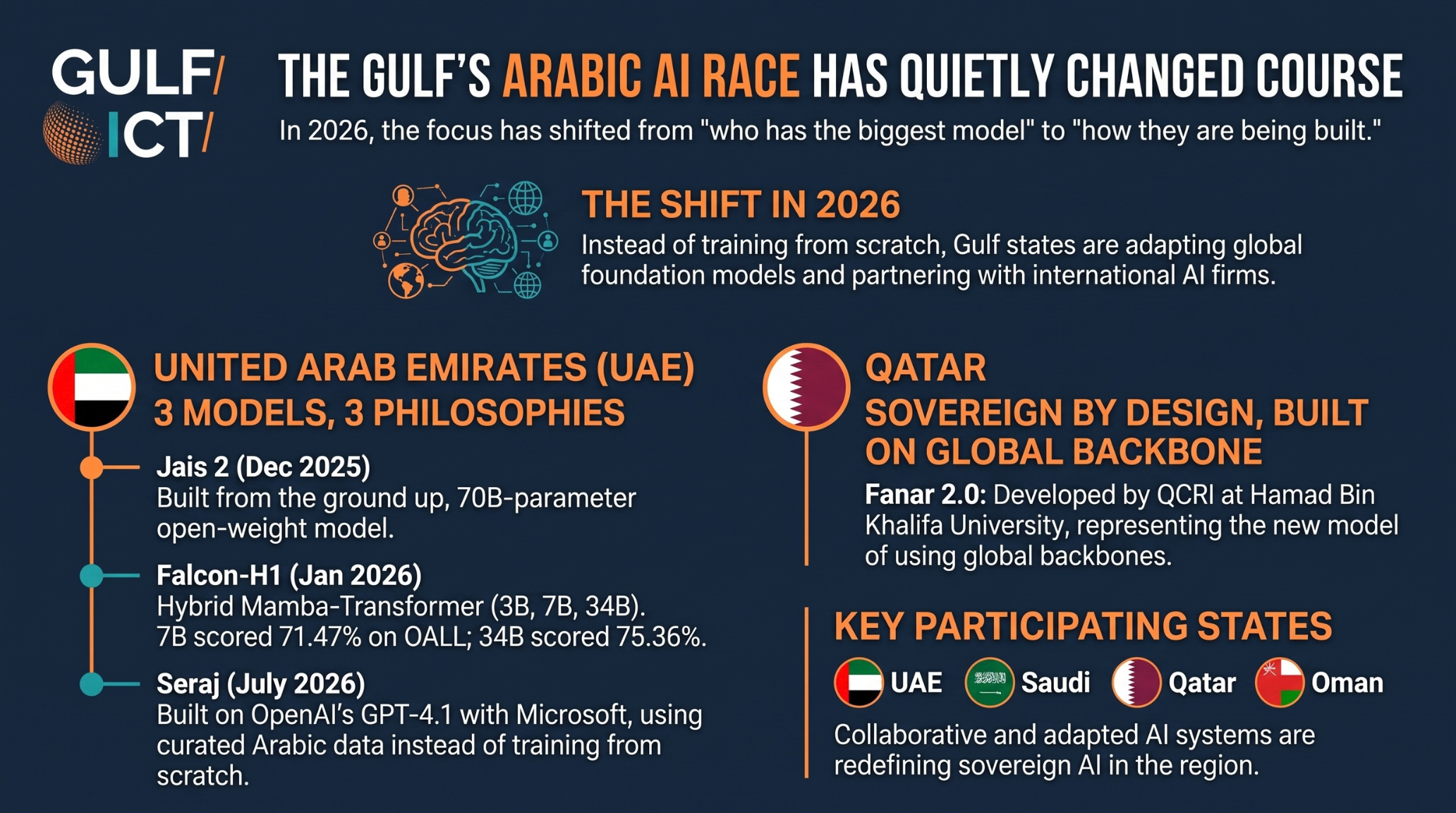
For three years, the Gulf's Arabic AI story was told as a race: whose model is largest, whose model tops the leaderboard, whose model is truly sovereign. In 2026 that story has changed shape. Across the UAE, Saudi Arabia, Qatar and Oman, the newest Arabic-language systems are increasingly built by adapting global foundation models, partnering with international AI firms, or both, rather than training every layer from scratch.
We reviewed every major Gulf Arabic model release and partnership announced between December 2025 and September 2026. The pattern is consistent, and it changes what "sovereign AI" means for the region.
The UAE: three models, three philosophies
The UAE now runs the widest Arabic AI portfolio in the region, and its three flagship efforts point in three different directions.
In December 2025, Inception (a G42 company), Cerebras and MBZUAI released Jais 2, a 70-billion-parameter open-weight Arabic model that its developers describe as built from the ground up on what they call the richest Arabic-first dataset assembled to date.
In January 2026, Abu Dhabi's Technology Innovation Institute (TII) launched Falcon-H1 Arabic on its own hybrid Mamba-Transformer architecture, available in 3B, 7B and 34B sizes. According to TII, the 7B version scored 71.47% on the Open Arabic LLM Leaderboard (OALL), ahead of Qatar's Fanar-1-9B and Saudi Arabia's ALLaM 7B, while the 34B version scored 75.36%.
Then, in July 2026, the same G42 group that built Jais from scratch took the opposite route. Its renamed unit, Inception42, launched Seraj with Microsoft: an enterprise Arabic model built on OpenAI's GPT-4.1 and strengthened through targeted mid-training on curated Arabic data, rather than a new Arabic-first model. Seraj is offered through Core42's Compass sovereign AI platform for government and enterprise users.
Qatar: sovereign by design, built on a global backbone
Qatar's Fanar 2.0, developed by the Qatar Computing Research Institute (QCRI) at Hamad Bin Khalifa University, is the clearest example of the new model. Its technical paper, published in March 2026, states that every component was designed and operated at QCRI, and frames sovereignty as a first-class design principle.
Yet the core 27-billion-parameter model was continually pre-trained from Google's Gemma-3-27B backbone, using 120 billion curated tokens and 256 NVIDIA H100 GPUs. QCRI reports that despite using eight times fewer pre-training tokens than Fanar 1.0, the new version gained 9.1 points in Arabic knowledge and 7.3 points in language benchmarks.
QCRI has also said work on Fanar 3.0 is under way for release in December 2026, and researchers expect that version to move away from an external backbone towards a Mixture-of-Experts architecture trained from scratch. That makes Qatar the one Gulf programme publicly signalling a move in the opposite direction, and its December release is the next milestone to watch.
Saudi Arabia: from national model to global distribution
Saudi Arabia's ALLaM family, now carried commercially by the PIF-owned company HUMAIN, reached the public in August 2025 through the HUMAIN Chat app, powered by ALLaM 34B.
In late August 2026, HUMAIN moved the model onto a global platform. Under a new collaboration with Microsoft, ALLaM is to be made available through Microsoft Foundry, with Microsoft engineers working alongside HUMAIN specialists on enterprise deployments. The same week, HUMAIN and France's Mistral announced a strategic collaboration spanning infrastructure, model development and deployment for regulated industries, which the companies value in the hundreds of millions of euros.
The Saudi approach treats sovereignty less as a question of who wrote every line of the model and more as a question of where the data, compute and operations sit.
Oman: the newest national model
Oman has entered the field with Maeen, which officials describe as the country's first national large language model for generative AI. A pilot version was launched in the first phase of the National AI and Advanced Digital Technologies Programme, built on more than 3,000 local datasets with the participation of 60 government institutions.
Maeen is designed to strengthen Omani content in the age of generative AI and to support government institutions, a narrower and more practical mandate than the region-wide ambitions of the larger programmes.
What independent benchmarks say
Most headline rankings for Gulf Arabic models come from the developers themselves. Independent evaluations tell a more cautious story.
Stanford's Center for Research on Foundation Models published HELM Arabic in December 2025, testing models across seven Arabic benchmarks. It found that open-weight models trained or fine-tuned specifically for Arabic, a group that included ALLaM and Jais, underperformed both closed and open multilingual models. Stanford noted an important caveat: the Arabic-specific models it tested were older than the multilingual leaders, so the gap may partly reflect model age.
A study using the Balsam benchmark from Saudi Arabia's King Salman Global Academy for the Arabic Language, published in January 2026, reached a similar conclusion: global models outperformed Arabic models in most language-skill categories, while Arabic models slightly led in summarisation and matched global models in creative writing and reading comprehension. The same study found Saudi Arabia led the list of countries developing Arabic language models in 2025.
Why the strategy is shifting
The underlying constraint is data. Arabic is spoken natively by more than 400 million people, but QCRI estimates it accounts for only around 0.5% of web data. Building a competitive model entirely from Arabic text is therefore far harder than building one for English.
Adapting a strong global base model and concentrating national investment on curated Arabic data, cultural alignment, safety and local hosting offers a faster route to usable performance. Seraj, Fanar 2.0 and the HUMAIN partnerships all follow versions of that logic. Falcon-H1 Arabic and Jais 2 show that fully national architectures remain part of the mix.
Kuwait and Bahrain: the open question
Four of the six GCC states now have a named Arabic AI model or a national programme with a model at its core. In our review of public announcements, we did not identify a comparable national Arabic large language model programme in Kuwait or Bahrain. Both countries are active in AI adoption, but neither has yet put a flagship model in the regional race.
Whether they build, adapt or partner will say a great deal about which approach the Gulf ultimately settles on.
Our reading
The Gulf's Arabic AI race has not slowed. It has matured. The question is moving from "who built the biggest Arabic model" to "who controls the data, the deployment and the compute behind the Arabic AI that governments and businesses actually use".
For the region's 400 million-plus Arabic speakers, that may prove the more important contest. The next test arrives in December 2026, when Qatar expects to release Fanar 3.0.
Frequently asked questions
Which Gulf countries have their own Arabic AI models?
As of October 2026, the UAE (Falcon-H1 Arabic, Jais 2 and Seraj), Saudi Arabia (ALLaM, via HUMAIN), Qatar (Fanar 2.0) and Oman (Maeen, in pilot) have named Arabic language models. We did not identify a comparable national model programme in Kuwait or Bahrain.
What is the best Arabic AI model?
It depends on the benchmark. TII reports that Falcon-H1 Arabic leads the Open Arabic LLM Leaderboard across model sizes, while independent evaluations such as Stanford's HELM Arabic found that large multilingual models often outperform older Arabic-specific models.
Is Qatar's Fanar 2.0 built from scratch?
No. According to QCRI's March 2026 technical paper, the core Fanar-27B model was continually pre-trained from Google's Gemma-3-27B backbone, with all development operated at QCRI. Fanar 3.0, expected in December 2026, is planned to be trained from scratch.
What is Seraj?
Seraj is an enterprise Arabic AI model launched in July 2026 by Inception42, part of the UAE's G42 group, with Microsoft. It is built on OpenAI's GPT-4.1 and enhanced with targeted Arabic mid-training.