AT&T and T-Mobile Leadership Reject Elon Musk’s Starlink Mobile Disruption Plans as Unviable Against Terrestrial Fiber
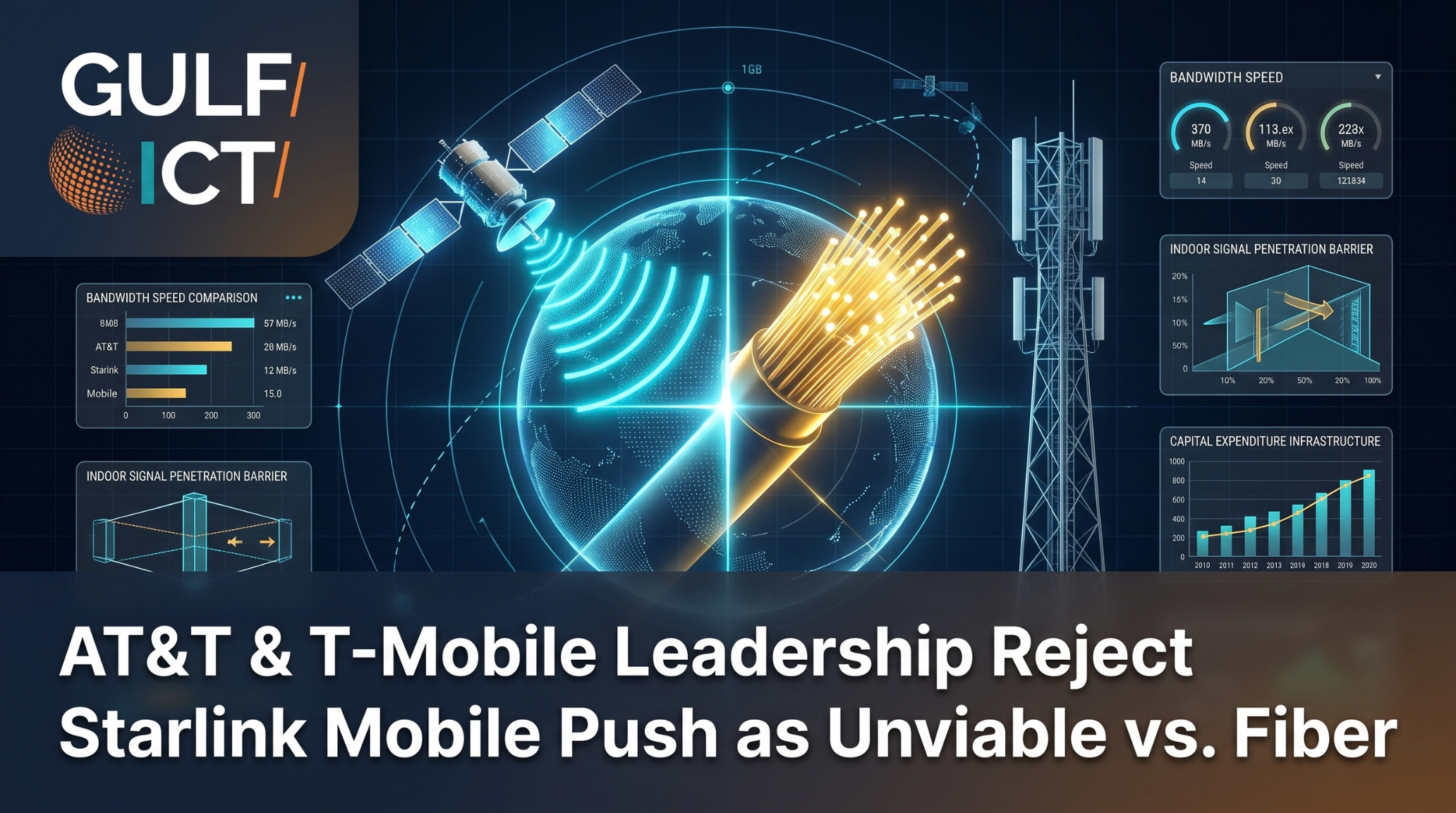
DALLAS — Telecommunications leaders at AT&T and T-Mobile have united in publicly dismissing Elon Musk’s strategy to transform SpaceX’s Starlink satellite constellation into a disruptive fourth major national mobile and broadband carrier, labeling the proposal technically unworkable and economically unviable.
The pushback follows remarks by T-Mobile leadership dismissing Starlink’s mobile market ambitions outright, stating that the proposal to challenge established cellular networks lacks the economic scale and physical capability to compete directly, arguing it should be laughed out of the room. From a physics and radio propagation standpoint, satellite signals struggle to penetrate buildings, dense architectural materials, and automotive windshields, creating fundamental service limitations for urban and indoor mobile subscribers compared to terrestrial cell grids.
Speaking to media, AT&T Chief Executive Officer John Stankey firmly endorsed the critique, asserting that SpaceX’s mobile ambitions do not represent a viable competitive strategy against high capacity fixed infrastructure. Stankey underscored that even if low Earth orbit satellite platforms achieve theoretical peak performance over the next decade, orbital links cannot match the bandwidth density, low latency, and reliability delivered by fiber optic backbones. Reinforcing its terrestrial bet, AT&T recently finalized a $3 billion infrastructure procurement agreement with Corning to aggressively expand its domestic fiber footprint.
The controversy emerged after SpaceX leadership highlighted connectivity operations as the company’s primary commercial engine, accounting for over 55 percent of total company sales across 12 million subscribers and more than 10,200 satellites in orbit. To bypass the estimated $100 billion capital cost required to construct a competitive terrestrial tower footprint, SpaceX proposed installing micro cellular base stations alongside residential and enterprise Starlink customer dishes to offload localized traffic.
Stankey challenged that hybrid architecture, arguing that placing uncontrolled transmitting base stations on private customer property introduces prohibitive regulatory, legal, and operational hurdles that undermine the economic thesis. The united stance signals an escalating competitive battleground between legacy telecommunications carriers doubling down on fiber and satellite operators seeking to enter consumer mobile markets.