TOKYO — The Japan Aerospace Exploration Agency (JAXA) has launched its landmark Martian Moons eXploration (MMX) spacecraft aboard an H3 launch vehicle from the Tanegashima Space Center in Kagoshima Prefecture, commencing an interplanetary voyage to explore the two moons of Mars and execute humanity’s first physical sample return from the Martian system.
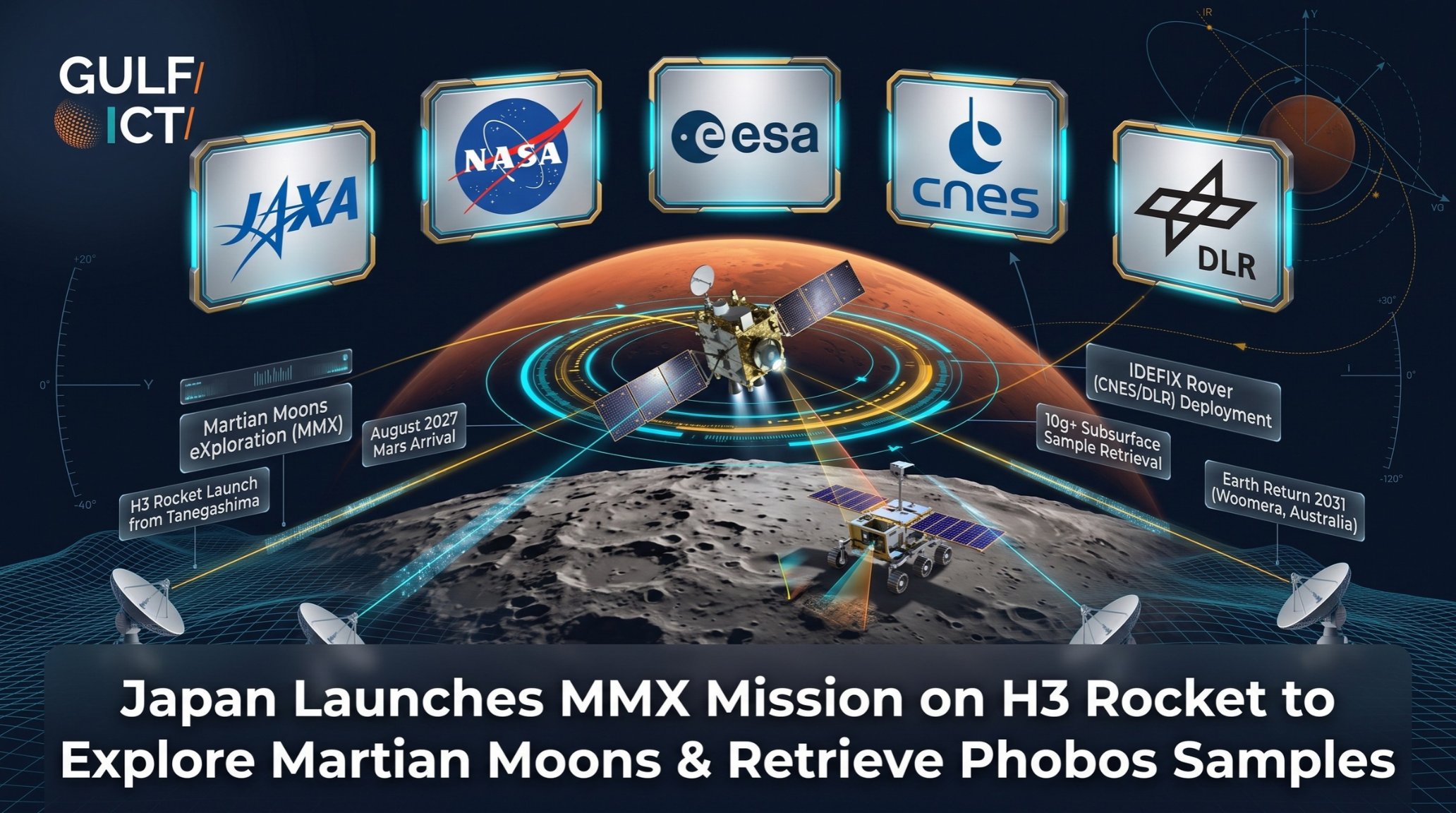
Weighing approximately 4.2 metric tons and developed at an estimated cost of 55.3 billion yen ($350 million), MMX represents one of Japan’s largest and most ambitious deep space probes. The mission marks the first time that Japan’s flagship H3 rocket has been deployed to deliver a scientific payload into an interplanetary transfer trajectory toward Mars.
The five year expedition brings together a coalition of five leading space agencies, uniting JAXA with the National Aeronautics and Space Administration (NASA), the European Space Agency (ESA), France’s National Centre for Space Studies (CNES), and the German Aerospace Center (DLR). Following a ten month cruise, the probe is projected to enter the Martian gravitational system in August 2027, establishing a quasi satellite orbit around Phobos, the larger and closer of Mars’ two irregular moons, while conducting close remote flyby surveys of its outer companion, Deimos.
Central to the surface exploration phase is the deployment of IDEFIX, a compact four wheeled robotic rover developed jointly by CNES and DLR. The rover will touch down on Phobos to assess surface regolith mechanics and local terrain conditions ahead of the main spacecraft’s landing attempts. Utilizing specialized coring mechanisms and pneumatic collection canisters developed in collaboration with NASA and industrial partners, the mothercraft will perform two controlled touchdowns to extract at least 10 grams of regolith from depths of at least two centimeters beneath the surface.
The scientific payload includes NASA’s MEGANE gamma ray and neutron spectrometer alongside European and Japanese spectral imagers, designed to resolve an enduring planetary debate: whether Phobos and Deimos are captured carbonaceous asteroids or rocky fragments ejected from Mars during an ancient giant planetary collision.
Following three years of orbital reconnaissance and surface sampling, the return module will fire its propulsion systems in late 2030 to depart the Martian system. The hermetically sealed sample canister is scheduled to enter Earth’s atmosphere in 2031, with recovery operations targeted in the Woomera Prohibited Area of South Australia, securing pristine extraterrestrial material that could decipher the evolutionary history of the inner solar system and inform future crewed missions to the Red Planet.