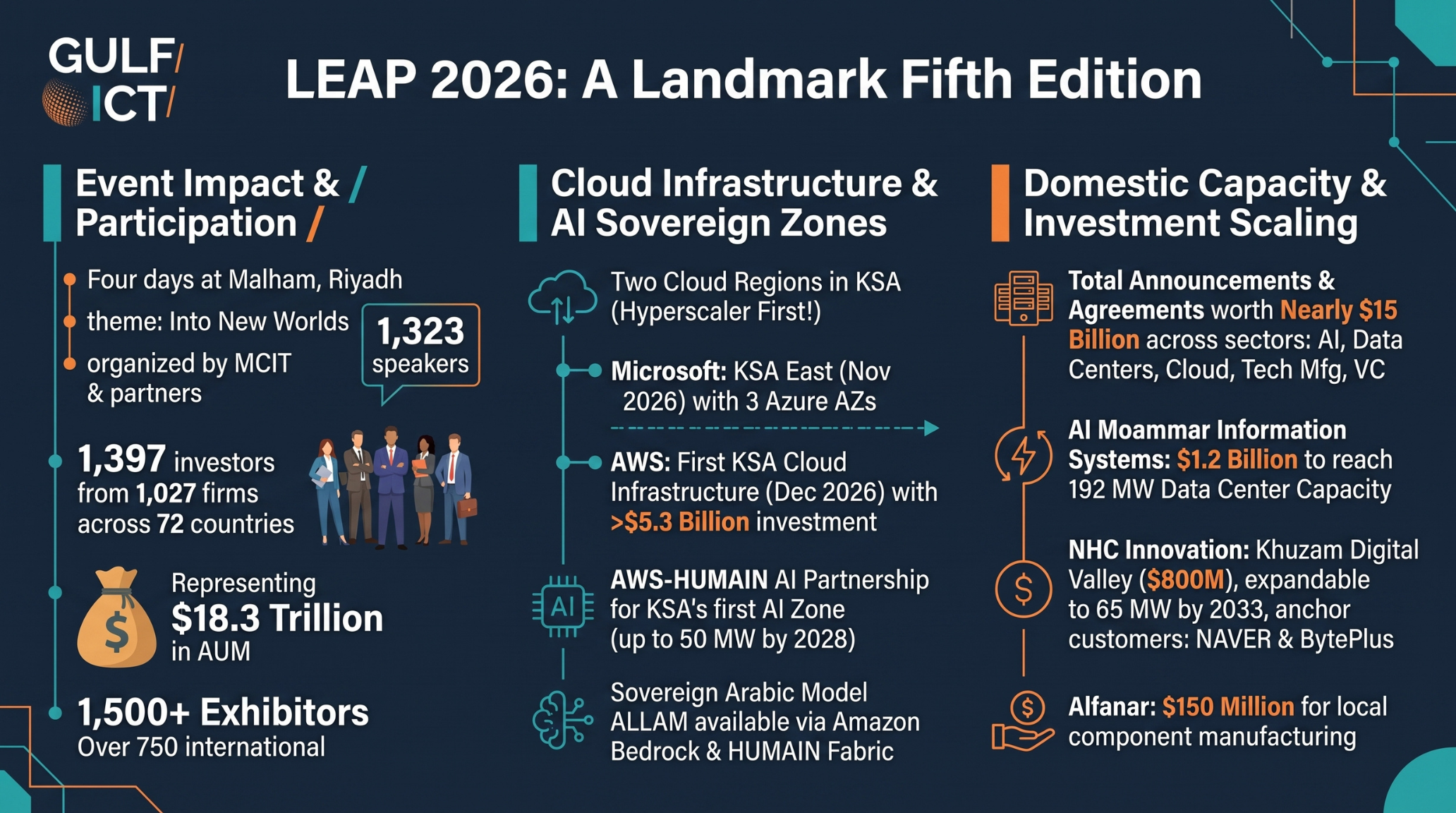
LEAP 2026 concluded its fifth edition on Thursday after four days at the Riyadh Exhibition and Convention Centre in Malham, capping a week that brought announcements, investments and agreements worth nearly $15 billion across AI infrastructure, data centres, cloud computing, technology manufacturing and venture capital.
Organised by the Ministry of Communications and Information Technology, the Saudi Federation for Cybersecurity, Programming and Drones, Tahaluf and the Events Investment Fund under the theme "Into New Worlds," the edition drew 1,323 speakers and 1,397 investors from 1,027 firms across 72 countries, together representing $18.3 trillion in assets under management. More than 1,500 exhibitors took part, including over 750 international companies, with 1,294 companies participating across the exhibition and startup programme.
Two cloud regions, one calendar
The week's infrastructure announcements gave Saudi Arabia something no other market in the region currently has: two hyperscaler cloud regions arriving within five weeks of each other.
Microsoft confirmed that its Saudi Arabia East region, located in the Eastern Province with three Azure availability zones, becomes available to customers in November 2026, enabling local data hosting and low-latency access to cloud and AI services. AWS confirmed that its first Saudi cloud infrastructure region launches in December 2026, backed by a planned investment exceeding $5.3 billion.
AWS also expanded its partnership with HUMAIN to deliver up to 50 megawatts within the Kingdom's first AI zone by 2028, alongside making the ALLAM Arabic-language model available through Amazon Bedrock and HUMAIN Fabric through AWS Marketplace. Together these give developers across the region direct access to a sovereign Arabic model through the same channels they already use to build everything else.
Domestic capacity scales up
Saudi companies matched the international commitments with their own.
Al Moammar Information Systems announced a $1.2 billion investment to expand its data centres to a total capacity of 192 megawatts. NHC Innovation unveiled Khuzam Digital Valley, an $800 million multi-phase project with capacity expandable to 65 megawatts by 2033, welcoming NAVER Innovation and BytePlus as its first two anchor customers.
Alfanar committed $150 million to manufacture data centre components inside the Kingdom, deepening local content in advanced technology industries and building domestic supply for the equipment the sector will need through the decade.
Adobe's expanded partnership with MCIT and HUMAIN, valued at more than $4 billion, will give over 27 million eligible citizens and residents aged 13 and above twelve months of free access to Adobe Firefly Standard and Adobe Express Premium by the end of 2026, alongside a new image generation model built on Firefly Foundry and tuned to Saudi culture for Arabic-language prompts.
Capital finds its channels
Venture activity ran throughout the week, with roughly $293 million announced across 11 deals covering AI, fintech, travel, gaming, human resources and digital automotive services.
Ula Capital launched a $100 million fund in partnership with South Korea's FuturePlay, opening a dedicated channel for deep-tech investment between Saudi Arabia and Korea. Impact46 and HALA expanded their SME financing vehicle from $26.7 million to $66.7 million, a 150% increase in under two years.
Rocket Fuel crowns a global field
The final day belonged to founders. The Rocket Fuel Finale in Hall 1 distributed $1 million across seven equity-free prizes, with ten finalists reaching the main stage from a semi-final cohort of 100 startups representing more than 25 countries and over 40 nationalities. Women accounted for 23% of participating founders, and the companies spanned AI, cybersecurity, biotechnology, healthcare, manufacturing, water security and sustainability.
The $250,000 LEAP Award went to Waspito, a Cameroon-headquartered AI healthcare company using teleconsultations and digital systems to connect healthcare consumers, providers and payers across Africa. Among the other winners, Imagine Devices took the $150,000 Shooting Star Award, Ferveret the $150,000 Scaling Star Award, SarsatX the $150,000 Into New Worlds Award, and Melt Water the $150,000 Tech for Humanity Award.
A Cameroonian company taking the top prize in Riyadh says something encouraging about where LEAP now sits: a Saudi platform judging and funding global founders on their merits.
Building the talent to run it
MCIT and the Saudi Digital Academy launched a Gemini initiative with Google providing one million Saudi university students with access to advanced AI tools. A separate AI academy developed with WeCloudData will train educators, university faculty, startup founders and tens of thousands of online learners, ensuring the workforce grows alongside the infrastructure.
LEAP 2027
Organisers closed the week by confirming that the sixth edition will run from 12 to 15 April 2027, returning LEAP to its spring window. Planning is already advanced, with 653 applications received for the 2027 startup programme.
Annabelle Mander, Executive Vice President at Tahaluf and Co-Creator of LEAP, said the scale of the fifth edition reflected how far the platform has come, and that what matters most is what that scale enables: a genuinely global community of founders, investors and technology leaders gathering in Riyadh.
Gulf ICT's takeaway
Saudi Arabia arrived at LEAP 2026 as a market that buys compute. It leaves as one that hosts it, distributes it and manufactures for it.
The evidence is in the detail rather than the headline. Two hyperscaler regions with confirmed dates. A sovereign Arabic model shipping through Amazon's marketplace to enterprise buyers across the region. Alfanar building the components. Korean and Chinese platform companies committing to Saudi capacity before it is built. A Korean venture fund and a Cameroonian prizewinner in the same week.
That is a market becoming a hub, and a hub creates room rather than taking it. Compute built and distributed from Riyadh serves Doha, Manama, Muscat, Kuwait City and Abu Dhabi as readily as it serves Saudi enterprises. The strongest reading of this week is that the Gulf's digital economy just gained capacity it collectively did not have, on a schedule that starts in November.