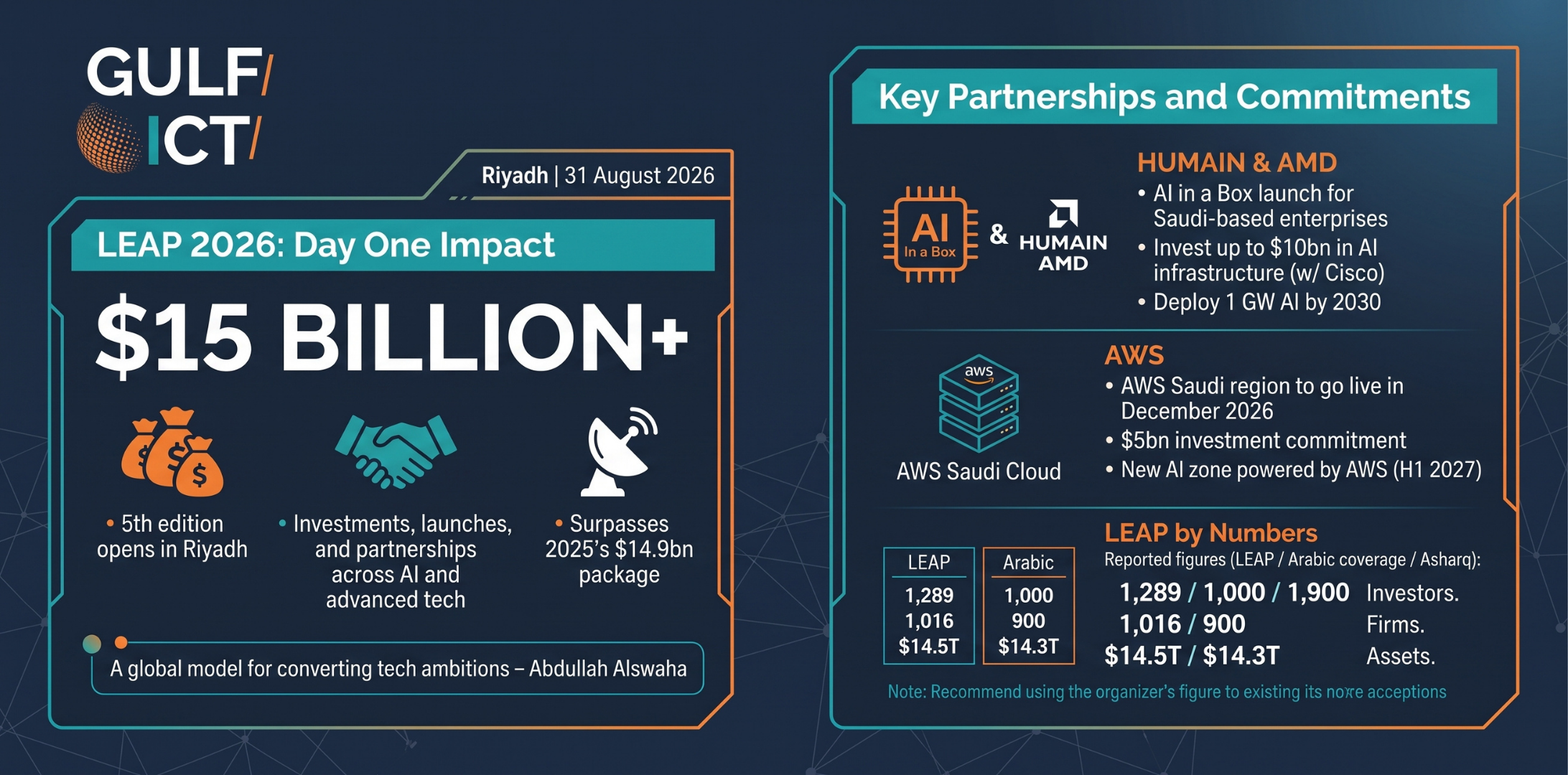
The fifth edition of LEAP opened yesterday at the Riyadh Exhibition and Convention Centre in Malham under the theme "Into New Worlds," accompanied by launches, investments and partnerships valued at more than $15 billion across artificial intelligence and advanced technologies. The figure surpasses the 2025 edition, which produced an announcement package worth roughly $14.9 billion.
Minister of Communications and Information Technology Abdullah Alswaha said in his opening address that the launches and investments were made possible through the support and empowerment of Crown Prince and Prime Minister Mohammed bin Salman, adding that the Kingdom has built a global model for converting technology ambitions and commitments into delivered outcomes.
Editorial note on the numbers: sources conflict on investor attendance. LEAP itself reported 1,289 investors from 1,016 firms holding $14.5 trillion in assets under management. Arabic-language coverage cited more than 1,000 investors from over 900 firms with $14.3 trillion, while Asharq Al-Awsat reported 1,900 investors. We recommend using the organiser's figure and noting the discrepancy.
HUMAIN Dominates the Opening Day
The weight of the day's announcements came from HUMAIN, the PIF-owned AI company. Chief Executive Tareq Amin framed the sequence as building intelligence inside Saudi Arabia across the full stack: data centres and infrastructure, compute, advanced AI chips, models and the model library, HUMAIN Voice, ALLAM, and developer access to all of it.
The AMD partnership. HUMAIN and AMD launched AI in a Box, aimed at widening AI access for Saudi-based enterprises by giving organisations at the start of their AI journey access to advanced compute without hyperscale infrastructure. Amin said the launch builds on a strategic collaboration between AMD and HUMAIN to invest up to $10 billion in AI infrastructure initiatives, and that a joint venture with AMD, HUMAIN and Cisco plans to deploy up to 1 GW of AI infrastructure in the Kingdom by 2030.
Amazon Web Services. Tanuja Randery, AWS president for EMEA, confirmed that the AWS Saudi region will go live in December 2026, following a commitment made on the same stage two years ago to invest more than $5 billion in the region. She said the region will provide resilience, data residency and low-latency capability, and will connect Saudi Arabia into the AWS global footprint of 40 regions. Randery added that HUMAIN and AWS plan to establish an AI zone in the Kingdom powered by AWS in the first half of 2027, and that AWS has trained 682,000 people free of charge across the region against a target of two million by 2030. She also stated that 45 percent of the Saudi population already uses AI.
HUMAIN Voice. A platform allowing users to prompt and converse with AI in their own language and dialect. A live stage demonstration showed the system receiving input in a local dialect and responding in the user's preferred regional dialect. The platform went live on day one as an API for developers in Saudi Arabia to test and validate.
HUMAIN Crew. Khalid Al-Shammari, at 20 the company's youngest AI engineer, presented Crew on stage as a virtual co-worker supporting finance, HR and customer support teams. Amin said HUMAIN recruited him while he was building his startup in Silicon Valley.
Applied Intuition. Among the closing announcements of the day, HUMAIN and Applied Intuition, a $15 billion company building autonomous cars, trucks, mining and agricultural equipment and drones, announced a joint venture. Co-founder and CEO Qasar Younis said the companies are opening a Riyadh office to build driverless trucks and deploy thousands of them on Saudi roads by 2030.
Further partnerships announced the same day. Microsoft and HUMAIN expanded their collaboration, offering HUMAIN ONE with Microsoft 365 and Copilot as an AI productivity bundle hosted on Azure, initially targeting one million users across the Middle East and Africa. This builds on the first phase announced on 26 August, which covered making ALLAM models available through Microsoft Foundry. HUMAIN also announced a partnership with MinIO to build an AI data fabric, an engineering collaboration with KORA Systems on HUMAIN OS, an AI-native enterprise Linux operating system shown in early form at the venue and slated for commercial availability in 2027, and the selection of Compal as its long-term strategic ODM partner for cloud-to-edge expansion.
Adobe: Free Creative Tools Under a $4 Billion Commitment
Adobe announced an expanded partnership with the Ministry of Communications and Information Technology and HUMAIN to give more than 27 million eligible citizens and residents in Saudi Arabia a one-year free subscription to Adobe Firefly Standard and Adobe Express Premium features. Reuters valued Adobe's commitment under the agreement at more than $4 billion. The initiative includes a new image generation model aligned to Saudi culture, co-developed by Adobe and HUMAIN on the Firefly Foundry platform, which will let users generate culturally consistent images from Arabic-language prompts. The partnership also covers integrating HUMAIN's ALLAM model into Adobe's creative tools. Adobe said free access will roll out gradually by the end of 2026.
Infrastructure: Cables, Power and Land
The least glamorous layer of day one was the most consequential from an infrastructure standpoint. Saudi Arabia announced plans to install more than 20 subsea internet cables by 2030, intended to deliver connections with latency below 30 milliseconds to more than three billion people worldwide. The Kingdom has allocated 80 square kilometres of land for large-scale AI data centres, alongside more than 12 GW of designated power capacity.
stc group, through center3, is developing AI-ready data centre capacity starting at 250 MW while expanding subsea, terrestrial and satellite connectivity to link Saudi AI infrastructure to international markets. For context, SPA reported in April that operational data centre capacity in the Kingdom grew from 68 MW in 2021 to more than 440 MW in 2025, with over 60 data centres developed by more than 20 companies and investment exceeding SAR 16 billion.
Figures presented at the conference put growth in the Saudi digital economy at 70 percent, making it the fifth-largest technology market globally after the United States and European Union member states. The sector employs roughly 411,000 people, with women accounting for between 35 and 36 percent of the workforce.
The Government Track
The Digital Saudi Exhibition opened alongside the conference with more than 40 government entities showcasing digital products, platforms and AI initiatives. The Ministry of Human Resources and Social Development is participating with a package of new digital products and solutions and a set of memoranda of understanding to develop digital services.
On the fringes, 100 finalists are competing in the Rocket Fuel competition for $1 million in equity-free prizes following more than 3,000 applications, while LEAP Nights runs from 30 August to 4 September with 60 events across more than 15 venues in Riyadh.
Our Read: What This Means for the Gulf
Day one marked a change in the character of the announcements, not just their scale. The 2025 package was largely capital commitment. The 2026 package includes products that are immediately consumable: a voice API live the same day, a cloud region with a fixed launch date, an operating system shown running. That narrows the distance between announcement and operation.
The point that matters most to the rest of the GCC is the connectivity layer. Twenty subsea cables by 2030 and a sub-30-millisecond promise to three billion users is not a domestic Saudi project. It is an attempt to make the Kingdom a regional transit point for compute. The UAE and Qatar are building comparable data centre capacity, and the open regulatory question facing Gulf authorities is where data routes and where it is processed, not how much capacity exists.