Where the opening day belonged to sovereign AI and hyperscaler capital, the second day of LEAP 2026 belonged to the layer underneath it. Saudi Arabia's three mobile operators moved on radio access, network autonomy and data centre capacity, while the Digital Cooperation Organization used the exhibition floor for its most significant membership announcement of the year.
Ericsson takes both major RAN deals
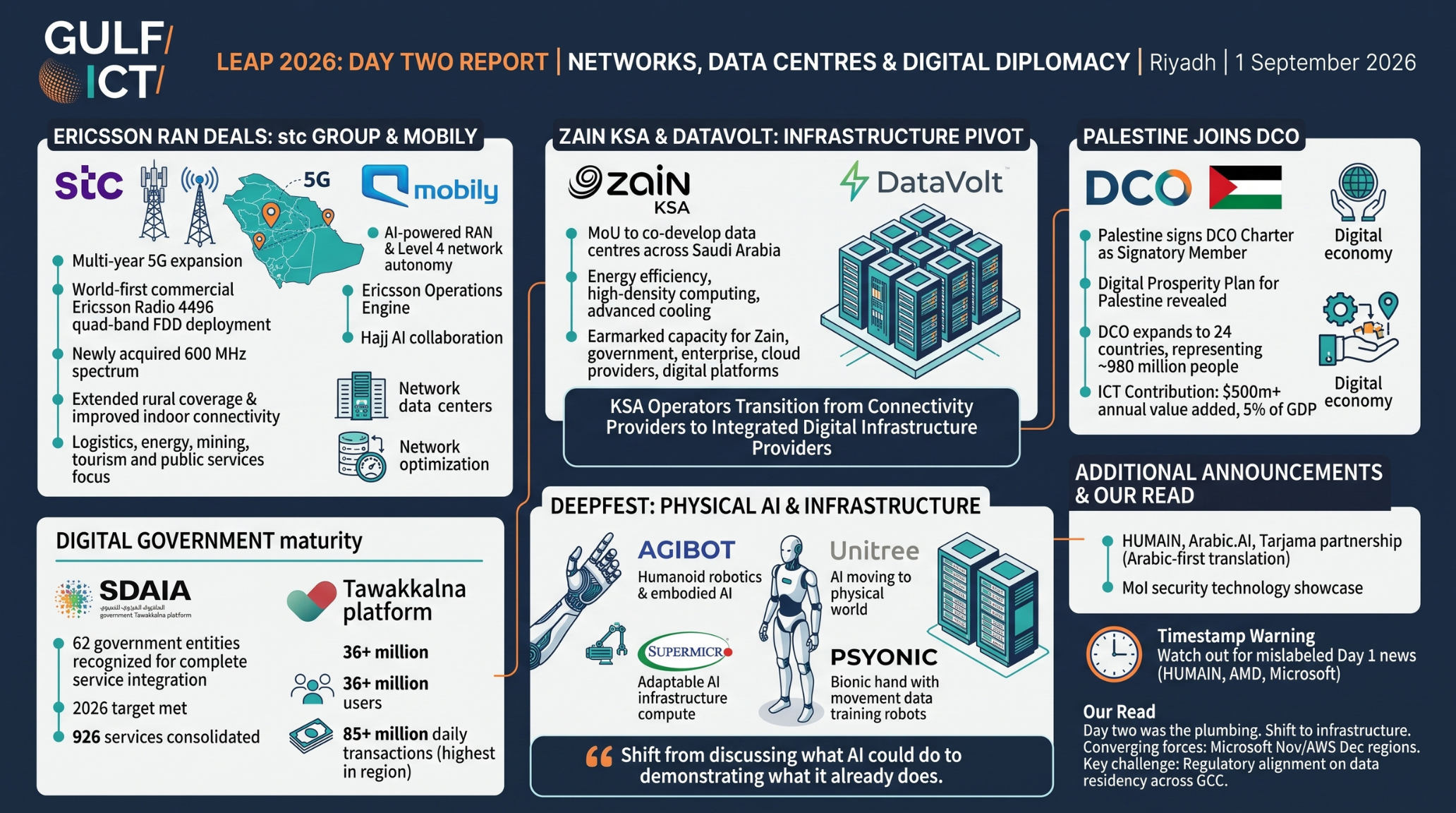
stc group signed a multi-year agreement with Ericsson to expand its 5G network across the Kingdom. The scope covers new network sites, added capacity at existing sites, expansion of stc's 5G Standalone network, and preparation for differentiated connectivity services.
The technically notable part is the world-first commercial deployment of the Ericsson Radio 4496, a quad-band FDD radio that aggregates four low-frequency bands into a single 400-watt unit, including stc's newly acquired 600 MHz spectrum. Combined with mid-band deployments, the low-band allocation is intended to extend coverage into rural and remote areas and improve indoor connectivity while reducing power draw. stc will also deploy Ericsson massive MIMO and mid-band radios, baseband and associated RAN software. Deployment of new sites begins in 2026.
Sultan S. Alturki, technology procurement general manager at stc group, framed the expansion around logistics, energy, mining, tourism and public services, and around strengthening fixed wireless access as a broadband alternative outside fibre coverage.
Editorial note: this is distinct from the five-year Master Frame Agreement stc and Ericsson signed in December 2025. Several outlets are conflating the two. The December deal was a portfolio-wide framework; this is a 5G expansion contract under it. Do not describe it as new.
Ericsson also signed two memoranda of understanding with Mobily, covering AI-powered RAN and Mobily's push toward Level 4 network autonomy using the Ericsson Operations Engine. Mobily will join the EIAP ecosystem, which Ericsson describes as carrying more than 100 rApps from over 100 members. The work builds on AI-driven collaboration between the two during Hajj.
Taking the flagship expansion at stc and the autonomy roadmap at Mobily in the same week gives Ericsson an unusually strong position across two of the Kingdom's three operators.
Zain KSA moves into data centres
Zain KSA signed a non-binding MoU with DataVolt to co-develop data centre facilities across Saudi Arabia. The stated design priorities are energy efficiency, high-density computing, advanced cooling and high-capacity connectivity, with capacity earmarked both for Zain's own future requirements and for government entities, enterprises, cloud providers and digital platforms.
Zain KSA chief executive Saad bin Abdulrahman AlSadhan described data centres as a strategic step in the operator's expansion into integrated digital infrastructure. DataVolt chief executive Rajit Nanda framed it around combining complementary capabilities at scale.
Read alongside stc's center3 and Mobily's own data centre ambitions, all three Saudi operators are now positioning as infrastructure providers rather than connectivity providers. That is the structural shift worth tracking, and it is happening across the GCC simultaneously.
Palestine joins the DCO
The Digital Cooperation Organization announced that the State of Palestine has signed the DCO Charter as a Signatory Member. Palestinian Minister of Telecommunications and Digital Economy Abdel-Razzak Natsheh handed the signed charter to DCO Secretary-General Deemah AlYahya on the sidelines of the conference, alongside the reveal of a Digital Prosperity Plan for Palestine.
The accession follows DCO council approval of eight new countries for full membership. Once procedures complete, membership expands from 16 to 24 countries representing roughly 980 million people. Palestine's ICT sector comprises around 400 active establishments employing more than 13,500 specialists, generating over $500m in annual value added and contributing around 5% of GDP.
For a Riyadh-headquartered multilateral body, using LEAP as the venue for this is deliberate. The DCO is the clearest instrument of Saudi digital diplomacy, and its expansion trajectory is a story that runs well past this week.
Digital government hits its integration target
Tawakkalna, the national unified application supported by SDAIA, recognised 62 government entities for completing service integration, meeting the 2026 integration target in full. A total of 926 services were consolidated under a single interface. The platform now serves more than 36 million users, processes over 85 million transactions per day, and provides access to more than 1,700 government services.
Those daily transaction numbers are worth holding onto. They are among the highest for any unified government platform in the region and give a concrete answer to what "digital government maturity" means in practice.
DeepFest: robots, prosthetics and the embodied AI argument
The co-located DeepFest programme shifted toward physical AI. China's AGIBOT showed humanoid robotics, with Abel Deng, its head of Middle East and Asia-Pacific operations, describing embodied AI as the next interface revolution after keyboards and smartphones. Unitree vice president Zhang Min framed the industry as moving from AI on screens to AI in the physical world, calling Saudi Arabia one of the most promising markets for the next generation of intelligent robots.
US-based Supermicro presented AI infrastructure computing, with regional director Mohamed Zuhri arguing that organisations moving from experimentation to scale need more adaptable compute environments. PSYONIC demonstrated a bionic hand that adapts to its user's movements; chief executive Dr Aadeel Akhtar noted that movement data collected from users can also train robots to perform the same tasks.
Annabelle Mander of Tahaluf characterised the day as a shift from discussing what AI could do to demonstrating what it already does. Note: entARABI rendered her title as "Deputy CEO of Tahalyf," while LEAP's own material and earlier releases describe her as Executive Vice President at Tahaluf and co-creator of LEAP. Use the latter and verify against a Tahaluf release before quoting the title.
Also on day two
HUMAIN announced a strategic investment in and partnership with Arabic.AI and Tarjama, focused initially on an Arabic-first translation management system, archive digitisation, and document intelligence agents for contracts, tenders, filings and compliance. The Saudi Ministry of Interior ran a security technology showcase across the exhibition floor.
A timestamp warning
Several items circulating today as day-two news are actually day-one announcements published on overnight wire runs. The MCIT–HUMAIN AI infrastructure agreement, the MCIT–DCO–AMD open ecosystem initiative, the Microsoft November region date, and the DeepFest opening with SDAIA all carry 1 September timestamps in the 06:00–07:30 range but describe Monday. This is the same trap as the SAMENA digests. If you file them as day two, your own coverage will contradict itself by Thursday.
Our read
Day one was capital. Day two was plumbing, and plumbing is where the GCC comparison actually lives.
Three things converged. Two hyperscaler regions are now dated within a month of each other, Microsoft in November and AWS in December. All three Saudi operators are repositioning as infrastructure companies. And the DCO expanded its membership by half.
The regulatory question we raised after day one gets sharper here. Once Microsoft, AWS, HUMAIN, center3, DataVolt and Zain are all offering domestic capacity, the constraint stops being whether compute exists in the Kingdom and becomes which workloads are legally required to stay there. Saudi rules already impose conditions on transferring personal data overseas. The UAE, Qatar and Bahrain each have their own residency regimes, and none of them are aligned. The operators are building for a market that regulators have not yet defined.