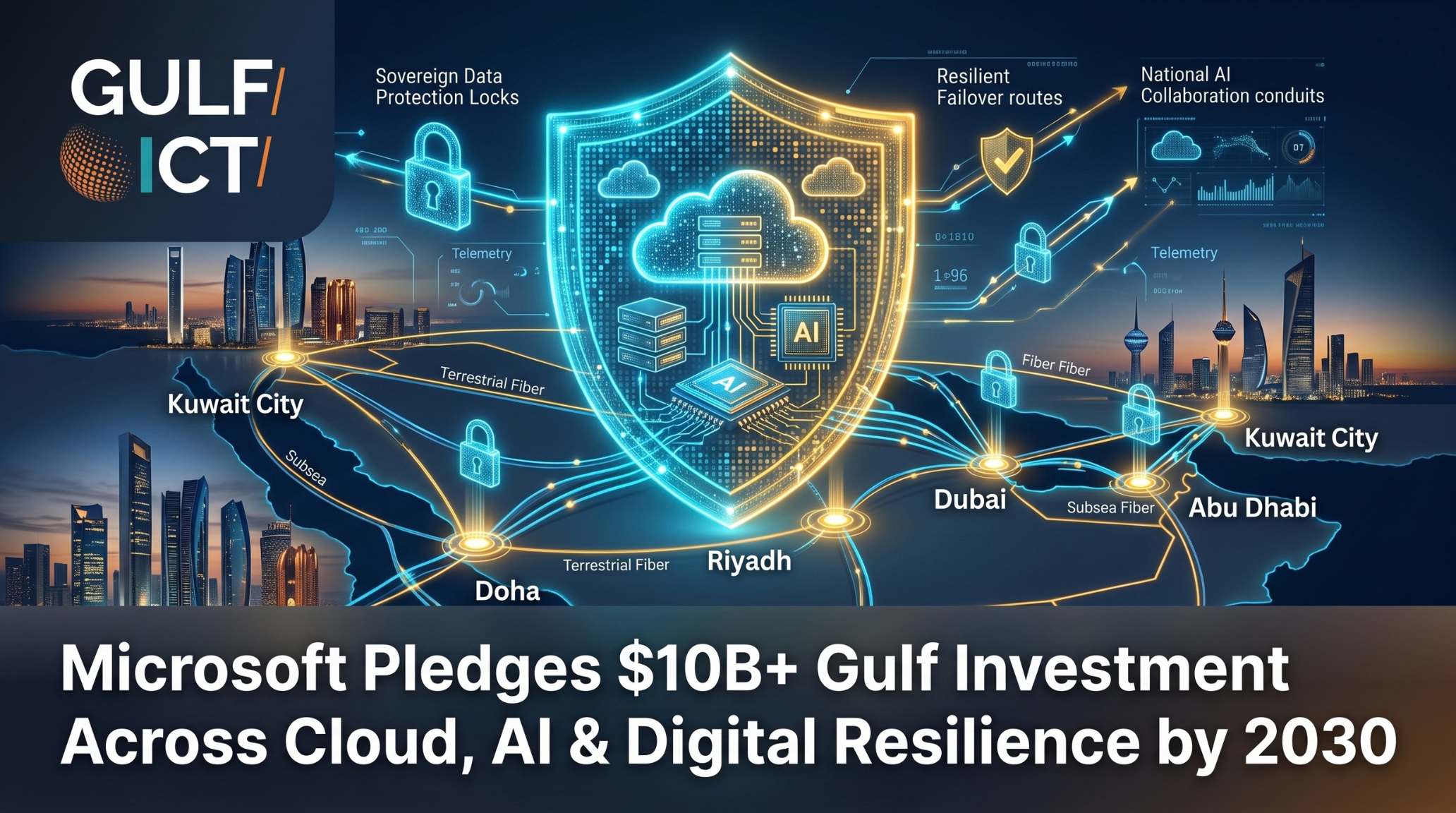
DUBAI / RIYADH — United States technology giant Microsoft has committed to investing more than $10 billion across the United Arab Emirates, Saudi Arabia, Qatar, and Kuwait between now and 2030, deploying substantial capital into sovereign cloud architectures, artificial intelligence compute facilities, and enterprise digital resilience frameworks.
The major capital expansion was confirmed by Microsoft Vice Chair and President Brad Smith, who emphasized that the enterprise is maintaining an aggressive deployment schedule despite ongoing regional geopolitical disruptions and drone strikes that previously degraded third party cloud data centers in Bahrain and the United Arab Emirates. Smith affirmed that Microsoft is actively adding to its pre planned capital allocations across the Gulf Cooperation Council, prioritizing continuous operations, data failover redundancy, and sovereign critical data shielding.
Under its dedicated regional resilience mandate, Microsoft has worked closely with regional enterprise and public sector partners to deliver digital readiness audits and sovereign disaster recovery protocols. In tandem with core data center expansion, the company will deploy more than $400 million into terrestrial fiber routes and high capacity subsea telecommunications cables spanning the Middle East by 2030, reinforcing regional data transit independence and low latency connectivity.
The multi billion dollar initiative also deepens Microsoft’s strategic collaboration with national artificial intelligence champions across the Gulf. Building upon its landmark $1.5 billion minority investment in Abu Dhabi based G42 finalized in 2024, which secured Microsoft a board seat occupied by Smith, the tech giant is expanding technical alignment with Saudi Arabia’s Public Investment Fund backed AI champion Humain and Qatar’s Qai. While Microsoft clarified that it does not plan direct equity investments in Humain or Qai, it is collaborating closely with both sovereign entities across designated technical priorities to support local model development, public sector enablement, and domestic computing capabilities.