Qatar’s NCSA Unveils National Cyber Risk Management Framework and Inks CREST Agreement at 5th Cyber Governance Summit
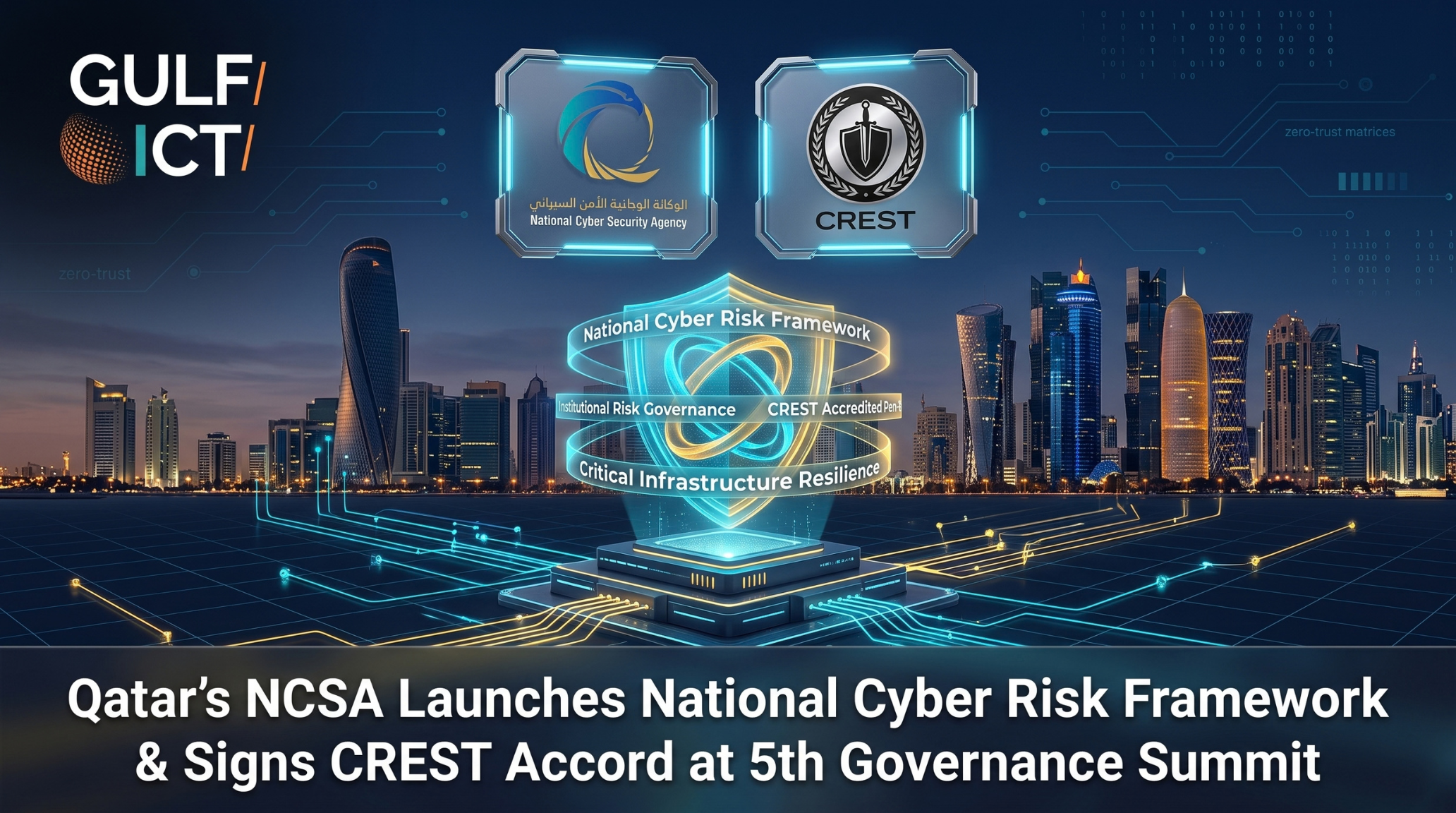
DOHA — The National Cyber Security Agency (NCSA) of Qatar has officially launched the National Cyber Risk Management Framework alongside the Institutional Cyber Risk Management Framework, unveiling both governance standards during the fifth edition of the Qatar Cyber Governance and Assurance Conference.
Held under the thematic banner of Securing the Digital Future in the Era of Convergence, the high level executive summit convened His Excellency Mohammed bin Ali Al Mannai, Minister of Communications and Information Technology, alongside His Excellency Eng. Abdulrahman bin Ali Al Farahid Al Malki, President of the National Cyber Security Agency, alongside senior government dignitaries, enterprise technology leaders, and critical national infrastructure operators.
The dual framework rollouts establish unified, standardized baseline methodologies for public entities and enterprise organizations to systematically quantify, assess, and mitigate systemic cyber exposure. Engineered to shift national readiness from siloed, perimeter level defense to proactive, measurable institutional resilience, the frameworks provide organizations with clear governance operational blueprints to maintain service continuity and defend mission critical workflows against zero day exploits and evolving advanced persistent threats.
Addressing the summit assembly, His Excellency Eng. Abdulrahman bin Ali Al Farahid Al Malki affirmed that safeguarding the digital frontier has matured into an overarching strategic imperative extending far beyond basic systems protection. Al Malki stated that sustainable resilience requires a proactive posture anchored in continuous threat intelligence sharing, institutional innovation, national human capital empowerment, and robust public private collaboration.
In parallel remarks, Eng. Dana Yousif Al Abdulla, Director of Cyber Policy and Governance at the NCSA, highlighted that modern cybersecurity directly safeguards service continuity, critical utilities, and economic trust. Al Abdulla underscored that the convergence between regulatory authorities, critical industry operators, and technology vendors is vital to eliminate systemic gaps and enforce collective defense.
Marking a major international compliance milestone, the conference witnessed the formal signing of a Memorandum of Understanding (MoU) between the NCSA and international non profit accreditation body CREST. The bilateral accord is designed to elevate domestic technical security standards and establish mutual recognition protocols governing accredited service providers delivering specialized penetration testing and offensive vulnerability assessment services across Qatar.