UAE and Saudi Arabia to Add Up to 3 GW of Data Center IT Power by 2030 to Capture Over 80% Regional Market Share
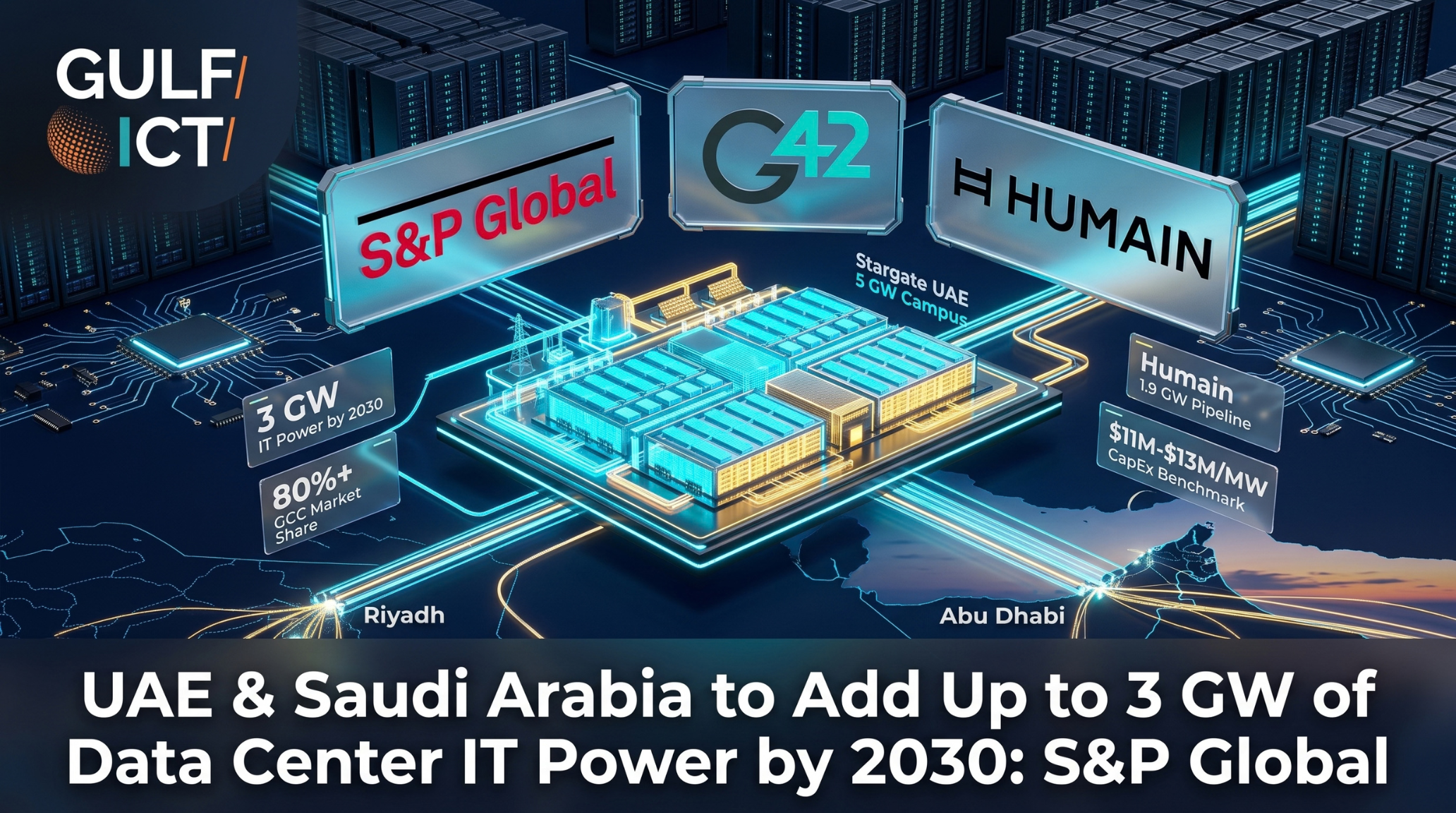
DUBAI — The United Arab Emirates and Saudi Arabia are projected to capture more than 80 percent of the Middle East’s aggregate data center capacity by 2030, collectively deploying between 2 to 3 gigawatts (GW) of operational information technology power, according to a market intelligence study by credit rating agency S&P Global Ratings.
While representing less than two percent of total global IT power additions over the projection window, which remain dominated by North America at seventy percent of new builds, the bilateral Gulf deployment represents the overwhelming share of regional compute infrastructure. Massive sovereign artificial intelligence infrastructure megaprojects could elevate regional capacity figures significantly higher. In the UAE, the 5 GW Stargate UAE campus within the UAE US AI Campus in Abu Dhabi, developed through an international partnership between G42, OpenAI, Nvidia, Oracle, Cisco, and SoftBank, is on track to energize its foundational 1 GW cluster within three years. Concurrently in Saudi Arabia, the Public Investment Fund (PIF) backed artificial intelligence company Humain is targeting 1.9 GW of energized capacity by 2030, scaling toward 6.0 to 6.6 GW by 2034.
Deployment trajectories reflect distinct macroeconomic schedules. S&P highlights that the UAE is accelerating immediate capital expenditures to meet surging neocloud demand, whereas Saudi Arabia's larger utility scale clusters will concentrate their primary capacity energizations later in the decade. Data center development economics remain competitive, with 451 Research estimating construction costs averaging $11 million per megawatt in the UAE and $13 million per megawatt in Saudi Arabia, positioned competitively alongside European benchmarks of twelve million dollars and North American averages of thirteen million dollars per megawatt.
Affordable, accessible power serves as the primary structural advantage for both Gulf markets, where commercial electricity rates sit significantly below international averages. Beyond substantial solar generation, the UAE is deploying baseload civilian nuclear power from the Barakah Nuclear Energy Plant to supply zero carbon electricity to high density graphics processing unit clusters. Concurrently, rigorous domestic data localization mandates, personal data protection laws, and sovereign cloud frameworks across both nations ensure that hyperscalers must partner with domestic operators, securing localized operational control and institutional digital sovereignty.