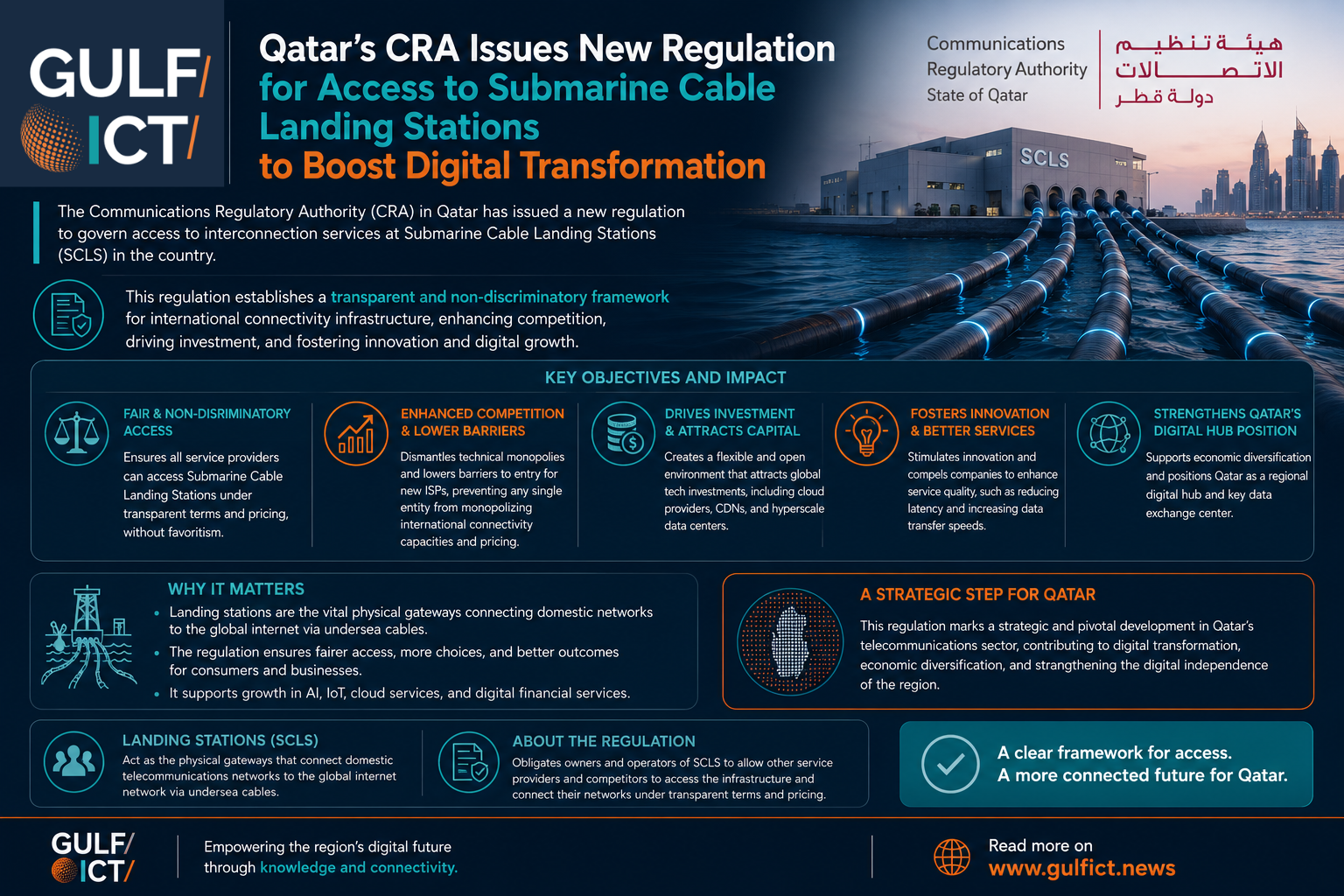
DOHA — Qatar’s Communications Regulatory Authority has introduced a regulatory framework governing access to interconnection services at submarine cable landing stations, aiming to strengthen competition and improve access to the international connectivity infrastructure underpinning the country’s digital economy.
Submarine Cable Landing Stations, or SCLS, are the physical gateways connecting domestic telecommunications networks with international undersea cable systems and the wider global internet.
The new framework described in the supplied announcement is designed to establish transparent and non-discriminatory access conditions for service providers seeking connectivity at those facilities.
The move builds on CRA’s previous regulatory work on submarine cable infrastructure. In 2025, the Authority launched a public consultation on a standard offer for access to submarine cable landing stations, following earlier work on international connectivity access arrangements.
By establishing clearer access terms, the framework is intended to reduce barriers for competing service providers and prevent owners or operators of landing stations from unfairly favouring their own affiliated businesses.
Greater infrastructure access could also create a more competitive market for international connectivity, encouraging operators to improve pricing, capacity and service quality.
The implications extend beyond the telecommunications industry. Cloud providers, content delivery networks and large-scale data-centre operators depend heavily on reliable and cost-efficient international connectivity when selecting locations for infrastructure investment.
More open access to cable landing infrastructure can therefore support Qatar’s efforts to attract digital infrastructure projects and strengthen its position as a regional connectivity hub.
Improved competition at the international network layer could also contribute to lower latency and greater capacity for data-intensive technologies including artificial intelligence, cloud computing, the Internet of Things and digital financial services.
CRA’s wider mandate includes supporting competition and the development of advanced communications and information technology services in Qatar. Its previous consultations on submarine cable landing access demonstrate a continuing regulatory focus on international connectivity infrastructure.
The framework represents another step in Qatar’s effort to develop an open digital ecosystem capable of supporting growing demand for cloud services, data infrastructure and advanced technologies.