BlackRock Sees UAE and Saudi Arabia Leading Sovereign AI Growth
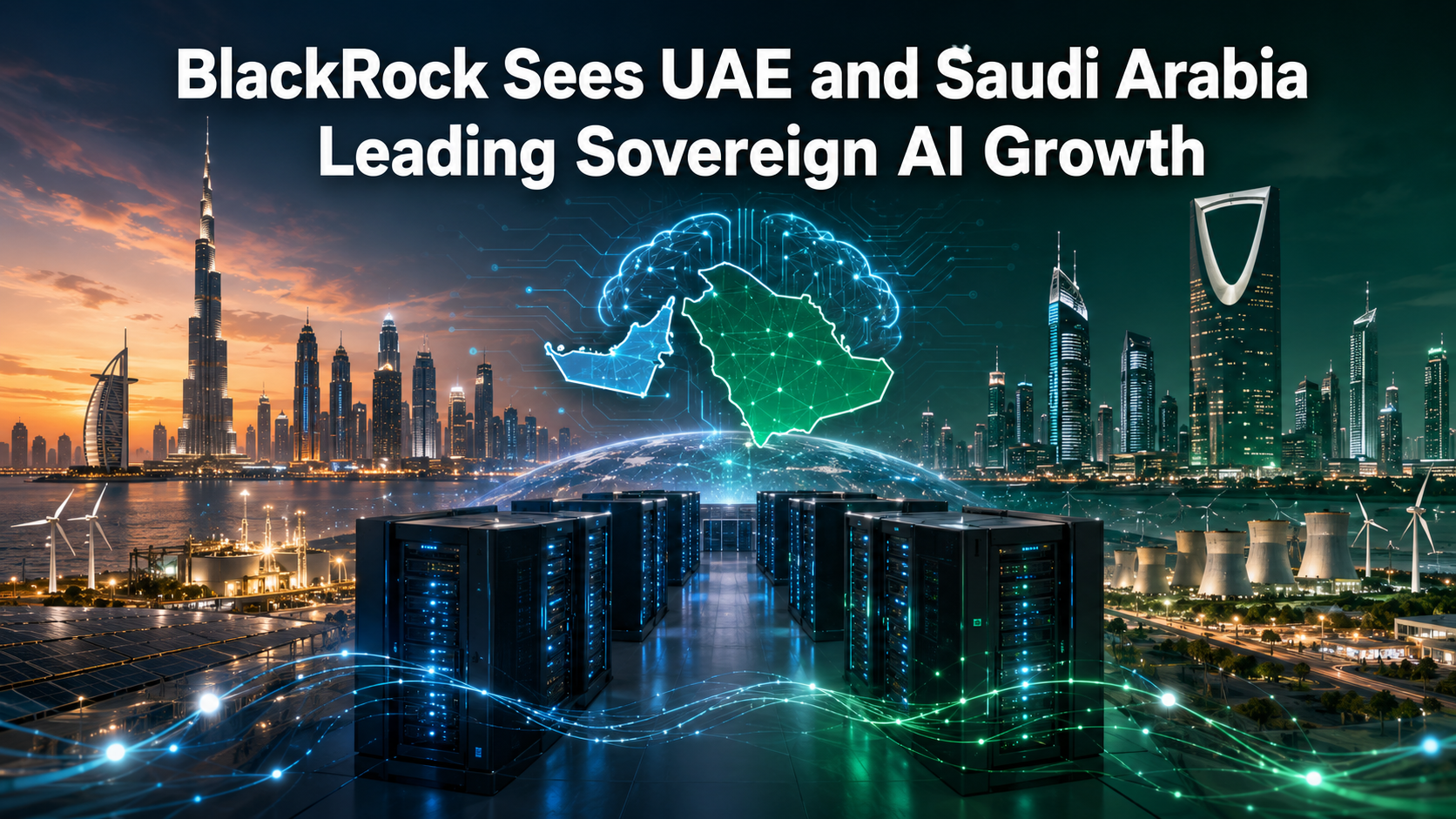
DUBAI — The UAE and Saudi Arabia are rapidly emerging as major artificial intelligence infrastructure hubs, with abundant capital, energy resources and large-scale investment in data centres, computing capacity and advanced manufacturing giving the Gulf a growing strategic advantage in the global AI race.
Speaking to Khaleej Times, Ehsan Khoman, Economist at the BlackRock Investment Institute, said the region’s two strongest structural advantages are its access to energy and deep pools of capital.
“The Gulf has two key structural advantages — abundant energy and abundant capital,” Khoman said. “Those advantages have become even more valuable in an AI world where compute, power and infrastructure are increasingly scarce resources.”
According to Khoman, the UAE and Saudi Arabia are moving beyond investments in global technology companies and increasingly building domestic AI capabilities spanning sovereign capital, cloud computing, data, foundation models and large-scale compute infrastructure.
The UAE has been among the region’s most aggressive movers. Since the launch of MGX in 2024, the country has expanded its AI ecosystem through entities including G42, Khazna and Falcon.
Khoman said that strategy culminated in the announcement of Stargate UAE, a planned one-gigawatt AI compute cluster forming part of a broader five-gigawatt AI campus.
Saudi Arabia is following a similar strategy through HUMAIN, its national AI champion. The Kingdom has partnered with technology companies including NVIDIA, AMD, Qualcomm and AWS to develop cloud infrastructure, AI factories and Arabic-language foundation models.
“The key takeaway is that the GCC is increasingly focused on owning the infrastructure that powers AI,” Khoman said. “On that measure, the region is positioning itself as one of the world’s leading sovereign AI hubs.”
BlackRock also sees opportunities extending beyond AI into advanced manufacturing, logistics, energy infrastructure and digital infrastructure as Gulf governments continue pursuing long-term economic diversification.
Khoman identified AI and digital infrastructure as the standout investment opportunity, noting that there are already more than 230 data centres across the Middle East, with further growth expected.
Private capital is also expected to play a larger role in financing infrastructure projects linked to energy, transport and digital networks.
Looking ahead, Khoman said the AI investment cycle still has room to expand despite concerns over technology valuations.
“Our view is that the next phase of the AI story is what we call physical AI,” he said. “The opportunity extends well beyond software.”