JOHANNESBURG — South African mobile telecommunications operator Vodacom has committed more than R1.6 billion ($97.4 million) in capital expenditure toward network infrastructure expansion across Mpumalanga and KwaZulu Natal (KZN) for the 2027 financial year, targeting coverage densification, transmission modernization, and critical power backup systems amid escalating data traffic demands.
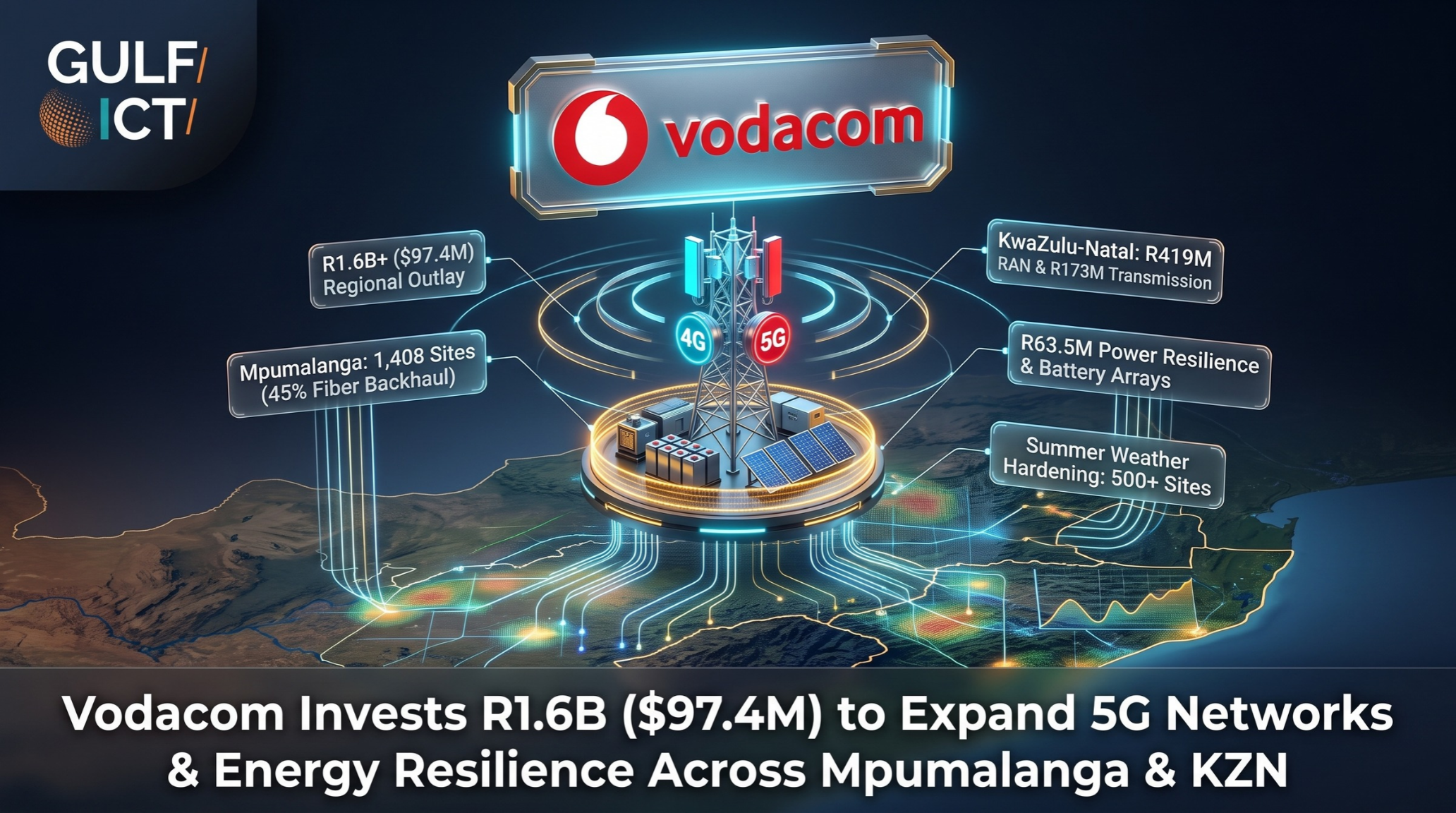
The combined regional capital allocation directs over R600 million to Mpumalanga and R1 billion to KwaZulu Natal,sustaining momentum from the prior operating cycle during which the operator deployed R620 million and R1.1 billion across the respective provinces. Both provincial engineering initiatives prioritize cellular capacity expansions across rural settlements and townships, extending advanced fourth and fifth generation connectivity while integrating robust infrastructure hardening measures to counter persistent municipal power grid failures, cable theft, and severe seasonal weather.
In Mpumalanga, the operator has expanded its physical macro footprint from just over 1,300 base stations to 1,408 active sites, targeting comprehensive wireless coverage across all 17 local municipalities. Concurrently, the proportion of cellular towers connected directly to high capacity optical fiber backhaul is increasing from 41 percent to 45 percent,accommodating a pronounced shift in consumer bandwidth utilization where 5G traffic share reached 20 percent in the 2026/27 cycle alongside 78 percent carried across LTE. To insulate operations against torrential downpours during the regional rainy season, Vodacom initiated a specialized Summer Plan Project reinforcing more than 500 regional installations against adverse climate conditions.
Within KwaZulu Natal, approximately R419 million of the dedicated budget is directed toward radio access network modernization and greenfield site construction across urban commercial hubs and underserved rural areas, with an additional R173 million allocated to high capacity microwave and fiber transmission backbones. Addressing regional power volatility, the operator earmarked R63.5 million specifically for energy resilience infrastructure, installing industrial diesel generators, lithium battery storage banks, and redundant backup power topologies to preserve network availability during municipal load shedding, distribution faults, and facility vandalism.
Imran Khan, Managing Executive for Vodacom KwaZulu Natal, stated that the R1 billion deployment builds directly upon last year's R1.1 billion allocation, underscoring the carrier's focus on connecting underserved rural communities and commercial enterprises across the province. Khan highlighted that infrastructure reliability remains intertwined with enterprise service enablement, noting that the company's regional business unit is driving digital case management platforms and unified communications to help municipal governments automate public service resolution.
Monde Ngcukana, Managing Executive for Vodacom Mpumalanga, emphasized that the regional capital layout aims to expand network quality, elevate rural broadband access, and establish the digital infrastructure required to underpin the province’s long term economic modernization. Parallel to civil engineering works, the operator is scaling commercial accessibility programs, pairing localized micro data bundles through its Just4YourTown platform with Easy2Own smartphone financing options to accelerate customer migration away from legacy 2G and 3G handsets toward 4G and 5G enabled devices.