SANTA CLARA — Chinese internet conglomerates ByteDance, Alibaba, and Tencent have placed collective commercial orders exceeding 3 million units for Nvidia’s newly introduced RTX PRO 5500 workstation graphics processing units, representing an aggregate sticker value surpassing $35 billion, according to people familiar with the transactions.
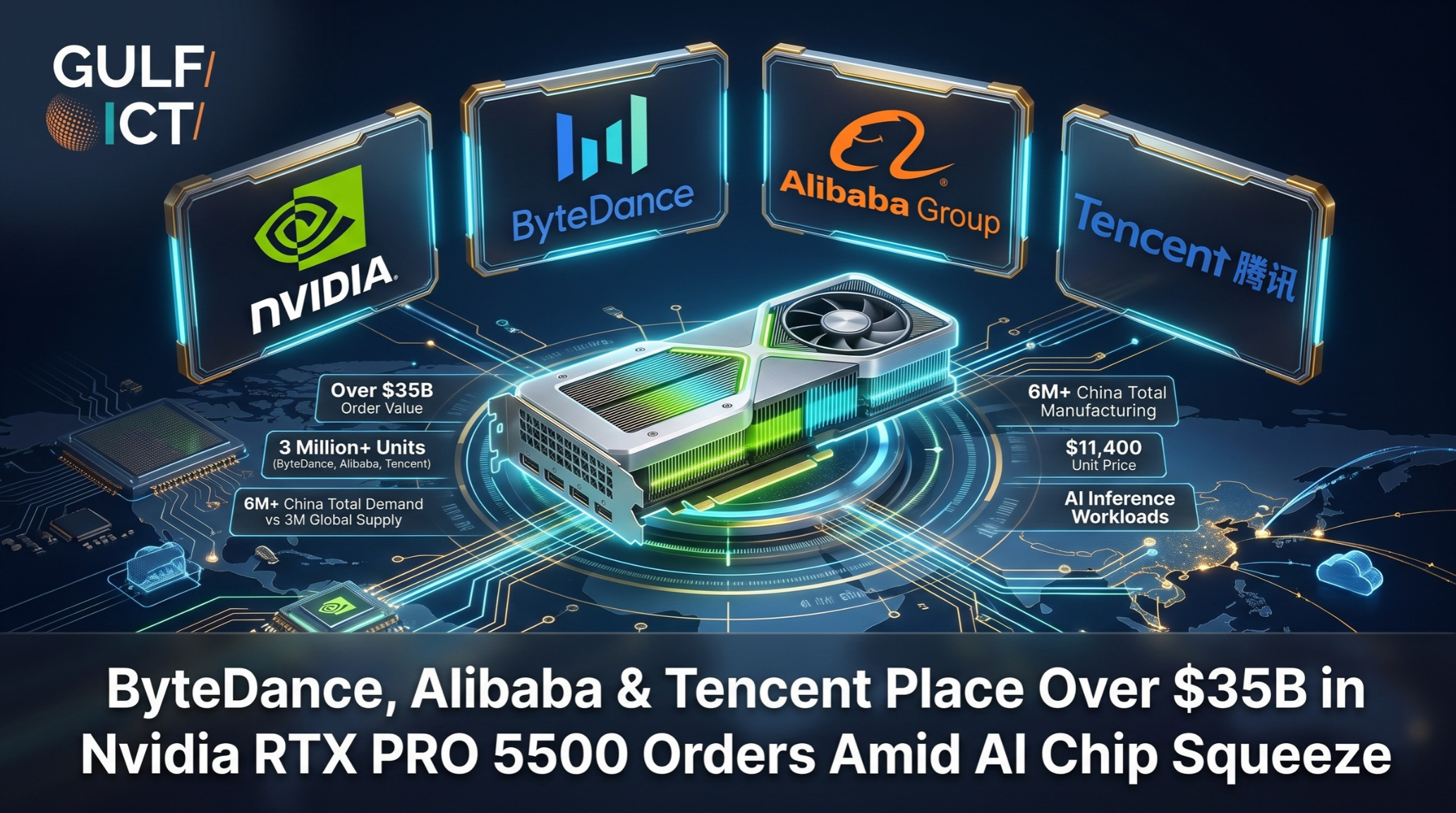
The procurement drive underscores the sustained demand among Chinese technology leaders for Western semiconductor architectures despite tightening United States export restrictions. The RTX PRO 5500, a high performance workstation processor carrying a unit price of approximately $11,400, is engineered for professional computing rather than massive hyperscale AI training clusters. However, it represents one of the most capable processors compliant with current US export regulations, positioned as an alternative following strict trade bans on Nvidia’s Blackwell B300 data center processor and case by case licensing reviews for Hopper H200 shipments.
The unprecedented volume has created severe supply constraints. Nvidia has informed enterprise partners and customers that it cannot guarantee order fulfillment, indicating that total demand from Chinese technology firms far outstrips manufacturing allocations. Aggregated Chinese orders across the market have reportedly exceeded 6 million units, whereas Nvidia expects to produce no more than 3 million units globally throughout 2027. Distribution partners have been warned they may receive as little as five to ten percent of requested volumes.
Chinese technology giants are acquiring the workstation cards primarily to support AI inference workloads, deploying trained foundation models to generate responses for public chatbots and commercial applications where compute intensity is lower than full parameter model training. While the RTX PRO 5500 delivers performance comparable to the prior RTX 6000D, enterprise expectations for potential regulatory easing have evaporated, prompting Chinese developers to secure available capacity as the previously discontinued RTX 6000D saw its secondary market price double.
The allocation bottleneck is further exacerbated by foundry capacity prioritization at Taiwan Semiconductor Manufacturing Company (TSMC). Entering 2027, Nvidia is dedicating the majority of its advanced packaging and fabrication lines to its next generation Rubin hyperscale data center platform, constraining wafer volumes for workstation lines. While Washington’s trade controls have expanded market opportunities for domestic alternatives like Huawei, Chinese semiconductor producers continue to face production constraints from equipment export bans, leaving top tier domestic tech conglomerates dependent on international workstation supplies to power their artificial intelligence roadmaps.