ABU DHABI — The UAE Space Agency has confirmed that the Emirates Mission to the Asteroid Belt (EMA) remains firmly on schedule for its targeted three week launch window during the first quarter of 2028, marking a cornerstone strategic investment in sovereign aerospace engineering, national talent cultivation, and commercial space industry expansion aligned with the National Space Strategy 2031.
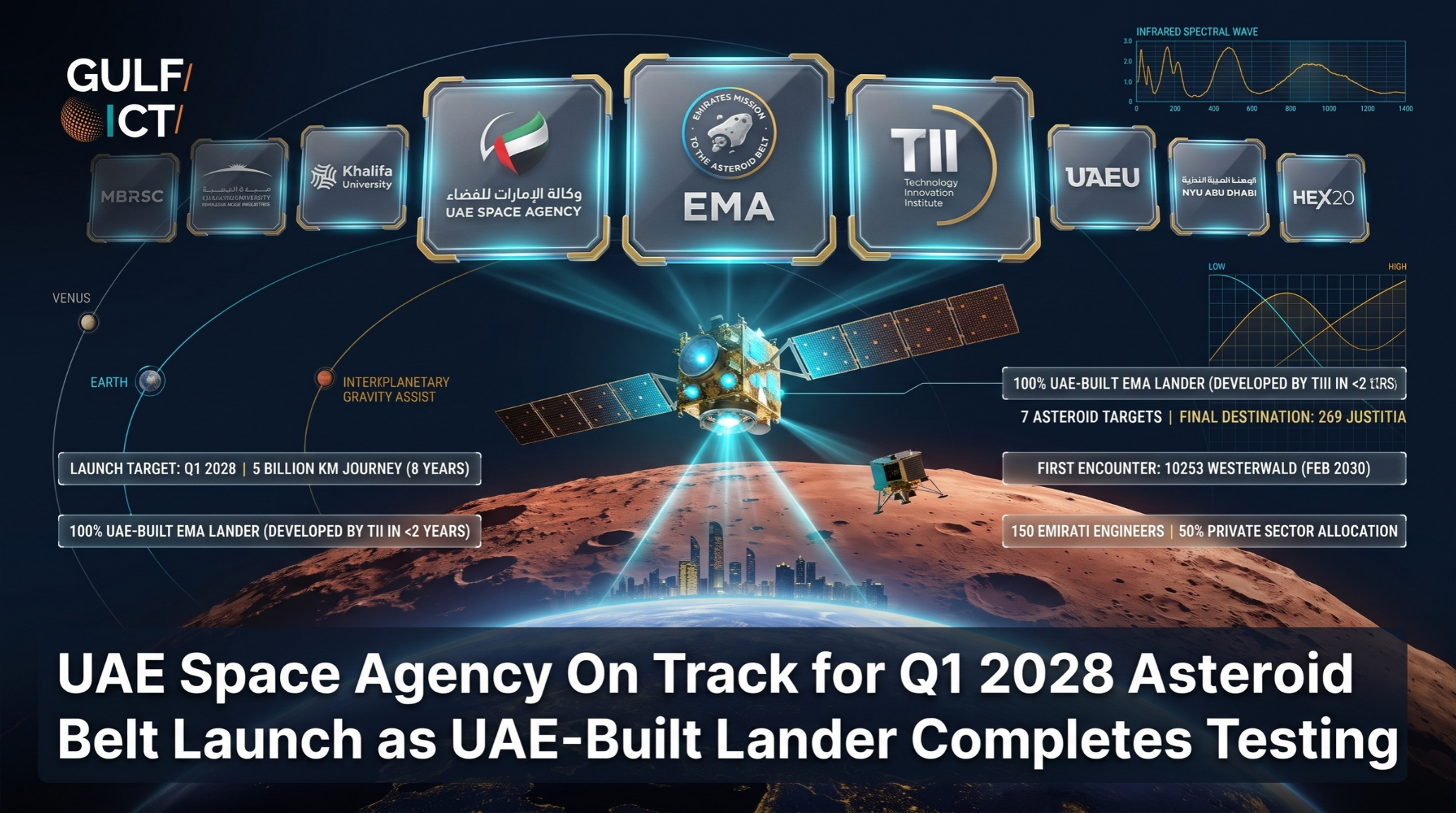
Mohsen Al Awadhi, Director of the Space Missions Department at the UAE Space Agency, announced that the program has achieved a major domestic engineering milestone with the successful completion of the EMA Lander, which was designed, developed, assembled, and tested entirely within the United Arab Emirates in under two years. Spearheaded by the Technology Innovation Institute (TII) alongside domestic research institutions and private aerospace enterprises, the autonomous lander has cleared all required technical and environmental qualification tests verifying flight readiness and is now being prepared for shipment to the Laboratory for Atmospheric and Space Physics (LASP) at the University of Colorado Boulder in the United States for full physical integration with the MBR Explorer spacecraft.
Following the completion of its Critical Design Review and its System Integration Review in September 2025, the mission has transitioned into the comprehensive assembly, integration, and testing phase. Engineering teams are currently integrating and validating the MBR Explorer’s core subsystems ahead of mating the lander, which will be followed by environmental testing of the combined spacecraft, final flight readiness reviews, and shipment to the launch facility in Japan for liftoff aboard a Mitsubishi Heavy Industries rocket in partnership with the Japan Aerospace Exploration Agency (JAXA).
Spanning an eight year interplanetary trajectory covering approximately five billion kilometres, the MBR Explorer represents the most complex deep space mission in the history of the UAE space program. The spacecraft will execute precision gravity assist maneuvers around Venus, Earth, and Mars while enduring extreme thermal fluctuations near Venus and beyond Martian orbit, complicated by deep space communication signal delays and diminished solar radiation levels. The explorer is scheduled to conduct its first high speed flyby of asteroid 10253 Westerwald in February 2030, sequentially investigating six main belt asteroids before arriving at its seventh and final target, asteroid 269 Justitia.
Because spectral analysis indicates that 269 Justitia may have originated within the outer Solar System’s Kuiper Belt prior to migrating inward, studying the celestial body offers vital scientific evidence regarding early planetary migration and the delivery of water and organic compounds to rocky planets. To conduct this analysis, the MBR Explorer carries four primary scientific instruments comprising a high resolution camera, a thermal infrared camera, a mid wavelength infrared spectrometer, and a thermal infrared spectrometer. After studying 269 Justitia from orbit for approximately seven months, the explorer will deploy the autonomous EMA Lander to approach the asteroid’s surface and capture close range imagery without direct intervention from Earth, with all resulting scientific datasets made accessible to the global research community.
Approximately 150 Emirati engineers and scientists are actively participating across all phases of the mission, which allocates 50 percent of total contract scope to private sector companies and recently yielded 10 technical research papers presented at the 2026 International Astronautical Congress. Domestic mission collaborators include the Technology Innovation Institute, Mohammed bin Rashid Space Centre (MBRSC), Khalifa University, New York University Abu Dhabi, Sharjah Academy for Astronomy, Space Sciences, and Technology, the National Space Science and Technology Center at United Arab Emirates University, and HEX20, working alongside international partners including LASP, the Italian Space Agency, JAXA, NASA, and Mitsubishi Heavy Industries for development, launch services, and Deep Space Network telemetry support.